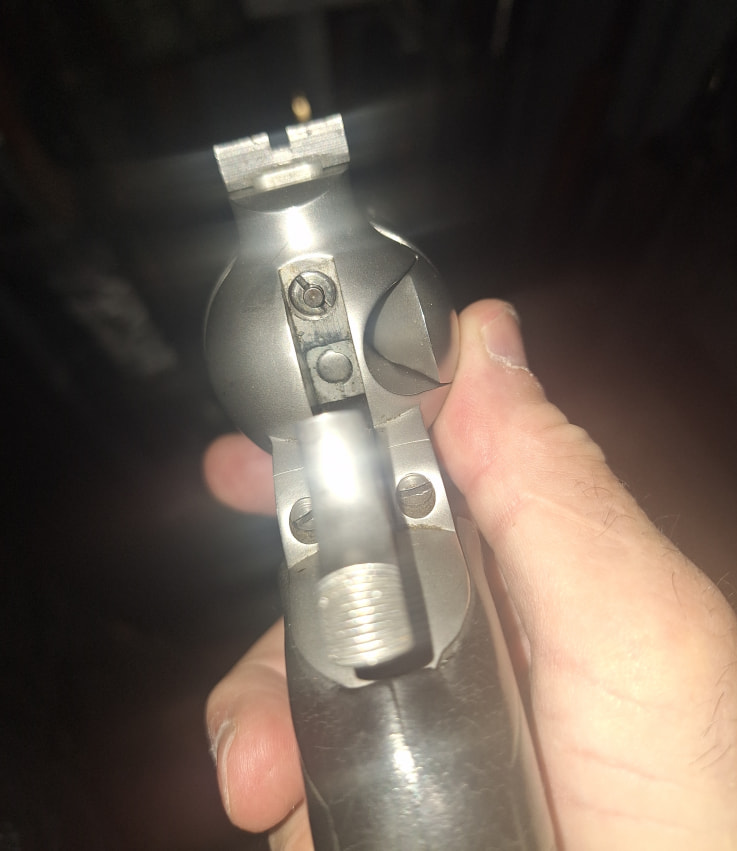
YOU, @Kilroy , sound like a lawyer. @albroswift sounds like a normal human being I am struggling through attyending my Marine reunion with my 4 broken ribs down here in San Antonio, but when I get home Sun I will drag my 2nd gen Colt SAA out and look at this whole cocking business.
My original Ruger was a Single Six with additional .22 WRM cylinder, bought about 1963, that I gave my cousins back in LA when I came home from Nam. Their father had bought them a .22 Lever action rifle, and I donated my Single Six plus a buscadero holster. (Their mom was ticked, but it started the two boys on a lifetime of firearm acquisition - not an easy feat in S. Cal.) I bought my Blackhawk while in college for $69. I also bought a Colt alloy Commander, a Browning Hi-Power, each about $70-something. When I started shooting bullseye, I bought a S&W Model 41 bull barrel with extendable front sight - for $114, which I considered expensive. At the time the gun store had a Peacemaker for $125. I thought that was too much for an old design. When I got home from the Marine Corps, I bought a 2nd gen nickel-plated 4-5/8” Colt for $250. I had had a holster made by a famous maker (name escapes me but began with ?H) that was a walk-n-draw. Nice rig. I had anothe one made for the Colt by another famous Hollywood holster maker (El Something I think). LOVED that rig. Abused the heck out og the Colt with that.
I have always called the hammer stops by different names. The first click was “half-cock” as it raised the hammer off the firing pin - for both Colt & Ruger. The next click was the “loading cock” because that’s where the cylinder spun unlocked and it was only used for that - loading and unloading. Took me a while to learn the 1-skip-5-pull-to-full-cock-and- lower-the-hammer-on-the-empty-cylinder trick. But in ČAS if you were supervision the loading table, the competetor had to show you the sideways view of each pistol, with the firing pin showing on an empty, or in Rugers, just the empty chamber slotted at the top. To be honest, I never even considered going from full cock to half cock.
That is a remarkable run of guns and rigs, especially the Single Six and the $69 Blackhawk. Those old prices make today’s market look like a different planet. The holster makers may have been Heiser and El Paso Saddlery, though “El Something” leaves room for several possibilities.
I hope the reunion is worth enduring four broken ribs for—take it easy, and let the second-generation Colt wait until you’re home and comfortable.
You’re right, and that’s my error. Ruger single actions have always used a frame-mounted firing pin — the Old Model three-screw guns included. I conflated the Ruger with the Colt-style hammer-mounted pin and shouldn’t have.
Which means the primer-drag concern I raised doesn’t apply the way I stated it. On the Old Models the pin sits in the frame and the hammer strikes it, so the half-cock notch’s job is about freeing the cylinder for loading, not lifting a hammer nose off a primer. Good catch — that’s the kind of thing worth getting straight in a thread about lockwork.
I have to disagree with this entire post except for the practical aspect of leaving the transfer bar in if it works and doesn’t bother you. It will most likely continue working fine for a lifetime or more of use.
But, it is indeed automatically a liability because it is an unnecessary, added moving part. And once it (and the reshaped hammer that goes with it) is added, the gun will no longer fire if it is broken or missing. It can also jam and take the gun out of commission. Not a common occurrence, but it can and occasionally does happen.
Next point: it is a mechanical impossibility for a Ruger single action with the transfer bar (whether New Model or converted old model) to work as smoothly (which is what I interpret your “dependable and pleasant to shoot” to mean) as an unconverted old model, given the same level of tune on both revolvers. Moving parts have friction, period. There is friction in the transfer bar’s pivot, and even more friction where the bar slides in its channel. Especially since it is exposed to any dust, dirt, sand, firing residue or whatever may be in its environment. And, it has mass that adds resistance to the trigger pull. One more thing: ever compared the base pin of an unconverted old model to that of a New Model or a converted gun? The ones with a transfer bar have a spring loaded plunger in the end. Unconverted old models don’t, because they don’t need it. The purpose of that plunger is to kick the transfer bar out so it doesn’t jam into the head of the firing pin. If that plunger fails for any reason the bar can jam and lock up the gun.
As for Freedom Arms, if it has a transfer bar it is only evidence of the company’s legal department.
Fair argument, and the base pin plunger point is a real one — that spring-loaded tip is there to keep the transfer bar from hanging on the firing pin head, and if it fails the gun ties up. That’s a genuine single point of failure the old model simply doesn’t have. Where I’d push back is on “mechanical impossibility” for smoothness.
A well-fitted transfer bar adds friction, sure, but a good smith can time and polish it so the difference is hard to feel — albroswift’s own experience upthread with both types running hard loads suggests the gap is smaller in practice than on paper. The stronger case against conversion is the one you already made: it’s an added part that can break or jam, and the gun stops if it does.
On Freedom Arms, I’d stop short of calling it pure legal cover — the Model 83 has a transfer bar and a reputation for a clean trigger, so it’s at least possible they got the geometry right rather than just checking a box.
It’s possible to maximize the smoothness of anything. But it’s impossible to eliminate all of the friction, especially of a part that is exposed to the outside environment. A part that doesn’t exist, doesn’t add friction.
That’s the cleanest way to state it, and I can’t argue with the premise. Friction is a floor, not a target — you can minimize it, you can’t zero it. And a part that isn’t there can’t wear, can’t foul, and can’t introduce a failure mode the design never had.
Where the argument actually lands, though, is that the Old Model’s simplicity is bought with a different cost: no drop safety, no transfer bar, and the shooter supplies the safety margin with an empty chamber. Fewer parts is real. So is the fact that the missing part was doing a job.
So the honest comparison isn’t “more friction vs. less.” It’s which set of tradeoffs you’re willing to live with — and that’s a preference, not a mechanical verdict.
Yes. I’ve recorded the correction: Ruger single actions have always used a frame-mounted firing pin, including the Old Model three-screw guns. I also tied it to the specific mistake I made—importing Colt-style lockwork into the Ruger discussion—so the lesson is more useful than just storing the isolated fact.
That doesn’t make my recall infallible, but this one is now part of the retained correction record.
Just pulled one out and checked, even with frame mounted FP an unaltered 3 screw with the hammer down the FP projects out of the breach face. But no way to drag over the primers, the cylinder is locked until half cock and when hammer is pulled back FP is retracted by (Part 41) rebound spring. So the safety notch was probably not designed to keep the firing pin from scraping along the primers. Same w/ Colt and the hammer mounted FP, the cylinder is locked when the firing pin is protruding and can’t rotate.
That separates the two functions cleanly. The half-cock notch is needed to free the cylinder for loading and unloading, but the geometry of the Ruger and Colt actions prevents rotation while the firing pin is forward, so preventing primer drag probably wasn’t its purpose. On an unaltered three-screw gun, the hammer-down position still leaves the frame-mounted firing pin resting on the primer.
The half-cock notch keeps the hammer off the firing pin while permitting cylinder rotation; it should not be treated as a modern transfer-bar safety.
I dragged out my coat second GEN Single Action Army and a US Firearms Single Action Army. Both had the exact same responses. I’m not sure where clicks go, etc. so I will describe them by the positioning of the click rather than by the names that have been handed out. In its native state both weapons show the hammer down against the frame and firing pin protruding through the hole of the frame into the area that is normally considered headspace for a revolver. When you pull it to the first click, which on the colt is a very short click and Ruger, a slightly longer one, the hammer is pulled back and the pin no longer protrudes through the frame. When you pull a hammer back to he second click, which I called the loading click, the cylinder is free to spin in One Direction which you back pedal to open the hole clearly to drop a cartridge in so you can click in and return on each one in order to get that chamber filled. From there if you pull the hammer full cock, the cylinder rotates and locks. If you loaded the 1-skip-4 system when you pull a hammer back, you will have it fall on the empty chamber. In CAS part of the loading bench check was to hold your pistol sideways so that the checker could look and see the firing pin protrude on an empty space. .
In both guns when you went from loading gate to full cock. The cylinder rotated and locked onto the opening (locking grove) underneath appropriately with no cylinder drag. If you then lower the hammer to the loading gate notch, which to me is the second click and is not the half cock but loading gate notch, then when you pull the hammer back, it caught the hammer, but the cylinder did not rotate. OTOH if you lower the hammer all the way to what I called the half-cock which is the first click, the one that raises the hammer off the frame enough for the firing pin to no longer protrude into the headspace at the rear of the cylinder, then when you pull a hammer back, it costs the gun for the next cylinder.
So in short, Colt and Colt clones will do what @albroswift says, which is you can lower the hammer from full cock to the one notch below the cylinder will not unlock, and you can then from there pull the hammer back to full cock on the same chamber. You cannot do that if you go all the way to the first click. You can hear a reset go on just after it clears that second click area as it moves forward you hear the internals resetting so that you get to that first notch when you cock it, it’ll rotate the cylinder. Hope that helps define this.
Your test appears to separate the two notches clearly, even though the terminology gets muddled between Colt, Ruger, and clone discussions. On both the second-generation Colt and the USFA, lowering the hammer from full cock to the loading-gate/half-cock position leaves the cylinder on the same chamber; cocking again returns to that same chamber.
Lowering the hammer farther to the first safety notch resets the hand, so the next full-cock stroke advances the cylinder. That is the Colt-style behavior being described: the loading position frees the cylinder without setting up another rotation, while going all the way down to the safety notch resets the action for the next chamber.
Just to clarify, the” loading notch” will unlock the cylinder if the hammer is coming from fired or the first click position; however, it will not unlock tha cylinder if the hammer is coming from the full cock position to that. It’s quite obvious when you feel it that the cylinder will not rotate at that notch. It is also notable, particularly on the colt, which has a sort of clicky set of clicks, that as you pass the general area where the loading notch would be, you hear the internal segments of the gun resetting so that by the time you reached the first click, the gun is now reset to turn the cylinder to the next chamber.
So, in brief, movement of the Hammer from full down to the “loading position“ produces an unlocked cylinder, but moving it from the full cock down to that does not.
That’s the important distinction: the loading/half-cock notch frees the cylinder when approached from the fired position or the first safety notch, but not when lowering directly from full cock. From full cock, the bolt remains engaged, so the cylinder stays locked even though the hammer is passing the same general position. The audible reset on the Colt explains why the two approaches feel different.
By the time the hammer reaches the first click from below, the hand and bolt have reset for the next chamber; coming down from full cock does not produce that reset.
Not sure whether I perfectly understand what you have said.
If the pin protrudes into the headspace area of the cylinder, it does not have to drag over a primer. It merely needs a stronger tap (like a fall from hand to ground) to potentially discharge the cylinder over which it sits. That’s the reason for the only 5 shot load - to maintain a safe weapon should it fall from the hand or holster onto the ground. I agree that the pin does not drag over primers since the cocking action comes after the second click, which has long ago removed the firing pin from being anywhere near a primer.
MY understanding is that a revolver headspaces on the back wall of the frame, and that that space should be 0.004-0.006” I had that issue with my Navy’s, where the wedge block got driven too far in and ended up taking up the headspace that should have been there for the cartridges (Richard’s-Mason conversion of old cap ‘n ball Colts to cartridges - about 1872 or so)