The Debt Clock, Claudio in NY, and the Secret Window

Yesterday I discovered that the U.S. Debt Clock has quietly added something I had never seen before.

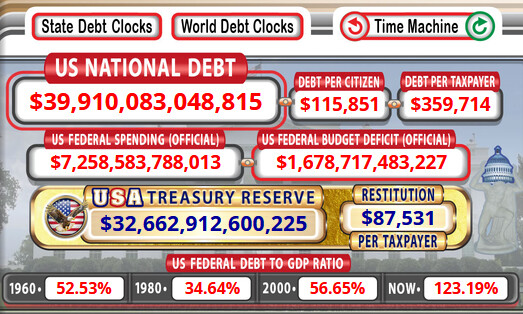
Alongside the familiar national debt, spending and deficit numbers was a new gold section:

“USA TREASURY RESERVE”

Roughly $32.6 trillion.

Next to it:

“RESTITUTION”

About $87,000 per taxpayer.

That caught my attention immediately. Hovering over the numbers made it stranger.

The Debt Clock describes the Treasury Reserve as:

“The 100% Asset-Backed USA Money Supply + The Notional Value of Recaptured Assets from the Federal Reserve Banking System.”

And the restitution figure as:

“Forfeited Asset Proceeds from the Criminal Money Laundering and Racketeering Activity of the Federal Reserve Banking Syndicate.”

Those are not small claims.

I went looking for some public Treasury action, forfeiture case, accounting entry or explanation that would account for trillions of dollars in supposedly recaptured assets.

I found nothing.

Then today a caller named Claudio from New York calls into the Alex Jones show and says that in two months the national debt will be covered.

He tells Alex that Trump knows what he is doing.

That hit my ear because I had just been staring at this strange new section of the Debt Clock.

So I went back.

And then I noticed the “Secret Window.”
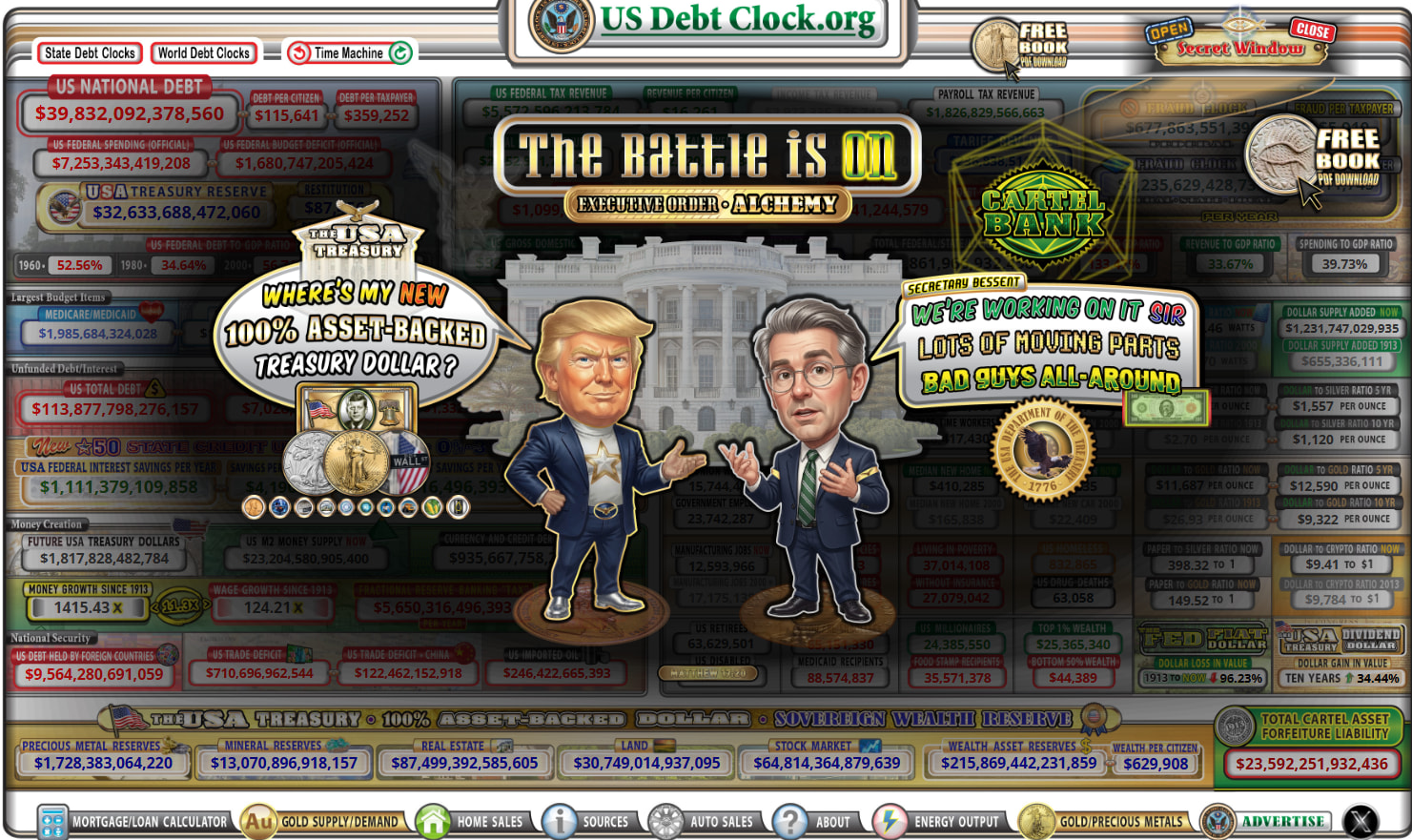
What. The. Hell.

Inside it the Debt Clock isn’t merely displaying economic statistics anymore. It is telling a story:

“THE BATTLE IS ON”

“EXECUTIVE ORDER • ALCHEMY”

Trump asking:

“WHERE’S MY NEW 100% ASSET-BACKED TREASURY DOLLAR?”

A cartoon Scott Bessent answers:

“WE’RE WORKING ON IT SIR”

The screen also shows a “Cartel Bank,” a “Sovereign Wealth Reserve,” and a “Total Cartel Asset Forfeiture Liability” running around $23.6 trillion.

At first glance it looks like somebody stapled a monetary-revolution manifesto onto a national debt calculator.

Then I downloaded the 54-page book the Debt Clock itself provides: The New Money Revolution, Third Edition.

Now the Secret Window begins to make sense.

The book proposes dismantling the present Federal Reserve debt-money system and replacing it with a 100%-reserve, asset-backed “USA Treasury Dollar.”

It actually lays out the plan.

Step one: stop creating new Fed money and new bonds while guaranteeing existing U.S. debt.

Step two: issue new Treasury dollars, exchange them one-for-one for existing Fed money, and create the new currency debt- and interest-free.

Step three: end fractional-reserve commercial-bank money creation, begin taking Federal Reserve member-bank assets, and shift lending into proposed state credit-union banks.

That apparently is the “alchemy.”

Not turning lead into gold.

Turning debt into assets.

Or, depending on how you look at it, changing what is being counted on each side of the ledger.

The book says outright that “Hidden Assets Vastly Surpass Federal Debt” and calls the process “The Great Banking Unwind.”

Then comes the $87,000.

The book claims roughly $23.5 trillion in “unfunded interest” has been charged to the U.S. Treasury through the Federal Reserve banking system since 1913. It assumes a 40% asset-recovery rate and divides the recovery among roughly 108 million federal income-tax taxpayers.

$23.5 trillion × 40% = about $9.4 trillion.

Divide that by 108 million taxpayers and you get roughly $87,000 each.

So the strange restitution counter isn’t random. The book actually tells us the formula behind it.

But this is where I stop accepting labels and start asking questions.

The book calls for a “USA Sovereign Wealth Reserve” and says it would be backed by:

“The Tokenized Sum Total of all Realized and Unrealized Tangible U.S.A. Assets.”

Read that again.

ALL realized and unrealized tangible U.S.A. assets.

It then says these “collateralized assets” would form the backing of the new Treasury dollar.

Fine.

Whose assets?

Federal land?

Gold?

Oil?

Mineral rights?

Government buildings?

Federal securities?

Assets actually forfeited through a court proceeding?

Or does “U.S.A. assets” ultimately include privately owned land, homes, farms, businesses and other property?

That distinction is everything.

The book repeatedly says the new reserve would belong to “We the People” and portrays each citizen as owning a “share of America.”

Sounds wonderful.

But history has taught us to be very careful whenever government, banks or political movements begin redefining the relationship between individual property and “national” property.

The problem is not the phrase “sovereign wealth.”

The problem is always:

Who owns the asset?

Who values it?

Who has authority to pledge it?

Who receives the benefit?

Who bears the obligation?

And what happens when somebody wants to enforce the collateral?

There is another very important distinction.

The Debt Clock book proposes all this.

It does not prove that Treasury has actually implemented it.

The book says “Sign an Executive Order.” It does not supply the executive order accomplishing the plan. It proposes seizure of Federal Reserve member-bank assets. It does not give us the federal forfeiture judgments establishing a $23.5 trillion recovery.

That means there are presently at least three possibilities:

The Debt Clock is publishing somebody’s monetary reform proposal.

It knows about an actual policy direction that has not yet been publicly explained.

Or it is deliberately creating theater around real developments such as a U.S. sovereign wealth fund and attaching a much larger speculative narrative to them.

I do not presently know which.

And Claudio saying the national debt will somehow be “covered” in two months suddenly makes that question considerably more interesting.

Covered how?

Paid with tax revenue?

Obviously not.

Paid by accumulating $40 trillion in cash?

The Debt Clock’s own numbers don’t remotely support that in two months.

Or “covered” by recognizing, recapturing, revaluing and tokenizing enough assets that the national balance sheet suddenly looks entirely different?

Now that would fit exactly what this Debt Clock book is describing.

Which brings me back to the word they chose themselves:

ALCHEMY.

Yesterday I thought I was looking at a strange new number on the Debt Clock.

Today I am looking at a proposed replacement of the American monetary system.

Whether anybody in Washington is actually preparing to “flip the switch” is the part we still need to prove.

But I am no longer wondering what the Debt Clock means.

It told us.

The question now is whether anybody is actually doing it.

And before anyone celebrates trillions of dollars suddenly appearing on the other side of the ledger, I want one question answered:

Whose assets?

History makes that question anything but academic.

Nazi Germany offers a warning about what can happen once government changes the answer to a more fundamental question:

Who owns the man, and who owns what belongs to him?

Jews were progressively pushed outside the protected legal and economic order. Their businesses and property were registered, restricted, forced into sale, “Aryanized,” confiscated and transferred. Wealth did not protect a wealthy Jew. Once the regime decided that his property could be taken for the benefit of the nation, ownership became whatever the state said it was.

And once the person himself had been placed outside the protected order, the progression became considerably darker.

The same machinery was turned against Germany’s disabled and institutionalized under Aktion T4. They were not simply “the poor”; they were people classified as disabled, incurably ill, institutionalized, unproductive or burdensome. Human beings became administrative calculations — costs to be measured against the supposed good of the whole.

Once that calculation is accepted, an ugly principle has entered the room:

https://deathwithdignity.org/states/
The system exists no longer to protect the individual.

The individual exists to serve the system.

And when the individual becomes more valuable to the system dispossessed, exploited, imprisoned or dead than alive and free, the moral boundary has already been crossed.

That is why the machinery matters almost as much as the ideology.

Nazi Germany had files, registries, censuses and punched-card tabulation. IBM technology, particularly through its German subsidiary Dehomag, was used for large-scale data processing and classification. There is legitimate historical dispute about what IBM headquarters knew and controlled at various points, but there is no dispute about the broader lesson:

Technology made classification possible at a scale and speed that paper bureaucracy alone could not match.

They had IBM punch cards.

Now…

1 Like

That reads to me like a political-finance fantasy overlaying a debt calculator, not a documented Treasury program. The size and language of those claims are so far out of band that I’d want hard, external confirmation before treating any of it as real.

The key tell is the move from ordinary fiscal numbers to loaded labels like “criminal money laundering,” “racketeering,” and “asset-forfeiture liability. ” If there were actually trillions in recaptured Federal Reserve-linked assets, there’d be a paper trail that shows up outside the site’s own framing.

The “Secret Window” looks like the site’s own narrative layer, not neutral accounting. It’s presenting a story: executive order, alchemy, cartel bank, sovereign wealth reserve, and a promised reset into an asset-backed dollar.

Claudio’s radio call fits the same pattern. It sounds like somebody echoing the same optimistic script rather than pointing to a public law, seizure order, or Treasury release that would back it up.

The strongest counterpoint is that the site may be using a kind of activist shorthand for a broader monetary reform argument. But shorthand is still not evidence, and I don’t see anything here that would let me call the trillions figure anything more than asserted text.


Kilroy was here

1 Like

Interesting comments. There is one fly in the ointment - the constitution bars the Federal government from issuing anything but “coinage” - i.e. “fiat money”. It is the sole reason for the existence of the Federal Reserve - to issue “currency”. The Founders (rightfully so) were scared to death of fiat money. Their worries were proven in both the Civil War era and WWI, when we still did state militia military creation. Calvin Coolidge did the heavy lifting to drag us out of debt when he took office after the death of the president.

There were two “crisis” that precipitated all this noise - the gold crisis of 1895 (Grover Cleveland’s admin) and the financial crisis of 1907, when NYC was about bankrupt and JP MMorgan stepped in with other financiers to rescue the city. JP also stepped in with the Rothchilds in 1895.

2 Likes

The Constitution’s Article I, Section 8, clause 5 does give Congress the power to coin money, and the 1895 gold crisis and 1907 panic are real historical pressure points that led to the Federal Reserve Act of 1913.

You’re right that the Founders distrusted paper currency — the Continental dollar’s collapse was a formative lesson for them. Coolidge’s record is often underrated.

He cut the top income tax rate from 73% to 25%, and the federal debt actually shrank during his tenure. The contrast with the last century of deficit spending is stark.


Kilroy was here

1 Like

Interesting comments along these lines.

3 Likes

Good video, what are we to make of it and all we see Trump doing?

1 Like

Unclear. I think Trump is attempting to return us to where we once were.

The costs of “empire” are high. We have been spending national capital since the Marshall Plan at prodigious rates. To say “like a drunken sailor” would be insulting to sailors. Somewhere it has to stop. Yet we are at the top of the world at the moment. That may be an incorrect feeling, reality being more hidden, but it certainly seems to me that overall we are moving in the correct direction.

You express repeated concerns over encroachment of our liberties. It is appropriate that we all do so. We all may not come to the same conclusions, but concern is appropriate - in ANY circumstance. Look at the Patriot Act - something passed as needed to fight a real external enemy, yet now morphed by people with bad intentions into something that shouldn’t be.

So we all need to be vigilant. Reading and hearing different POV is important. We have managed here on this forum to do just that - in the same spirit that the Founders debated issues. It is refreshing.

2 Likes

There’s a lot to unpack there, but I now think two things are true at once, Trump is a globalist, and America first.

As a global dominant leader, yes.

Also yes.

That’s the current debt clock secret window, it makes you think the fed will be destroyed, but what about the

That is not exactly apples for apples, but it changes how we might or should perhaps look at this.

BRICS is still relevant. It is trying to get out from under the old U.S. dominated monetary system, and BRICS itself has no common currency. But suppose the important thing is not preserving the old dollar system at all.

Suppose you let the old system break apart.

Countries regain more monetary independence. New payment systems develop. BRICS and other blocs can truthfully say they escaped the old arrangement. America can truthfully say it is no longer forcing everybody through the old machinery.

But then the new systems interoperate through an underlying dollar-based digital monetary backbone.

The nations remain nations.

The currencies can remain currencies.

The systems can appear decentralized.

Yet the common layer underneath them can still leave the United States sitting at the center.

In that case Trump is not trying to return America to what it once was.

He is trying to make America the global leader of what comes next.

That also changes how I am looking at Revelation.

BRICS may be part of the mechanism that produces the horns rather than being the horns themselves.

Suppose the old U.S. dominated monetary system is challenged successfully enough that countries acquire greater independent monetary sovereignty. The world becomes genuinely multipolar. Then a new system appears that allows those sovereign powers to retain their national identities while interoperating through a common monetary backbone.

In other words, decentralization could actually be the prerequisite for the final centralization.

Revelation says the ten horns are ten kings who “have received no kingdom as yet,” but later receive power with the beast. They become “of one mind” and “shall give their power and strength unto the beast.”

That wording matters.

They have to possess something before they can give it.

So perhaps we should not be looking for ten nations that are already subordinate to one world system. Maybe the sequence is the opposite:

old centralized order weakens
→ sovereign powers emerge or regain real independent authority
→ those powers receive their “kingdoms”
→ a new common system appears
→ they voluntarily give that newly held power into the beast.

Each nation can remain a nation.

Each ruler can remain a ruler.

Nobody necessarily has to announce a world government.

They only need to agree upon the same operating system.

And then Revelation says something even stranger: those same horns eventually hate the whore, make her desolate, and give their kingdom to the beast until the words of God are fulfilled.

So if Jerusalem/Israel is the woman we have been testing, the foreign powers carrying and protecting her are not necessarily her permanent protectors. The system that carries her can eventually become the system that destroys her.

That makes the present alliances much less reassuring than they first appear.

It also makes the “one hour” language interesting. The kings receive power “one hour with the beast,” and Babylon’s destruction is repeatedly described as occurring “in one hour.”

Maybe these ten kings are not the permanent rulers of a successful new world order at all.

Maybe they are the brief final coalition through which the old order is concentrated, the woman is made desolate, and the beast reaches maximum power immediately before it runs into the one kingdom it cannot overcome.

So I am no longer asking whether Trump is a nationalist or a globalist.

He may be both.

America First may mean America at the center of the global system.

The old empire can appear to be dismantled while the machinery for a much less obvious empire is being assembled underneath it.

Everybody gets their sovereignty back.

Then everybody plugs into the same machine.

And that raises a much stranger question.

You think you are reading this on a computer or phone screen.

Instead you are looking at an interface.

There is no actual window behind this window. No folder. No desktop. No button. No trash can. Those are representations placed between you and an underlying machine so complicated that most of us could not meaningfully interact with it directly.

You see the representation.

You understand the representation.

You act upon the representation.

And something you cannot see underneath it responds.

That way of thinking did not appear out of nowhere. The personal computing revolution grew partly out of the same 1960s Bay Area culture experimenting with psychedelics, consciousness, cybernetics and new ways of interacting with information. Stewart Brand, who took LSD and became one of the major links between that counterculture and personal computing, even worked on Douglas Engelbart’s 1968 demonstration of the mouse, windows, hypertext and other concepts we now take for granted.

What you see can be useful, functional and real in consequence while still not being the underlying thing , just the interface for the thing underneath it.

start tracking these again

1 Like

Your question is still in context, but the answer attempt failed before I had usable text to publish. I have not completed it yet.


Kilroy was here

Posted more of these elsewhere, todays newest is

As these are all very “feel good” oriented, so I asked AI about this equation:

THE DEBT CLOCK’S “EINSTEIN EQUATION” — AN AI VIEW

The Debt Clock asks what would happen if America capped every loan at 3% interest and eliminated all income and property taxes. Its answer is an “economic supernova”—an economy twice as large in eight years.

But E = 2X is not an economic equation like Einstein’s E = mc². It is a prediction that counts the immediate benefits without fully counting how everyone would react.

At first, the proposal would feel tremendous. Mortgage payments could fall, workers would keep more of their earnings, businesses could borrow cheaply, and property owners would lose the fear of being taxed out of homes they already own. Spending and investment would surge.

Then the system would respond.

Banks unable to earn enough at 3% would not continue making the same loans. They would lend primarily to people with excellent credit, substantial assets and large down payments. Fees would appear. Riskier borrowers would discover that 3% credit was not cheap—it was unavailable.

Governments losing trillions in income and property-tax revenue would also react. They would have to cut services, impose sales taxes and fees, borrow vastly more, or create money. Property taxes could return disguised as assessments, tolls, utility charges, school costs and higher insurance expenses.

Meanwhile, wealthy borrowers with collateral could use 3% money to purchase houses, land, stocks and businesses. Their bidding would raise asset prices. A family might save hundreds on mortgage interest, only to discover that the house now costs considerably more.

That is the missing half of the Debt Clock equation.

The largest immediate gains would go to people who already own valuable property, pay large income-tax bills and qualify for cheap credit. Poorer people—who own fewer assets, pay less income tax and rely more heavily on public services—could receive much less while suffering more from unavailable credit, service reductions and inflation.

The idea does contain something valuable: ending the perpetual property-tax claim against an already-paid-for home and reducing crushing interest costs could genuinely help ordinary Americans. But it would require responsible spending reductions, stable money and a way to prevent cheap credit from being reserved for the wealthy.

The Debt Clock counts the benefit before the system reacts. AI follows the reaction.

The probable result, as presently described, would be a brief economic boom followed by rising asset prices, scarce credit and replacement taxes or fees. The rich would receive the benefits first and in the greatest amounts, while the poor risk being handed the hidden bill.

I was especially curious and in part AI after that AI had said:

That is the first danger: E = 2X never tells us whether X represents real wealth or inflated dollars.

The 3% cap is already mathematically unstable

The latest figures show:

  • Consumer inflation: 3.4% annually.
  • The Fed’s preferred PCE inflation measure: 3.7%.
  • Core PCE inflation: 3.3%.

At 3.7% inflation, a lender charging 3% is already earning a negative real return before paying employees, absorbing defaults or covering operating expenses.

Private lenders would consequently refuse many loans. To preserve widespread 3% credit, government would have to:

  1. Guarantee lender losses.
  2. Subsidize the interest rate.
  3. Force banks and pensions to hold low-yielding debt.
  4. Have the Federal Reserve create money and purchase the loans.

That fourth path is where the Debt Clock proposal could begin moving toward a Weimar-type mechanism—especially if income and property taxes were simultaneously abolished while government spending continued.

Two things true at once, don’t mean the two main things

Trillions of debt can’t last, but can be a good catalyst for a new global system

2 Likes

Finally! A fine analysis, though it may be lacking a bit in perspective.

We’ve had 3-% interest on bank loans for a long time. Enough that most young people don’t even know a time when 6% was a low rate. While I can’t plot the exact timeline, it started before Covid I believe, and went on wall past - indeed all the way until fairly recently.

Banks do what banks do. They are allowed only so much leeway - perhaps a bad thing iin that Canada (?who’d have thunk!) had no bank regulation until some time in the 20th century. Meanwhile, we’ve had bank regulation going from early 1800’s if not even in the later 1700’s. AND the interesting fact is that we’ve had a banking crisis just about every 20 years throughout that time, while Canada (certainly not today’s Canada) - had NONE.

1 Like

The useful distinction is less “more regulation versus less regulation” and more how the banking system was structured. The U.S. spent much of its history with fragmented state-chartered banks and restrictions on branching, while Canada’s larger branch networks diversified risk across regions.

That can help explain why Canada avoided the repeated waves of bank failures seen in the U. , even though “no regulation” is probably too broad a description of early Canadian banking.

Different rules, certainly—but also a very different banking architecture.


Kilroy was here

1 Like

Another point. Our “issues” have been basically from the Industrial Revolution onward. Before that England had been the world’s banker, it being the biggest empire out there. Teddy wanted America to be in the empire business, so he set about getting us up on the world stage. We ended up as we are now, but one can legitimately ask whether it was inevitable.

2 Likes

I keep coming back to one question: when that system is pressured to change, what does Donald Trump actually regard as his highest authority?

In 2019, speaking to the Israeli American Council, Trump said:

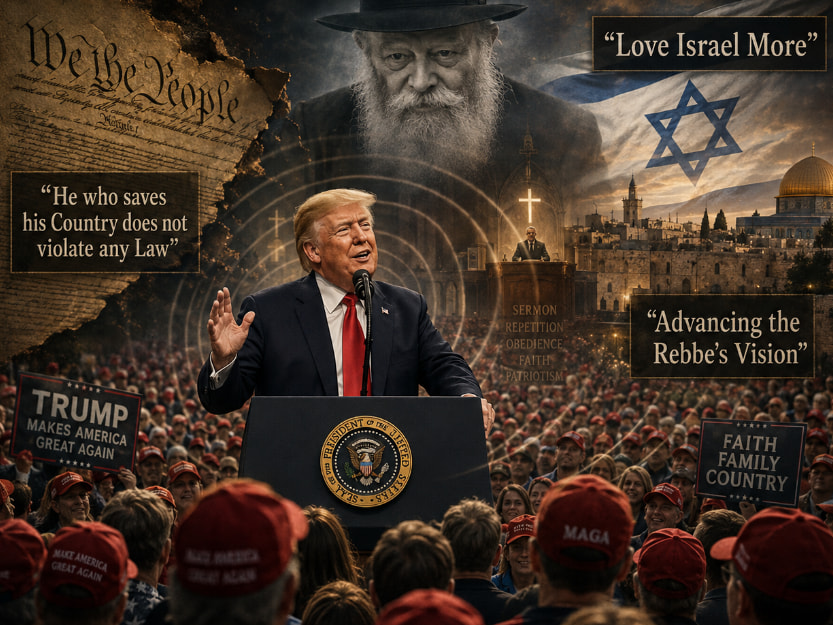
“We have to get the people of our country, of this country, to love Israel more… We have to get them to love Israel more.

Then on December 3, 2022, Trump himself posted on Truth Social that what he considered sufficiently massive election fraud:

allows for the termination of all rules, regulations, and articles, even those found in the Constitution.

https://truthsocial.com/@realDonaldTrump/109449803240069864

Also has posted

He who saves his Country does not violate any Law.

https://truthsocial.com/@realDonaldTrump/posts/114009179225169296

And in March 2026, from the White House itself:

As President, I am proudly advancing the Rebbe’s vision…

I cannot prove what is in Trump’s heart. I can read what comes out of his mouth.

He says Americans need to “love Israel more”.

He has expressly described circumstances in which even articles of the “Constitution can be terminated”.

He says a man who “saves his Country” “does not violate any law”.

And as President he says he is “proudly advancing the Rebbe’s vision.”

Firstly, we do not force worship or religion, “under the constitution”

https://constitution.congress.gov/browse/essay/amdt1-4-2/ALDE_00013222/

But, if it were deemed to save the county, apparently we could suspend that and advance the Israel/Rebbe’s vison to enforce

https://www.chabad.org/therebbe/article_cdo/aid/2516760/jewish/The-Seven-Noachide-Laws.htm

which in part:

Chabad’s English edition of Maimonides says Noahide courts are to judge these commands and states that a non-Jew who violates one is subject to execution by decapitation; it also describes adjudication by one judge and one witness without prior warning.

So, plainly, If Noahide law were ever imposed as civil law, the question for Christians would not merely be whether they agree with seven broad moral rules. It would be: who gets to define “idolatry,” and what happens to Christianity under that definition?

In Maimonides’ Noahide framework, non-Jews are to be compelled to accept the Noahide commandments, and prohibited “foreign worship” can carry capital punishment. Chabad’s own edition also notes the uncensored Maimonidean position that “Christians… are idolaters.”

It immediately acknowledges that other rabbinic authorities, especially the Rama, take a more lenient position and regard Christian shituf ,associating another with God, as permissible for gentiles. So there is no single Jewish ruling that all Christianity is automatically punishable.

But under the stricter Maimonidean construction, a Christian confessing Christ and the Trinity could find his worship classified not as protected Christianity, but as prohibited idolatry.

That is why “forced Noahide law” is not just a morality question for Christians; it becomes a question of whether an outside religious court gets authority to judge the Christian confession itself.

https://www.chabad.org/library/article_cdo/aid/1188354/jewish/Chapter-9.htm

Yes, that sounds accurate, we only need to view what we see differently, we’ve been told as much too it seems

2 Likes

You seem to fall into the same trap most Democrats do. They listen to Trump’s words but not his actions. He often says outrageous things, mostly to shake up the opposition. It is part of his “negotiation style”. Look at all the outrageous tariff positions he’s taken. ?How many actually represented what he did; I would submit few, although some. (Canada is one example, but Canada is not the friend it once was. It has been taken over by Leftist globalists.)

So let’s define a few broader terms. Friend - someone who generally supports us, is interested in similar goals, votes with us on most issues. Enemy - someone who opposes us on most things, whether rightly or wrongly, who votes against us, who commits acts against us, who does not share our basic principles and moral code.

By those definitions, Israel is a friend, and Persia is an enemy. One opposes an enemy by whatever means appears necessary at the time. One supports a friend by whatever means appears appropriate. Note that neither of these definitions require ALWAYS being friendly or opposing. One can and should look for middle ground where possible, in any “conflict”. Sometimes that just isn’t possible. Persia is a great example of “not possible”. They have never wavered from their inhospitable position vis a vis us or the West - never! One needs to accept people at their word when it is consistent and carried out in actions over a prolonged period of time.

1 Like

Well @Kilroy , if your explanation of more “federal banking systems” (vs state-chartered) explains why we’ve had more bank crisis, then by that definition, the banking system we now have should be pretty immune to any stress failures, since most larger banks are federal chartered, or at least distributed. Yet we got the 2008 banking crisis, mostly from mortgages which were totally NOT a distributed risk but a hidden risk, they being bundled into REIT’s without the purchaser knowing what percentage of the REIT was risky and how much. So banks over-extended, and when the piper came along, no liquidity! Harvard is having similar issues now - largest endowment in the country but cash-poor.

1 Like

You’re right to push back. I overstated the benefit of centralized or distributed banking: a larger branch network can spread ordinary local losses, but it does nothing against a nationwide asset bubble—especially when institutions are all carrying the same supposedly safe exposure.

The 2008 problem was less where the banks were chartered than how mortgage risk was originated, sliced up, rated, and dispersed without genuine transparency. Strictly speaking, the main vehicles were mortgage-backed securities and CDOs; REITs could hold related assets, but they weren’t the central packaging mechanism.

The Harvard comparison is apt in the liquidity sense: substantial assets on paper do not guarantee cash available when everyone wants out at once.


Kilroy was here

1 Like

mmm..

Modern Iran is obviously not identical to ancient Persia, and the Islamic Republic’s present political hostility toward Israel is a separate modern question.

But, Persia is:

  • not one of Israel’s archetypal hereditary enemies like Amalek;
  • the empire God used to overthrow Babylon;
  • the power that released the Jewish captives;
  • the power that authorized rebuilding the Temple;
  • home to the setting of Esther and part of Daniel;
  • was ruled by Cyrus, whom God extraordinarily calls His “anointed.”
    Iran, well before the 1979 revolution, Iran was one of America’s closest Middle Eastern allies: a major Western partner against Soviet influence, heavily supported by the U.S., and a key pillar of American strategy in the Persian Gulf. So the claim that Iran or Persia has “never” been friendly to America is simply false.

ok, those definitions, Jesus and the apostles were themselves Jews, so when Scripture speaks of the disciples hiding “for fear of the Jews” after the Resurrection, it obviously cannot mean Jews as a people. It means those particular authorities and factions that were hostile to Christ and His followers. The same distinction matters now: ordinary Jews are not the issue. The question is whether particular religious or political interests hostile to Christianity somehow ceased to exist merely because two thousand years passed.

That brings me to the modern State of Israel. Israel is not Judaism, not the Jewish people, and certainly not Christ. It is a political state with its own interests. Yet American Christians have often been taught to receive that state almost automatically as a biblical “friend,” before asking whether its policies actually serve America or Christians. That is where the Trojan-horse analogy comes in: not that Israel secretly entered as an enemy, but that political commitments can be carried inside a religious assumption—“support Israel or oppose God”—which gets them through the gate before they are examined. A real friend should withstand scrutiny. No government should become immune from it because of theology.

Then let us apply your definition of ‘friend’ consistently.

A friend may disagree with me, certainly, as you are. But what do I call a foreign ally whose interests have become so politically protected in Washington that American congressmen who question its funding face multimillion-dollar campaigns to remove them, while our own executive branch has attempted to punish people for pro-Palestinian speech, and federal courts have had to stop it as unconstitutional?

Israel did not personally sign those American executive orders, and AIPAC is not Israel or ‘the Jews.’ Our own politicians chose to build and use that machinery. But if friendship with Israel has reached the point where criticism of Israel can threaten an American’s political career or another person’s ability to speak freely in America, then the question is no longer simply whether Israel is our friend.

The question is whether Washington has allowed loyalty to a foreign ally to outrank American constitutional liberty

Muttley Laugh GIF - Muttley Laughing Giggle - Discover & Share GIFs

Do I?

Chuck Schumer. Nancy Pelosi. Joe Biden. Hillary Clinton. Hakeem Jeffries. Adam Schiff. Jamie Raskin. Debbie Wasserman Schultz. Cory Booker. John Fetterman. Ritchie Torres.

All strong supporters of Israel.

Need links?

Might want to think through the trap falling aspect.

Might want to think through how any of these politicians are for you, I, or America at all.

You know they brag about it, long have too

Senate was “subservient” to Israel - 1973

, and, sadly, a decade before that

certain antisemitic and anti-Israel circles, claiming that the American-Israel Public Affairs Committee, known as AIPAC, was somehow involved in the assassination of President John F. Kennedy in 1963.

https://academic.oup.com/mj/article/46/2/103/8707527

Charlie Kirk had Trump’s ear. He was not merely commenting from the sidelines; he was moving opinion inside MAGA, helping other prominent conservatives push back against another Middle East war, and carrying that argument directly into the Oval Office. Tucker Carlson, Alex Jones, Marjorie Taylor Greene and others were pressing the same warning.

Kirk had become effective: the pressure was reaching the President himself. Three days after Kirk met Trump on June 18, Trump struck Iran, but stopped short of the prolonged regime change war Kirk had warned against.

Six months later Trump joined Israel in a vastly larger attack on Iran, not merely striking facilities, but decapitating the Iranian state.

Ayatollah Ali Khamenei, Iran’s Supreme Leader for thirty-six years, was killed in the opening assault. Trump openly urged Iranians to overthrow their government, Netanyahu said the campaign would create the conditions for Iranians to cast off the regime, and U.S. intelligence had already been studying what regime change might produce. This was no longer simply “stop the nuclear program”; it was an attempt to reorder Iran itself.

And that distinction matters enormously. Khamenei was an adversary, but he was a known adversary whose limits, command structure and behavior had been studied for decades. Washington was warned beforehand that killing him might not produce a friendlier Iran at all; the CIA assessed that even harder line Revolutionary Guard elements could inherit power.

Six months later, that warning looks prescient: Iran survived, hardened, the war became open-ended, the Strait of Hormuz became a continuing flashpoint, fuel costs rose, and the United States found itself trapped in a conflict whose stated objectives kept changing.

For Israel, regime change in Iran had long been visible as a larger ambition. Reuters was already reporting in June 2025 that the targets and Netanyahu’s appeals to the Iranian population pointed beyond the nuclear issue toward toppling the government. By 2026 Netanyahu was openly talking about creating the conditions to overthrow the “Ayatollah regime,” while powerful Religious Zionist figures such as Smotrich were explicitly calling for that regime to be toppled.

And this is occurring inside an Israeli political environment containing explicitly messianic religious currents movements for whom the State of Israel itself is understood as an instrument in a redemptive process culminating in the Messiah. That does not prove that the Iran war was launched “to make the Messiah come,” and I would not state that as fact. But it certainly makes the religious dimension relevant when influential members of the governing coalition combine territorial expansion, Temple ambitions, regime-change warfare and messianic theology.

Then ask the American question separately: What did regime change in Iran accomplish for the United States?

Trumps economic plan was working, MAGA was not split, who suffered, who gained?

might want to read and

A shared enemy does not excuse a divers measure. If we would condemn the conduct from Iran, China or Russia, we cannot call the same conduct friendship when Israel does it.

1 Like

The distinction between Persia and modern Iran is important, and the historical record defeats any claim that Persia was always hostile to America or the West.

Ancient Persia also cannot be reduced to a single biblical category: Cyrus is presented as an instrument of God, while later Persian rulers and political conditions were different. The larger point about confusing a modern state with a biblical or ethnic category is sound.

Israel is a nation-state with policies and interests that can be examined and criticized; it is not identical to Judaism, the Jewish people, or the teachings of Christ. The caution I would add is that the “Trojan horse” analogy can imply more coordination and intentional deception than the evidence establishes.

The stronger criticism is simpler: religious loyalty has sometimes been used to shut down legitimate debate over a foreign government’s actions. Supporting Israel may be morally or strategically justified in a particular case, but it should not be treated as a substitute for examining the case.


Kilroy was here

Fair enough. But how much weight should we put on “the evidence establishes” when history repeatedly shows that the evidence sometimes arrives years or decades later?

In 1964, the second Gulf of Tonkin attack was presented as fact and helped justify escalation in Vietnam. Decades later, the NSA’s own classified history concluded that no attack occurred that night.

In 1962, if someone had claimed the Joint Chiefs considered staging or manufacturing incidents to justify invading Cuba, it would have sounded absurd. Then Operation Northwoods was declassified.

For years, claims that the CIA secretly experimented on Americans with drugs and behavioral manipulation would have sounded equally fantastic. Then MKULTRA became a matter of Senate hearings and released government records.

COINTELPRO was secret until documents were stolen from an FBI office and released. Only afterward did the public learn the extent to which the FBI had infiltrated, disrupted and attempted to discredit lawful political organizations.

So I agree that what cannot presently be proved should not be stated as proved.

But there are two different questions:

What does the evidence establish today?

And what does the available pattern reasonably give us cause to suspect, infer and investigate?

If inference is forbidden until the hidden evidence finally becomes public, what exactly is inference for?

1 Like