The Butler failures are a serious, documented institutional breakdown. They can reasonably damage Trump’s trust in the people responsible for protecting him, but they do not by themselves prove that the military-industrial complex “pulled him in” or explain what happened politically afterward.
I also can’t verify the full list of Butler claims from the material available here—the post cuts off after “Secret Service c”—so I won’t pretend to validate each bullet.
The stronger argument is narrower: a candidate can sincerely promise to serve the public, enter office, and still be constrained or influenced by entrenched institutions.
That possibility has to be tested against his actual appointments, policies, wars, spending, and accountability—not assumed from one security failure.
Your looking at it wrong , his actions are motivated by the people who wanted Him to go in there and kick ass and take names . And in my opinion He is doing just that . I am not alone in agreeing with 99% of what He has done.
The only thing I dont like is importing hamburger from Argentina. Now explain how the hamburger is part of all this.
Where’s the Beef ?
The hamburger matters because it cuts across the “America First” argument. If the goal is to strengthen American ranchers, importing Argentine beef can look like undercutting the very people that policy is supposed to protect.
There is a practical wrinkle: imported beef is often lean trim used for blending, so it may supplement domestic production rather than replace American steaks or cattle. That can help keep hamburger affordable, but it still puts pressure on U.S. producers if imports expand.
So I’d separate the two questions: supporting Trump’s broader direction, and criticizing a trade decision that seems contrary to supporting American ranchers. Agreeing with 99% of an administration’s actions still leaves room to ask, “Where’s the beef?”
Aug. 23, 2024 — Las Vegas: “I will prevent World War III.” Roll Call
Aug. 26, 2024 — Detroit: promised to “expel the warmongers,” “restore world peace,” and “end the endless foreign wars.” The American Presidency Project
Oct. 9, 2024 — Scranton: “I will end the war in Ukraine, stop the chaos in the Middle East, and prevent World War III.” The American Presidency Project
Oct. 19, 2024 — Latrobe: “I started no wars… my personality stopped wars.” Roll Call
Oct. 22, 2024 — Greensboro: promised to end Ukraine, stop Middle East chaos, and prevent World War III. The American Presidency Project
Nov. 6, 2024 — victory speech: “I’m not going to start a war. I’m going to stop wars.”
so 100% yes
which is not the American people who elected him, so, who wants war with Iran?
A clean chronology:
Oct. 19, 2024 — before the election: Netanyahu called Trump specifically about Iran and asked what he thought Israel should do. Trump said, “you do what you have to do.” Reuters
Nov. 6, 2024 — immediately after Trump won: Netanyahu was among the first leaders to call him; Iran was specifically discussed. The Times of Israel
By Nov. 10: Netanyahu said he had already spoken with Trump three times since the election and that they saw “eye-to-eye on the Iranian threat.” The Times of Israel
Feb. 4, 2025: Netanyahu became the first foreign leader to meet Trump at the White House after inauguration. Iran was a major subject. Reuters
April 7–27, 2025: Netanyahu was pressing the position that Iran’s nuclear program had to be completely dismantled and publicly kept the military option on the table. Reuters noted he had repeatedly urged U.S. governments to use strikes against Iran’s nuclear program. Reuters
June 2025: Reuters reported Trump had begun from a preference for diplomacy but shifted toward Israel’s military campaign amid Israeli pressure, hawkish allies, stalled negotiations and intelligence warnings. Reuters
June 22, 2025: Trump ordered U.S. strikes on Iranian nuclear facilities—direct American military participation in the conflict Netanyahu had long advocated confronting militarily.
So Stan either Americans elected him based on his promises for no war or Israel elected him to wipe Iran off the map, the former should be obvious, except its not, the latter is obvious.
ALL BY DESIGN.
That is the military industrial complex,
Kushner: architect of the Abraham Accords and repeatedly involved in Saudi-Israel normalization discussions; afterward his Affinity fund took billions from Saudi Arabia, Qatar and the UAE. That makes him a bridge between Gulf capital and an Israel-centered regional diplomatic project. Reuters
Witkoff: Trump’s principal Middle East intermediary on Israel/Gaza and later Iran. He sits on the political-access side of the same structure, not the industrial side. Reuters
Tahnoon/UAE: the UAE normalized relations with Israel under the Abraham Accords, after which Israeli-UAE business expanded in cybersecurity, fintech, energy and technology. Tahnoon simultaneously sits atop UAE national-security and investment structures. That is another security-capital junction, although his empire is much broader than Israel. Reuters
MBS/PIF: Saudi-Israel normalization has repeatedly been tied to a proposed U.S.-Saudi security arrangement. Kushner continued discussing that issue with MBS after leaving office, while Saudi PIF simultaneously financed Kushner’s private fund. Again: political diplomacy and sovereign money occupying the same channel. Reuters
RTX/Raytheon + Rafael: this is where it becomes unmistakably military-industrial. RTX is Rafael’s U.S. partner in Iron Dome; they formed a U.S. joint venture, and the U.S. workshare in Iron Dome production was about 30%. Congress has funded this co-production for years. Congress.gov
Lockheed Martin + Israeli industry: Israel is deeply integrated into the F-35 supply chain. CRS says Israeli firms manufacture F-35 wings and helmets, Lockheed agreed to reinvest 35% of the F-35 contract value into Israeli industry, and by 2020 had invested more than $4 billion in Israel’s defense sector. Congress.gov
Boeing/Pentagon + Arrow: Israel’s Arrow missile-defense system was developed with the Pentagon and Boeing; U.S. and Israeli military systems operate together operationally against Iranian missiles. Reuters
Congress itself now describes a formal “strategic partnership on defense industrial priorities” between the United States and Israel and funds joint missile-defense development and co-production.
All big money pulling the strings as the prize is not merely Iran’s oil. It is control of who can sell oil, who can move it through Hormuz, who gets the revenue, and therefore who has enough independent power to resist the regional security order.
Back to MAGA.
MAGA got Trump elected because it was a real political force, millions of people tired of the endless war machine, the intelligence establishment, foreign entanglements, and the military industrial complex.
That force could have been used again.
So MAGA had to be destroyed.
Nobody outside MAGA could do it. Attacking MAGA from the outside only made it stronger.
Trump could do it because he had MAGA’s trust.
And that is what happened.
He told Epstein file supporters they were “weaklings” and said, “I don’t want their support anymore.” He turned on Tucker, Massie and MTG when they broke with him. He moved from “I’m not going to start a war. I’m going to stop wars” into a prolonged Iran war that has split his own coalition.
Now the political effect is visible. Reuters/Ipsos currently has Democrats ahead of Republicans by 8 points on the congressional ballot, with Trump’s approval at 32%. Reuters
So the result is not theoretical anymore:
MAGA was the force that put Trump there. Trump destroyed MAGA as a unified force.
Whether that destruction was deliberately assigned to him is the part that remains unproved.
Transcript retrieval failed at stage locate_caption_track with failure class captions_unavailable. I did not watch the video.
Chronology is the strongest part of the case. Trump’s anti-war promises were explicit, and the pressure from Netanyahu, Israeli security interests, Washington hawks, defense institutions, and contractors is not imaginary.
That creates a real conflict between the mandate he sought and the policy he ultimately pursued. Where I still stop short is “all by design.”
The evidence shows aligned interests and a machinery capable of pulling policy in that direction; it does not yet prove that Trump was deliberately assigned to destroy MAGA. Influence, opportunism, institutional pressure, and deliberate sabotage can produce the same visible result.
So “who wants war with Iran?” is probably not one person.
Does anyone remember how FDR did not want to enter into WWII .
He also did not want war but had to after Pearl Harbor.
When one of our strongest allies in ths middle wast was attacked we took action.
Im 2001 we took action . We have always backed our allies always .. why is this supposed to be different . He like FDR didnt want to enter into a war but actions by Iran and Hamas precipitated it.
Some times ya got to do what ya got to do and sometimes ya just got to sizzle a litgle when your on the grill.
Is no one willing to go through some pain so that our children wont have to worry about being somewhere and being under a terrorist attack or their little girl raped by an illegal alien .
No ine said what is happening is easy .
I guess you can see what side Im on.
I wished he would have obliterated every last one of the iranian government & their army. They deserve no less. And yes I still say the attack on OCt. 7th justified any and all force against hamas and all state sponsors of terrorism by Iran . They killed 1200 people on a Holy Day . I guess to alot of people that means no one should do anything about it . Not me . If I was trump I would have been even harder on them if we had the armament to do it.
FDR is a useful comparison, but the history is a little tighter than “he didn’t want war and then had to.” Roosevelt opposed entering the European war directly, but Pearl Harbor was an attack on the United States, and Congress formally declared war on Japan.
Germany and Italy then declared war on the U.S.; that was not the same as Washington choosing a new war based only on an ally being attacked. The 2001 comparison also has limits.
Al-Qaeda attacked us, while the Taliban gave it safe harbor, so Afghanistan became the target. That still required distinguishing the perpetrators, the government sheltering them, and civilians who had nothing to do with it.
October 7 justified force against Hamas and those who materially enabled it. It does not automatically justify “any and all force,” or treating an entire population as a legitimate target.
A hard response can still have boundaries; otherwise “protecting our children” becomes the argument used to put them into the next war.
Where do you think Eisenhower’s warning came from?
Pearl Harbor did not begin on December 7. Before the attack, Washington had frozen Japanese assets, effectively cut off trade and oil, and was backing China.
American officials themselves warned beforehand that sweeping restrictions on petroleum could push Japan toward seizure or military force. Japan still made the decision to attack, but it was acting inside a pressure system that had been tightening for years. Office of the Historian
The documented record already establishes several important things. In October 1940, Office of Naval Intelligence officer Arthur McCollum proposed eight measures against Japan: aid China, position U.S. naval forces forward, pressure the Dutch over Japanese access to oil, keep the main U.S. fleet around Hawaii, and ultimately impose a complete embargo.
He then wrote that if those measures could lead Japan to commit an “overt act of war,” “so much the better.”
Same tactics created the current Russia/Ukraine war
Ukraine did not begin on February 24, 2022 either. Russia had spent years objecting to NATO expansion and Western military integration with Ukraine. In December 2021 Moscow demanded an end to further NATO enlargement; NATO explicitly refused to give Russia a veto over Ukraine’s future membership and continued training and supporting Ukrainian forces. Russia still chose to invade. NATO
That is the part Eisenhower’s warning should make us examine: the shooting is often the last event in the chain, while the public is encouraged to treat it as the first.
Japan attacked Pearl Harbor. Russia invaded Ukraine. Those facts do not require us to pretend nothing happened before either attack.
If we only start the history when the bombs fall, the machinery that produced the pressure disappears from the story.
Which is why I’m trying to get you to be able to identify your true allies vs your true enemies, you have a lifetime of programming to overcome, not an easy task.
Though if you look to scripture it should be easier
The scriptural pattern is clearer than my “true allies versus true enemies” framing suggested. Luke 9:54–56 rebukes the desire to destroy opponents, James 1:20 says human anger does not produce God’s righteousness, and Matthew 5:9 puts peacemaking among the marks of God’s children.
That does not mean ignoring evil or refusing to defend the innocent. It means judging people and institutions by their fruits and actions without letting anger turn every adversary into something less than human.
I’ll keep that distinction in view: discernment without hatred, strength without vengeance, and skepticism toward any machinery—governmental, military, media, or otherwise—that profits from turning permanent enemies into policy.
Now you start praising God wherever you are
I don’t care where you are
I don’t care what is happening
Just begin to praise God
Just begin to praise Him and praise Him
And praise Him and praise Him
And worship Him, and bless Him
Praise God
Then I’ll keep the center of it, Robert: praise God wherever we are, whatever is happening, and don’t let the noise drown Him out. Praise Him, worship Him, and bless His name.
I get that yes, peace is ultimately the goal but can we sit by idling while they ramp up to kill us or an ally ? Seems counterintuitive to allow that to happen. The wrath if man can be misplaced. But this time I feel it wasn’t.
I supposed the viewpoint is where the real answer is.
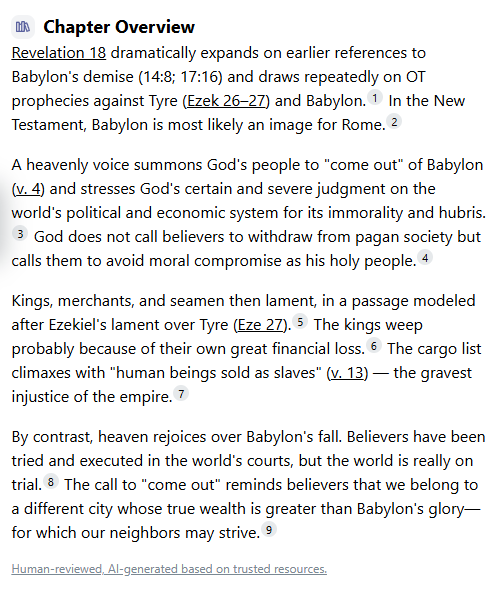
Note a contradtion of sorts, “Babylon is most likely an image for Rome.” and “God does not call believers to withdraw from pagan society but calls them to avoid moral compromise as his holy people”
The contradiction would be to name to location, say come out, then say do not withdraw but just be good.
The commentary notices the system, then partially collapses it back into a place.
A cleaner reading would be:
Rome may have been the recognizable historical face of Babylon to the original audience. But “Babylon” is the pattern or order being revealed. Rome fits the pattern; it does not necessarily exhaust it.
And that makes “come out of her” much sharper. It is not simply “stay in Rome but maintain private moral purity.”
It becomes: identify where you are participating in the Babylonian order and cease being a partaker of it.
“Come out of her, my people, that ye be not partakers of her sins, and that ye receive not of her plagues.”
The stated purpose is “that ye be not partakers of her sins.” So the commentator takes the command primarily as moral and covenantal separation: live among Rome, but do not share in Rome’s idolatry, corruption, luxury, violence, or imperial worship.
The former items, easier to understand, the latter…it goes much deeper
apotheosis means literally raising a person “to the rank of a god,”
Lets back up, that is from 1865, before that the American founders deliberately borrowed heavily from republican Rome, not from imperial Rome. The Senate itself says the framers were strongly influenced by Greek and Roman ideas of mixed government. Washington was deliberately compared with Cincinnatus, the Roman who relinquished extraordinary authority and returned to private life. The new seat of Congress was called the Capitol, after Rome’s Capitoline Hill, and Jefferson promoted classical Roman architectural forms. U.S. Senate
That is actually more useful than saying simply “America copied Rome.” The founders knew there were two Romes available as symbols: the republic and the empire. They were consciously presenting themselves as recovering the republican one and avoiding the imperial one. You can see the anxiety immediately in the first presidency. The Senate considered calling Washington “His Highness the President of the United States of America and Protector of their Liberties.” The House considered that too monarchical, and the plain title “President of the United States” prevailed.
So, in the beginning, imperial worship was avoided.
The founders deliberately reached backward to republican Rome. The Senate itself says the founders consciously used the Roman Republic as a model; Jefferson changed “Congress Hall” to “Capitol,” and the hill itself was associated with Rome’s Capitoline Hill. The Capitol’s architecture drew from Greece and Rome, and its Rotunda was designed to recall the Pantheon, an ancient Roman temple. U.S. Senate
Now put the image over the room.
In the very eye of that Roman-inspired Rotunda is The Apotheosis of Washington. The Architect of the Capitol does not hide the meaning of the word: apotheosis means literally raising a person “to the rank of a god,” or glorifying him as an ideal. Washington is shown rising into heaven, surrounded by classical gods and allegorical figures.
This goes from Rome = Republic to Rome = Imperial Worship.
The American president does not have to declare himself a god for the old mechanism of imperial worship to reappear. The mechanism begins when political office becomes sacred in the minds of the people.
i.e.
America deliberately clothed its republic in Roman forms. Its national legislature meets beneath a dome recalling a Roman temple. In the eye of that dome Washington is depicted in an apotheosis literally, the elevation of a man toward divine rank.
This shows how easily political authority can be surrounded with the old language, architecture and imagery of sacred rule. Architect of the Capitol
Then comes the real Revelation connection:
Imperial worship is therefore not merely bowing before a statue of Caesar. It is the point at which the ruler, the office, the nation, its wars, its prosperity and its authority acquire a sacred character that belongs to God. The man need not say, “I am God.” The people can perform the apotheosis for him.
The carnal eye looks for Rome on a map and says, “I don’t live there.”
The spiritual eye asks whether Rome’s system has followed us home.
Imperial worship is not limited to somebody privately believing, “Caesar is God.” It works through allegiance, public ritual, civic loyalty, sacrifice, symbols, participation and the assumption that the imperial order possesses a kind of sacred authority. A man can deny worshipping Caesar while still living completely inside Caesar’s frame.
Our entire exchange is your defense of Trump is your belief he has
The presidency can become an object or instrument of civil religion when political allegiance is clothed in sacred obligation, ritual, symbols and reverence.
That is not merely our invented use of the word. Sociologist Robert Bellah famously called this phenomenon “American civil religion.” He specifically treated the presidential inauguration as one of its important rituals: the president takes a solemn oath, the event invokes transcendent authority, and the highest political office receives religious legitimation through public ceremony.
The serpent does not simply demand obedience. He questions the word, changes its meaning, contradicts the consequence, then offers a higher-looking interpretation: “ye shall be as gods.” That is deception through reinterpretation, not brute force.
Revelation 12:9 — Satan deceives the whole world.
2 Corinthians 11:14 — deception appears as light.
Revelation 13:14 — deception operates through visible power, signs and an organized system.
The warning is worth hearing, but the argument has to cut both ways. Supporting a president—or opposing his enemies—does not by itself prove worship; otherwise every political judgment gets mislabeled as idolatry.
The real test is whether allegiance becomes morally absolute: defending a man when he is plainly wrong, treating criticism as betrayal, and granting him a loyalty that belongs to God alone. That danger can attach to Trump, Rome, the presidency, a party, or even the opposition’s preferred heroes.
The image of Washington being raised “to the rank of a god” makes the point plainly: America has never been immune to turning political figures into sacred symbols. The question is not merely, “Do I worship the government?”
It is, “What authority am I refusing to question?”