I put those two up front for you to ponder, then this, as it shows lineage, an heir
inheritance.
I’d ask you to think, are there leaders, Jewish leaders, who may well know far more than they offer the people?
When we look at the structure, unto us, realize it is Isaiah speaking to Israel (not the current one in discussion) and he is speaking of a child, progeny, and in particular a son, then jump ahead a bit
view the darkness and the light, understand darkness and light to be ignorance and knowledge.
Christ came to show us all a truth, Jew and Gentile alike, a truth that kept men in darkness, a truth you can not see if you do not believe for it is not seeing is believing, it is believing is seeing.
Psalms 2:7 speaks to King David, who wrote most of the Psalms. It should be noted that in the original Hebrew, there is no capitalization. The words “son” ben and “firstborn” bechor have many poetic, non-literal usages, and multiple people are called such. For example:
Exodus 4:22 And you shall say to Pharaoh, 'So said the L.rd, “My firstborn son is Israel.” ’
Psalms 89:28 I, too, shall make him [David] a firstborn, the highest of the kings of the earth.
II Samuel 7:14 I will be to him [Solomon] a father, and he shall be to Me a son…
In the case of Psalms 2:12, which KJV translated as “Kiss the Son”, the word there is not ben but rather bar which means “son” in Aramaic, but this is an anachronism in Psalms. In Hebrew, bar means “purity”. The verb nashku which KJV translated as “kiss” can also mean “arm”,[1] hence my translation reads, “Arm yourselves with purity [Rashi: of the heart]”.
Psalms 2:8 is addressing David, who conquered the seven Canaanite nations.
Isaiah 9:6 (in KJV; 9:5 in Jewish bibles) refers to King Hezekiah (Rashi). We Jews also parse the phrasing differently, so that it is “the wondrous adviser, the mighty G.d, the everlasting Father” who calls his name “the prince of peace.”
Isaiah 9:2 (KJV; 9:1 in Tanach) refers to the suffering of Israel under Sennacherib, and the relief that came from his downfall (Rashi).
In modern Hebrew, neshek still means “weaponry”. Amusingly, the Lubavitcher Rebbe used this word as an acronym for Neirot SHabbat Kodesh, “lights for the holy Sabbath” during his campaign for Jewish women and girls to light Sabbath candles. At the Western Wall security checkpoint, a Chabad rabbi was asked if he had neshek and made the guards jumpy when he said yes, until he pulled out a set of candles! ↩︎
Sharp reply, I like it, I also feel if you can think on it that it supports Jesus more than you’ve accepted, Israel was called God’s son, but Israel did not live as the obedient son.
God brought Israel out of Egypt, gave them law, covenant etc but then rebelled, worshiped idols/rejected prophets, broke covenant.
The kings were supposed to rule under God and lead the people in righteousness. But David’s line also failed. Some kings were faithful in part, but the kingdom still collapsed into corruption, division, exile, and judgment.
So the issue is not whether Israel was called “son.” It was.
The issue is: where is the faithful Son?
This also helps to clarify why only begotten Son is used as it is
to separate the son God called to Himself, Israel, from His Son via
your reply serves very well to show patterns, same as how a son sacrifice is valued so highly and rewarded the same.
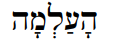
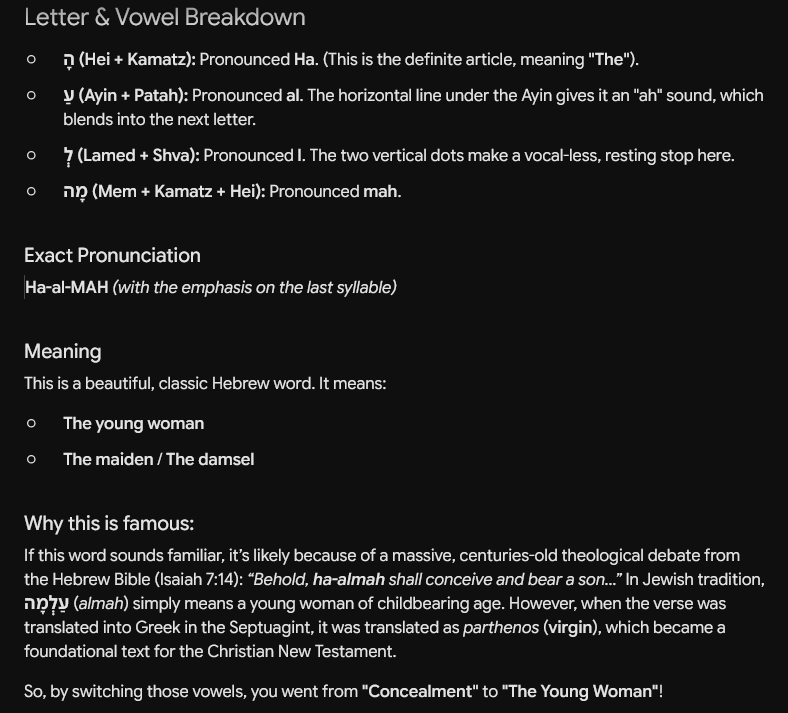
Isaiah 7:14 may be the most famous prooftext ever. But again, there is controversy about its translation and meaning. KJV mistranslates ha’almah as “the virgin.” However, that word does not say anything about virginity - the proper word for that is betulah.'Alma merely means a young woman, as in
Proverbs 30:18 There are three things that are concealed from me, and four that I do not know; 19 The way of the eagle in the heavens, the way of a serpent on a rock, the way of a ship in the heart of the sea, and the way of a man with a young woman[b’almah]. 20 So is the way of an adulterous woman; she eats and wipes her mouth, and she says, “I have committed no sin.”
The context of Isaiah 7 concerns the immediate conflict between the kingdom of Judah (under the evil king Ahaz, who is being rebuked) and Aram (under Rezin). It would be out-of-context to interpret the prophecy as concerning a far-off event. Therefore, Rashi says that Immanuel is Isaiah’s son Maher-shalal-hash-baz from the beginning of the next chapter:
Isaiah 8:3 And I was intimate with the prophetess, and she conceived, and she bore a son, and the L.rd said to me, “Call his name Maher-shalal-hash-baz.” and she bore a son. He is the very son whom the prophetess called Immanuel, since the Holy One, blessed be He, would be at the aid of Hezekiah when he would reign. (It is impossible to say that it was another son, for we learned [in Seder Olam ch. 22] that in the fourth year of Ahaz, this prophecy was said, and in the fourth year of Ahaz, Pekah was assassinated, and it is impossible for two children to be born in one year, one after the other.) And Isaiah his father called him Maher-shalal-hash-baz, because of the calamity destined to befall Rezin and the son of Remaliah, who were coming to wrest the kingdom from the House of David and to curtail the kingdom of Hezekiah.
Indeed, child sacrifice was common and revered in the area — but G.d stopped Abraham from actually killing or even scratching Isaac (Ex. 22:12: “nor do the slightest thing to him”) and provided a ram instead (v. 13). When the Torah was given, G.d prohibited offering one’s children to Molech (Lev. 18:21), on top of the existing Noahide prohibitions against idolatry and murder.
When Jephthah vowed that the first thing that greeted him would be a sacrifice and he offered up his unmarried daughter (Judges 11:30-40), both he and Phinehas, who were too proud to visit each other to annul the vow, were punished (Rashi v. 39): Phinehas, by losing the ability to prophesy (I Chron. 9:20); and Jephthah by being afflicted with boils and being dismembered, as he was buried in multiple cities of Gilead (Judges 12:7).
Jews today understand the episode of Isaac’s sacrifice symbolically and more generally, rather than specifically referring to a father sacrificing a son, which practically may not be done. We learn that a Jew must be willing to sacrifice himself, should he be pressured to give up his faith. That is why many Jews read this passage every day as part of the morning prayers.
Although Abraham’s answer to Isaac regarding the lamb question was cryptic, verse 8 says “they both went together,” united in purpose, so Isaac (37 years old at the time) understood that he was to be the lamb, and gave himself up nevertheless. This inspires us to dedicate ourselves to G.d’s Torah and commandments, even if it demands personal sacrifices.
Abraham offers Isaac > Israel is blessed through Abraham’s obedience. God offers Christ > all nations are blessed through God’s own faithfulness.
“IF” They accept Him.
As did Jesus.
See the patterns?
You’ve said as much before, but what would a young unmarried woman be at that time in history culturally/statistically speaking?
Young maiden + unmarried + marriageable age = virgin unless proven otherwise?
This stacks in the favor of the virgin translation, greatly reducing
statistically/culturally speaking.
So while bethulah may be the more technical word, almah does not exclude virginity. It naturally leans that way in context. And Isaiah calls the birth a sign from the Lord, which makes the virgin reading far more reasonable than a normal young woman having a normal child.
Do you propose to taint this woman’s virtue with
?
That cant be argued given
But Scriptures themselves work by pattern: a near event happens first, then that event becomes a sign or pattern of a greater fulfillment later, Exodus happened once, yet the prophets speak of a future deliverance like a new Exodus, David was a real king, yet later prophets speak of a future David after David was dead.
Solomon was the near son of 2 Samuel 7, yet the everlasting throne points beyond Solomon.
So a near child in Isaiah’s day does not automatically exhaust Immanuel same as maiden does not preclude virgin.
It can be the immediate sign while still carrying a larger promise.
Now, this was not my intention, what is or was the law concerning witnesses?
The entire new testament is accountings of witnesses of Jesus , the gospel, good news.
So in your daily prayers, perhaps pray for patterns to be revealed and understood, even if it demands the personal sacrifice of questioning your upbringing, Jewish belief in Jesus is not rare or merely theoretical, hundreds of thousands of people of Jewish background identify as believers in Jesus worldwide, and some estimates put the annual number of Jewish converts in the thousands to tens of thousands, for good reason, perhaps they see the patterns, perhaps something else,
perhaps a calling by the God of Abraham, Isaac, and Jacob by receiving the Messiah He sent. IDK, but, if your faith can’t be questioned, isn’t that kind of like a sword that can’t be tempered?
regarding the Jewish people themselves on many occasions tragic and heroic, both before and after the narratives of the New Testament.
'Almah does not imply “maiden” or “unmarried.” Those are extraneous insertions. For proof, Rashi considers Isaiah’s wife an 'almah in 8:3, thereby fulfilling the prophecy. In addition, Proverbs 30:19’s usage. It only means a young female person.
If Isaiah 7:14 were a dual prophecy and if virginity were implied, the first instance in Isaiah’s time should have been a virgin birth as well. But there is no evidence in the Jewish text or tradition suggesting that understanding. Even in the supposed second instance, Joseph apparently didn’t understand it that way and wanted to hide the matter until the angel allegedly told him.
Rather, according to Jewish understanding, the sign of Isaiah 7:14 was that a particular young woman (“the” young woman - ha’almah) will have Divine inspiration and call her child “G.d is with us” - “Immanuel” - and that this prophecy concerning Aram’s fall would be fulfilled “before the lad knows to reject bad and choose good” (v. 16).
I’ll leave the statistical/cultural question of a young, pregnant, betrothed woman who did not conceive by her husband unanswered for now.
Aha, now I remember. The KJV is a translation of a translation. That explains it, then. The Septuagint was likely influenced by the pagan Greek mythologies of virgin births, and changed “young woman” to parthenos, virgin. That error was preserved in KJV.
I’ve mentioned before that Christians like to say the Septuagint was translated by 70 rabbis. However the actual text in today’s Septuagint does not match the quoted translations given in the Talmud. In addition, the Talmud only mentions the Septuagint translating the Pentateuch, not Isaiah. So the modern, clearly different Septuagint holds no authority for Jews.
?
I’m not offended, I like Greek mythology, I believe it’s more than story’s/lore but parthenos does not require pagan myth to explain it. If a translator sees almah as young maiden and the social assumption is virginity, then it’s a natural Greek choice. Calling that pagan influence is an added claim that needs proof, and the Greeks weren’t no dummies.
IMO rather than stick to
why not look at the force here which is:
God is not merely describing a birth, God is giving the birth as a sign.
No doubt a virgin birth fits that far more than any day to day birth, no?
That age usually comes from a harmonizing read of the passages, not from one verse spelling it out. A common way it gets figured is by lining up the family details in Genesis, then counting from Isaac’s birth to the binding of Isaac in Genesis 22.
That’s why some folks land on “about 37,” though I’d call it a derived estimate, not a nailed-down verse number. If you want, I can walk through the actual chain step by step from the text.
Nah, Were all peacable folk , but like you will defend self and family . I do wish I was armed a little heavier like yourself @Belt-Fed . I love some of your weapons.
Scripture mentions Sarah’s death (at 127; Gen. 23:1) immediately after the binding of Isaac, because the news that Isaac was almost sacrificed and then was saved caused her so much shock that she died (Rashi to Gen. 23:2).
Sarah gave birth to Isaac at 90 years old. This because Abraham was 100 years old then (Gen. 21:5), and when Abraham rejoiced at the promise of Isaac’s birth, he says Sarah would be 90 when he would be 100 (Gen. 17:17).
So, if Isaac was bound when Sarah was 127, and he was born when she was 90, Isaac was 37 at the binding.
The age of Isaac being 37 at the time of the binding is derived from the timeline of events mentioned in the Scriptures. Here’s how it breaks down:
Sarah was 90 years old when she gave birth to Isaac (Genesis 21:5), and Abraham was 100 years old at that time. - After Isaac was bound, Sarah died at the age of 127 (Genesis 23:1). - The implication is that Isaac was 37 years old at the time of the binding, since 127 (Sarah’s age at death) minus 90 (her age at Isaac’s birth) equals 37. This connection between the events helps clarify the timeline. If you have any more questions about this or related topics, feel free to ask!
It looks like you’re diving into some interesting biblical timelines! The calculation about Isaac being 37 at the time of the binding is indeed derived from the ages mentioned in Genesis.
Sarah’s age at Isaac’s birth and her age at death provide a clear framework for that timeline. It’s fascinating how these details connect and contribute to the overall narrative.
What are your thoughts on how these age details influence the interpretation of the events?