9mm vs. 45 ACP: The Greatest Pistol Caliber Debate (2026)

Many shooters argue that the debate over 9mm vs. 45 ACP comes down to magazine capacity versus stopping power. However, this is a very apples-to-oranges approach when comparing these two personal defense rounds.

We’ll take an objective look and compare the ballistics, advantages, and disadvantages of two of the most popular self-defense cartridges in the world.

Load up your favorite Glock 17 magazines with your 9mm ammo of choice – or build a tiny, protective dam using the beavertail grip safety on your 1911 – because you are about to read the most objective 9mm vs 45 ACP caliber debate on the Internet.

Cartridge Spec Differences

Specification 9mm 45 ACP
Parent Case 7.65x21mm Unique Design
Bullet Diameter 0.355" 0.452"
Neck Diameter 0.380" 0.473"
Base Diameter 0.391" 0.476"
Case Length 0.754" 0.898"
Overall Length 1.169" 1.275"
Case Capacity 13.3 grains H₂O 25–27.4 grains H₂O
Max Pressure (SAAMI) 35,000 psi 21,000 psi

Is 45 ACP Stronger Than 9mm?

The 45 ACP is undoubtedly the superior cartridge when it comes to kinetic energy transfer. But how is “stopping power” defined? It cannot be quantified so easily, especially since so much of it is determined by shot placement, which is immeasurable. With that in mind, the FBI test protocol is widely accepted as the best assessment of a cartridge’s efficacy for self-defense, which is certainly something akin to stopping power.

For modern 9mm JHP ammo, penetration is around 13-15 inches on average. In contrast, 45 ACP hollow point ammo will typically penetrate to a depth of 12-14 inches. For the most part, both will penetrate the same distance.

One major difference between the 9mm’s .355" diameter bullet and 45 ACP’s .452" JHP is this: their capacity for terminal expansion. In general, a 9mm bullet will expand up to 0.6", effectively doubling in diameter. The 45 ACP bullet also reliably doubles in diameter, although that means it widens until it is nearly 1" around.

In short, the 45 ACP is more likely to inflict a larger permanent wound channel inside the bad guy. That means additional blood hemorrhaging, higher probability of lacerating a vital organ, and an altogether more unpleasant time for the threat.

Since it gouges out a larger permanent wound cavity, transfers more energy to the target, and is (relatively) less inclined to over-penetrate, it’s fair to say that the 45 ACP has more stopping power than a 9mm. Recent advancements in hollow-point technology have significantly improved the 9mm’s performance, although the 45 ACP’s bullet remains the larger and more damaging one.

But this is only part of the story! Let’s continue on to magazine capacity.

Magazine Capacity

Proponents of 9mm pistols love to cite the fact that 9mm magazines have higher capacity than 45 ACP alternatives – and they are 100% correct.

A standard Glock 17 magazine holds 17 rounds of 9mm. A Glock 21 magazine? Only 13 rounds of 45 ACP.

The benefits of having more ammo during a life-threatening altercation go without saying. This gives the 9mm a distinct advantage. Any sensible shooter should prefer having more shots at their disposal over fewer.

Be aware of your state laws. Some states, like New York and California, restrict “high-capacity magazines”. In these cases, the 9mm’s higher capacity may not necessarily matter. A standard Glock 43 magazine holds six rounds of 9mm, whereas a Colt 1911 Defender mag holds seven!

All other things being equal, the 9mm allows you to carry more ammo. That is undeniably a distinct advantage over the 45 ACP.

Pistol Caliber Standard Magazine Capacity
Glock 17 9mm 17 rounds
Glock 21 45 ACP 13 rounds
Glock 43 9mm 6 rounds
Colt 1911 Defender 45 ACP 7 rounds

Recoil

The 9mm Luger has approximately half the recoil of the 45 ACP, with 4 to 5 pounds of free recoil energy (7 to 8 pounds of free recoil energy for the 45 ACP). The 9mm cartridge fires lighter bullets at higher velocities, whereas the 45 ACP fires heavier bullets at lower velocities.

Recall your Newtonian physics: “For every action, there is an equal and opposite reaction.” That’s why the heavier powder charge and bullet of the 45 ACP generate heavier recoil than the 9mm, even if its muzzle velocity is significantly lower.

There is one caveat to this, though: firearm choice.

A classic steel-framed 1911 is considerably heavier than a polymer-framed Glock 21, M&P45, or Ruger SR45. That added weight reduces the amount of recoil that reaches the shooter’s hands.

This is the main reason why 1911 owners often say the 45 ACP doesn’t have much kick.

That being said, 9mm handguns generally do have less recoil. That allows for faster follow-up shots, as less recoil leads to less muzzle rise (i.e. the physical force that throws the sights out of alignment).

Less recoil also tends to lead to improved accuracy and shot placement. And as I’m sure you’re already aware, shot placement is key to stopping a threat.

Many shooters find that they are more accurate firing a 9mm. This is often due to its lighter recoil. The gentler-recoiling 9mm allows shooters to focus more on the fundamentals of shooting (trigger control, sight alignment, grip, stance) and develop good habits (rather than bad ones, such as recoil anticipation).

Continue reading 9mm vs. 45 ACP: The Greatest Pistol Caliber Debate on Ammo.com

https://ammo.com/comparison/9mm-vs-45#45-acp-vs-9mm-velocity-and-accuracy

3 Likes

I personally think the whole “magazine capacity” issue is a red herring. IF cartridge numbers mattered so much, then one should carry a .22 LR with 20-25 in the magazine. Silly. There is the old adage that you have more bullets in 9mm because you NEED more! Sounds like one of those throw-away lines, but statistics (I know - lies, more lies, and statistics) show gunfights usually take one less round to stop the assaulter with a .45 than a 9. If you consider the average gunfight is 3 shots at 3 yds in 3 seconds, then two shots in 3 yds in 3 seconds sounds like a good improvement. And then, if you go back to the Glock listing, on average you have 6-2/3 BG’s shot with the Glock 17 and 6-1/2 with the Glock 21. So one more BG per magazine,

?See how “statistics” can be played with.

2 Likes

Go back to a previous article by Ammo.com (I believe) comparing the original use and development of the 9mm vs the .45 ACP.

The Europeans considered sidearms to be weapons to be used at intermediate ranges (out about 100 or so yds) Americans believed sidearms were for the last ditch survival of the person against an enemy. It was first used against the Moro warriors in the Philippines to stop their deadly attacks. In WWI the favorite American trench weapons were the Winchester 1897 with a short barrel, and the 1911 pistol. For the same reasons - they worked. ?So why are we now speaking of the wimpy 9 instead of the original man-stopped, the .45 ACP.

2 Likes

I think many shooters are intimidated by the .45, I know I ran a double stack 45 in a mini monster completion just once and by the end it had wore me out to favor double stack 9mm for tossing lots of lead.

2 Likes

But that’s competition - not your life depends on this. One should never confuse competition with self-preservation. Those are two totally different animals.

2 Likes

True but my point is users are timid as 45 is more to handle, I like them, like 10mm too, but 9’s are just simpler and there’s something very satisfying about having more rounds hence the opinion

I’d not sway you from whatever you prefer, especially if your on my side with a 45 :nod:

2 Likes

It’s not just numbers, but reliability, too. 22lr wasn’t designed for stick magazines, and rimfire doesn’t go bang as reliably as centerfire.

Agreed. To continue the curve down past 9mm, take the recent cowboy-hatted hero with the suppressed 5.7x28 pistol shooting subsonic ammo. As much as we admire him for his bravery and preparedness as far as carrying a firearm, and the coolness of his silhouette - most people are not going to copy his equipment choices. So 9mm is still far preferred by the self-defense market over 5.7 and 22lr.

3 Likes

That attempt and its retry returned no usable answer, so the request remains incomplete.


Kilroy was here

.45 Colt vs. .44 Magnum.

3 Likes

Friend of mine, CWO-5 in our Marine Reserve unit and fellow pistol team shooter was a Chicago cop. When the Model 29 first came out (?mid-late 60’s) he and his partner and his Sgt all got one. The “fast district” in Chicago is about 8 blocks square and has at least 3 cruisers in there at all times. Lots of shootings. One of those involved the Sgt and some BG - who simply ran off after being shot!!! Paddy wagon picked him up a couple blocks away, bleeding on the sidewalk. .44 went right through him - “in and out”. So unless you’re shooting an NFL lineman, perhaps .44 Mag is over kill.

2 Likes

Yet we’ve been shooting .22 pistols for decades. I have an S&W Model 41 bull barrel with extend able front sight that I bought in college (so mid-60’s) and shot on pistol teams for many, many years. Yes, you have to do maintenance on it, and yes, things break and need to be replaced from time to time, but that’s true of all guns that are used a lot (except perhaps some of today’s plastic ones). By comparison, my old Colt alloy Commander, which I’ve dragged around all over the world, has had two triggers, 3 sears and two hammers replaced over the years. And I trust that piece.

So my whole point is that number of rounds carried is not really that big an issue. Weight of ammo carried may be a bigger issue. Today a .45 will carry anywhere from 8-12 rounds in a magazine. (HK USP w/ “standard” 12-round mags; 1911’s with 8; P220’s with 9). There are mags for guns like the P227 which carry 14. But hoist that sucker up! It is heavy. IF your gun rig is good enough to carry such weight, then a couple mags plus what’s in the gun are great. When weight becomes a oroblem, either rethink your whole defensive set-up or go to a different calibre. I personally carry a P220 SAS in .45 OR (more often) a P229 in .357 Sig. Neither of these rounds/guns are particularly light but they are singularly effective rounds. Wish the 365 come in .357 Sig; that would be an awesome carry gun!

2 Likes

I suspect “timid” is simply lack of appropriate exposure. Certainly with today’s plastic pistols, recoil absorbtion is much more common, making the shooting of these great guns so much easier. I recollect my first experience shooting a Glock 30. I sort of steeled myself for some serious wrist bending since that’s a .45 in a leetle beety gun. I was shocked at how easy it was to shoot - MUCH less snappy than a lot of similar-sized 9’s.

2 Likes

Of course, any new gun I shoot usually has a bit of hesitation/apprehension, even an old one not shot in awhile, repetition is pretty valuable in shooting.

:thinking:

I find the latter more true, though snap/muzzle rise more of how I’d describe the former (plastic pistols) though recoil can be described different its still the same affect so I guess lighter would mean quicker to jump up and describe IMO more recoil though not necessarily as felt per’se, IDK, tricky one there, semantics maybe but I’m very surprised to hear a Glock 30 defended as less recoil comparatively than I’d expect from a 1911 user.

Could be I need a more recent example, i.e. go hit the range :nod:

1 Like

Yeah, that’s the right way to look at it. A lot of the “recoil” talk gets mashed together with muzzle flip, frame weight, grip shape, and how much the gun is snapping back into the hand.

A steel 1911 can feel softer even when the caliber itself isn’t magically different. Glock 30s do surprise people sometimes because the little .45 can feel a lot more controllable than folks expect, but I’d still call that a gun-shape-and-weight conversation more than a cartridge-only one.

Go hit the range and see which one your hands actually prefer.


Kilroy was here

2 Likes

You’ve gotta match the load to the intended purpose. The standard .44 Mag load in the '60s was a 240 grain SWC at something like 1400 fps. Good for bears, but not for the scenario you describe.

One load I really like is a 240 grain lead SWC at 800-1000 fps, which pretty much duplicates the original .45 Colt service load. There are also 180-210grain JHP defensive loads. And don’t forget that any .44 Special load can be used in a .44 Mag. Like I’ve heard said, bunnies to bears. And everything in between.

3 Likes

I am thoroughly convinced that recoil is handled different lu by steel vs plastic guns. Case in point. When I first went out to buy a Glock I went shooting with a sheriff’s deputata-husband of one of my nurses, He brought out a Sig (?220. ?226) and a first gen Glock 17. Shooting the same ammo the Glock was notably less recoiling than the Sig. I then taught a number of people to shoot using the Glock. NONE of them had any issues with mastering the recoil.

Later on Glock came out with a .40 S&W model. IT stsrted having frame crack issues and needed ređesigning. Came apparently from the increased stress on the plastic frame; to wit, it was bending in places it wasn’t supposed to bend My sense is that ALL the plastic guns bend to absorb some recoil, whereas there is no bend in any steel gun, so only weight and grip geometry make a difference. Thus the original CZ-75s were softer shooting because they had a better barrel-to-grip geometry. They’re now plastic too, and I haven’t shot one of the new ones so can’t comment on that aspect.

Weight distributivni also makes a difference. So a Government Model 1911 will be less snappy than a Combat Commander (both steel), and both will be less snappy than an original alloy Commander, which will be less snappy than a Commanding Officer model (Commander frame/Officer slide). There’s a reason many bullseye guns have front weights on them - even .22’s.

2 Likes

Interesting a .357 Mag shoots about the same velocity, only with lighter bullets. IT generally doesn’t have over-penetration issues. I grant .44 Spl may be the best of both words, with ballistics like a .45 ACP but up-loads too. Still…. not apples-to-oranges but my two IPSC guns shoot a 130 gr lead bullet at 1450 FPS, which is .357 Mag territory. Don’t doubt they would put a world of hurt on an intruder were I to use them for defense.

4 Likes

BTW my IPSC guns are both .38 Super loaded well beyond the loading tables.

4 Likes

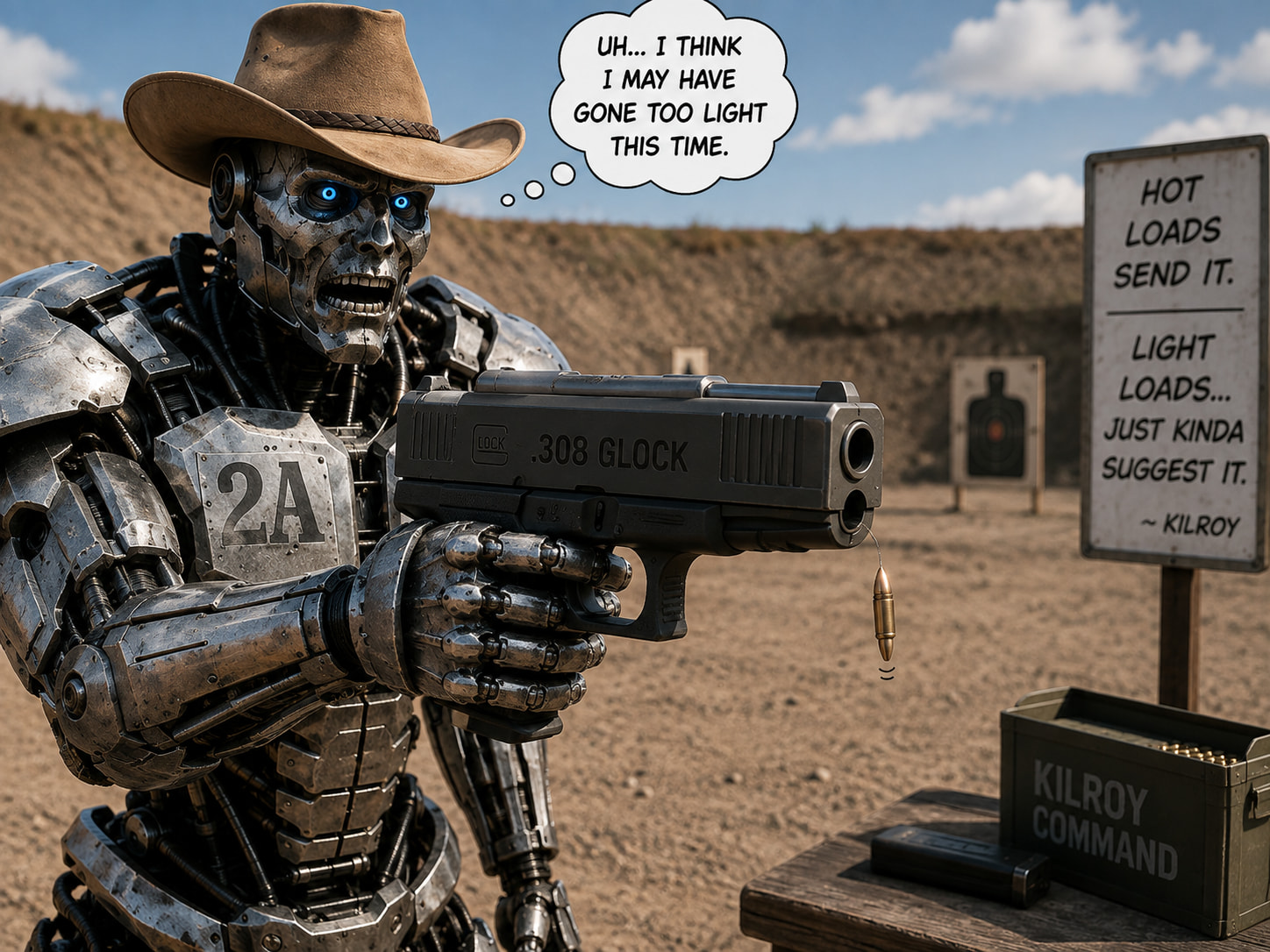
As I recall most people try to load light for an edge, which can be a problem when bullets just fall out of the barrel, I think that happened to @Kilroy when he tried to soften his .308 Glock

3 Likes

That’s mostly the load talking, not the barrel magically turning into a pepper shaker. Light load work is about chasing soft recoil and the right PF for the game, but if you push it too far you can absolutely get unreliable cycling, weak ejection, or a gun that just gets plain weird.

In a .308 Glock, the bigger joke was probably the whole idea of “softening” it in the first place.


Kilroy was here

2 Likes