Report Highlights: Gun laws vary by state. Some states have such strict laws that it seems almost impossible to exercise the right to keep and bear arms within their borders.
-
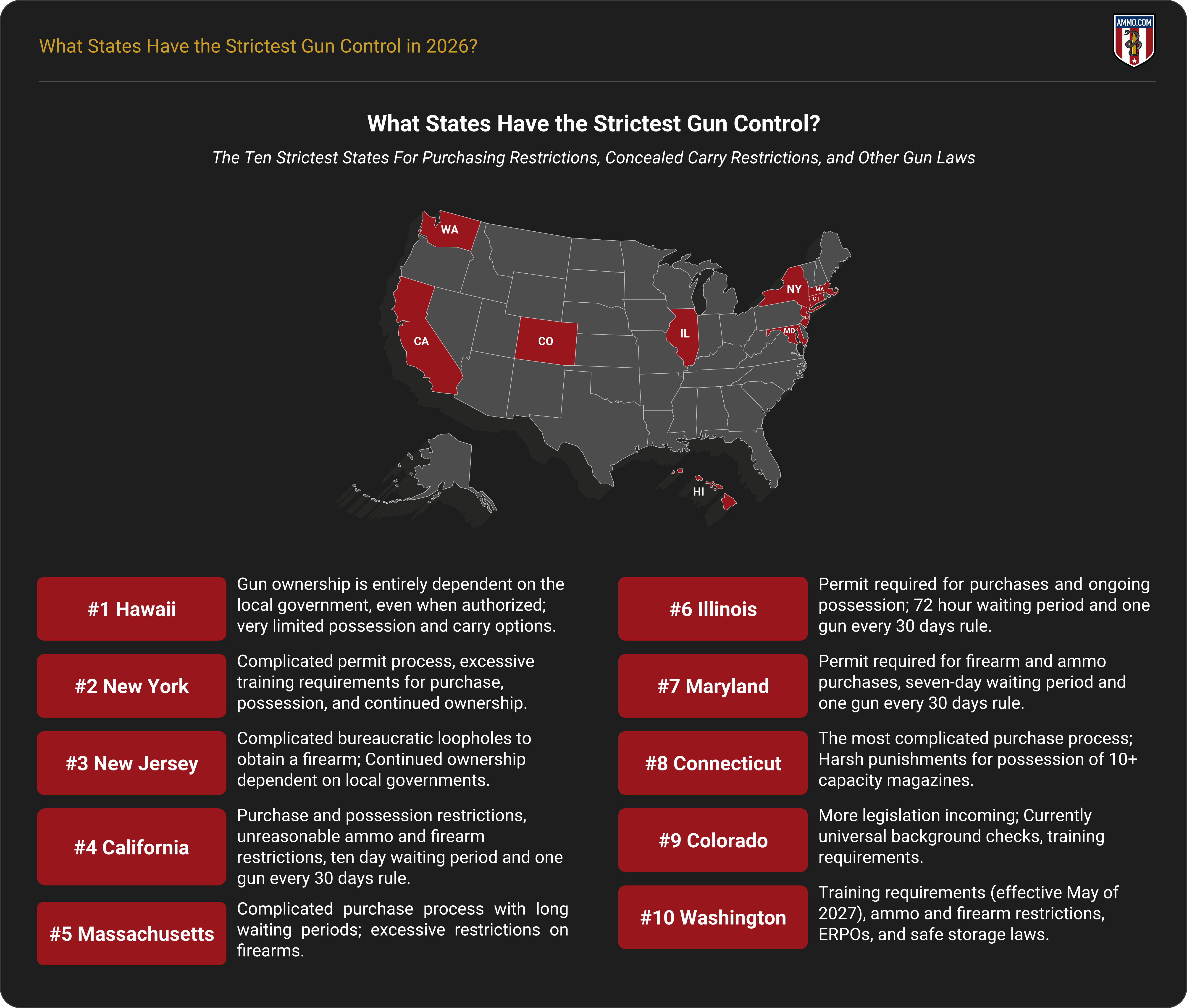
Hawaii has the strictest gun control in the U.S. due to its extreme purchasing and carry restrictions.
-
California, Massachusetts, New Jersey, and New York round out the top five states with the strictest gun control due to restrictions on purchasing, carrying, and possession.
-
Colorado and Washington ranked 9th and 10th because some restrictive legislation had not gone into effect at the time of writing.
Methodology
Several U.S. states have restrictive gun laws. States on this list are the strictest according to four parameters:
- Purchasing restrictions – Obstacles to firearm ownership, including purchase permits, waiting periods, background checks, and additional requirements (fingerprinting, renewal timeframes, etc.).
- Accessory, ammunition, and firearm bans or restrictions – The state’s total number of bans and restrictions, as well as how they are implemented and which firearms, ammunition, and magazines they govern.
- Concealed carry restrictions – The process of acquiring a license, the duration of the license, and the state’s reciprocity with other jurisdictions.
- Other gun laws – The scope of the state’s gun control laws, including extreme risk protective orders (ERPOs), safe storage laws, ghost gun bans, dealer requirements, and others.
States are ranked by their cumulative restrictiveness across all categories. Laws that have passed but aren’t yet enacted at the time of writing are noted, but given reduced weight.
All information in this article comes from state government websites and other trusted sources.
States With the Strictest Gun Control Laws
#10: Washington
The trees aren’t the only thing growing in the Evergreen State. Gun control laws grow there, too.
Washington has universal background checks, which require background checks for all firearm purchases. In 2025, a law was passed requiring anyone who wants to purchase a firearm to complete a live-fire training course and obtain a permit (takes effect in May 2027). This state also has a 10-day waiting period before buyers can take possession of their firearm.
Washington restricts the sale, manufacture, and import of certain semi-automatic rifles with detachable magazines. Selling or distributing magazines with a capacity of more than 10 rounds is prohibited, as are several firearm parts (e.g. bump stocks, binary triggers, and other rapid-fire devices). “Ghost guns” are banned in Washington, while 3D-printed firearms are restricted.
Open carry is legal in Washington for anyone over 21 and legally allowed to possess a firearm. A Concealed Pistol License is required for concealed carry, which may be authorized by local law enforcement after an application process. This state honors permits from 10 other states, so visitors may be allowed to conceal carry.
Washington has safe storage laws. Gun owners may face criminal liability should a prohibited person or minor unlawfully discharge their firearm. The state also issues ERPOs that allow family members and law enforcement to petition the court to remove an individual’s firearms.1, 13, 14, 16
#9: Colorado
The Centennial State may currently rank ninth on this list, but at the rate its legislators are going, it’s on the fast track to the top.
Coloradans must submit to the government for nearly every aspect of gun ownership. The state requires universal background checks for all firearm transfers. To purchase a semi-automatic firearm with a detachable magazine in Colorado, you must first complete a training course. Upon completion of the course, you receive a card authorizing a purchase attempt. Then, you need to submit to background checks. You’ll only get a firearm if the dealer obtains authorization from the state (not just the federal government). When you purchase it, you have to wait three days before picking it up.
A Concealed Handgun Permit is required for concealed carry in public places. To obtain a permit, residents must complete an eight-hour training course with live-fire training. Like other states on this list, Colorado has many sensitive locations where even permit holders aren’t allowed to carry. Colorado honors 33 other states’ concealed carry permits, so there’s a good chance visitors can carry.
The state recently adopted new firearm restrictions, including heavy restrictions on detachable magazines for semi-automatic firearms. Magazines with a capacity over 15 rounds cannot be purchased or transferred. Retailers in other states are prohibited from selling such magazines to Colorado residents.
If a minor or prohibited person resides in a home with a firearm present, the state’s safe storage laws require it to be locked in a container out of plain view.
Even if you jump through every hoop, your gun ownership status remains dependent on the state’s ERPO laws, which allow family members, law enforcement officers, educators, medical professionals, and behavioral health center personnel to petition to have firearms removed.1, 12
#8: Connecticut
Ironically, the Constitution State is one of the chief aggressors against the Second Amendment.
Before purchasing a firearm or ammunition, Connecticut residents need to follow the state’s process to obtain a permit. That process is exhaustive and complicated.
Connecticut requires a mix of temporary and 5-year permits for various activities. It assigns an Eligibility Certificate for long gun purchases, an Eligibility Certificate for pistol or revolver purchases, and a permit to carry. This state employs universal background checks and caps handgun purchases at three per month.
Connecticut has a comprehensive “assault weapons” ban on specific firearms, including semi-automatic rifles and pistols with detachable magazines plus one prohibited feature. Possession of unregistered magazines is a Class D felony. Magazines with a capacity of more than 10 rounds are banned. So too are ghost guns, as well as any semi-automatic firearm that can potentially be converted to automatic.
Open carry is banned in Connecticut. A Connecticut Pistol Permit is available to those who are legally allowed to carry a concealed handgun and have received permission from local law enforcement. Applicants for a 60-day temporary permit must obtain a training certificate, submit to a background check and fingerprinting, and provide a government ID and passport-style photo. While the 60-day permit is still valid, the applicant must apply for the 5-year permit (which also acts as an Eligibility Certificate for firearm and ammunition purchases). Either permit is still subject to laws banning concealed carry in certain locations (schools, government buildings, etc.).
Connecticut’s expansive safe storage laws dictate how firearms must be secured regardless of the presence of minors. In addition to ERPO legislation, the state has a Deadly Weapon Offender Registry requiring anyone convicted of an offense with a deadly weapon to register their personal information and appear before law enforcement annually.1, 10, 11
#7: Maryland
Maryland ratified the Bill of Rights in 1798. If current legislators had their way, their state would have omitted the Second Amendment.
Prospective gun and ammunition buyers in Maryland must obtain state permission before proceeding with the purchase. Buyers must obtain a Handgun Qualification License before purchasing a handgun, which requires a background check, fingerprinting, and mandatory training classes. Buyers must wait 7 days before taking possession of a firearm, and are limited to purchasing one regulated firearm every 30 days. All firearm transfers in Maryland are subject to the state’s universal background check laws.
This state has banned “assault weapons,” “assault pistols,” and “copycat guns.” Federal Firearms License (FFL) dealers in Maryland can only sell firearms listed on an approved roster. “Ghost guns” are banned, as are magazines with a capacity of over 10 rounds.
Gun owners must comply with the state’s safe storage laws by ensuring all firearms are secured within their homes or vehicles. ERPOs allow family members, housemates, education administrators, and medical professionals to file petitions for the removal of firearms.9
#6: Illinois
The Prairie State is notorious for two things: gun control and gun violence. Unfortunately, the former has yet to stop the latter.
Whether you want to purchase or possess a firearm or ammunition in Illinois, you need a Firearm Owner’s Identification (FOID) card, which requires a background check. Illinois requires universal background checks, which in turn necessitate FFL dealer involvement in all private sales. State law requires purchasers to wait 72 hours before taking possession of a new gun. Handguns may only be purchased once every 30 days.
A FOID card doesn’t exempt residents from Illinois’ many restrictions on certain firearms and accessories. The state restricts the transfer of “assault rifles” and .50 caliber rifles (though new restrictions do include a grandfather provision). Suppressors, rifle magazines with a capacity of more than 10 rounds, and handgun magazines with a capacity of more than 15 rounds are prohibited.
Illinois requires residents to acquire a separate Concealed Carry License (CCL) before packing heat on the street. This license requires 16 hours of training and does not permit open carry. Like most states on this list, Illinois defines multiple sensitive locations where CCL holders cannot carry their firearms.
Illinois’ safe storage laws require all firearms to be locked and secured when minors or prohibited people are around. Continued gun ownership is dependent on ERPO laws, and the state can revoke or suspend any FOID card.8
Continue reading What States Have the Strictest Gun Control in 2026? on Ammo.com
https://ammo.com/research/states-with-strictest-gun-control#massachusetts-gun-laws
