Report Highlights
Mass shootings in the U.S. are preventable attacks. The attackers often show signs of distress and exploit key security failures.
-
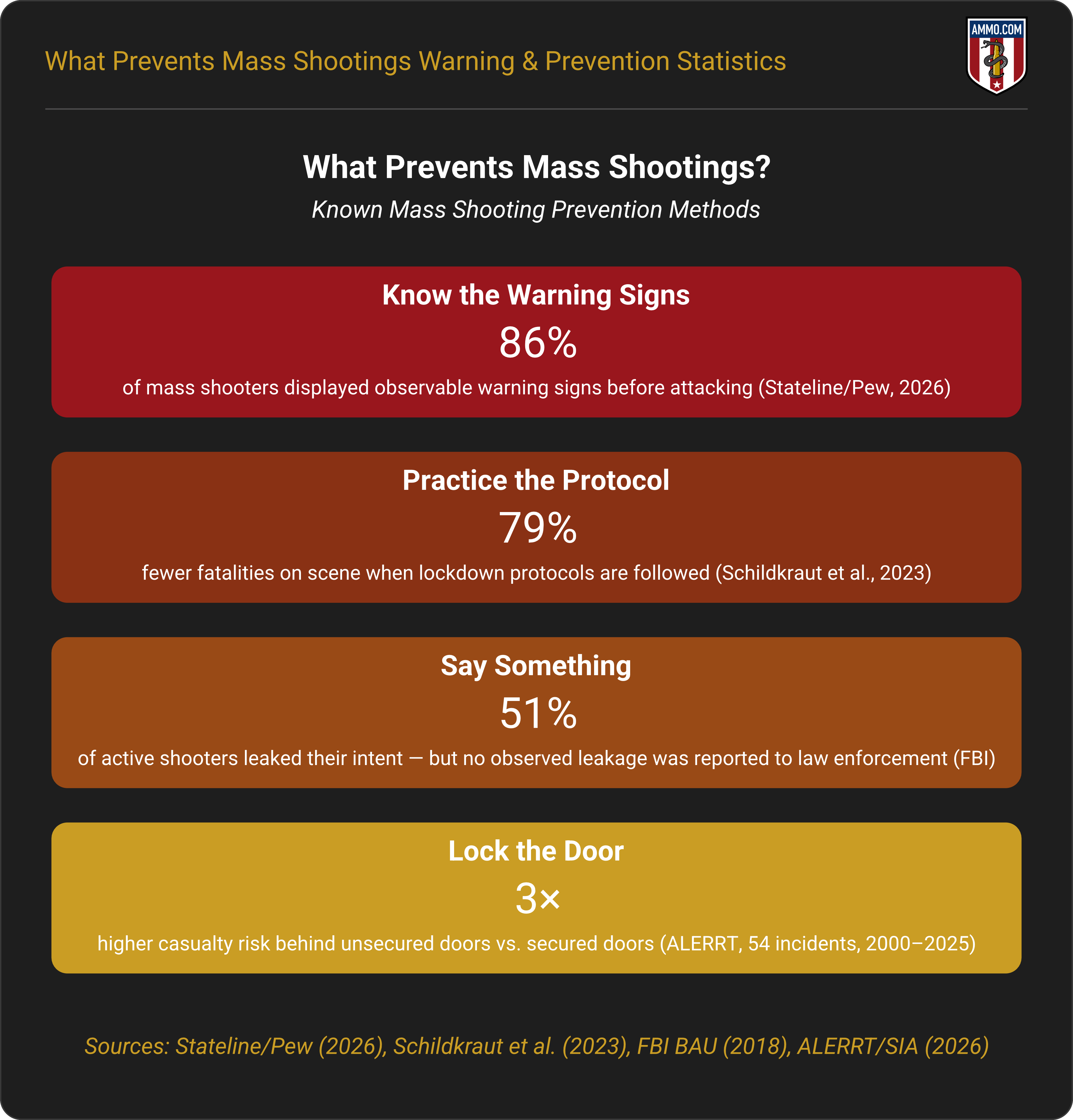
Between 1999 and 2024, 86% of attackers displayed observable warning signs before the attack.
-
When followed and supported by security infrastructure, lockdowns during mass shootings resulted in 79% fewer fatalities on scene, 63% fewer deaths overall, and 59% fewer casualties (including injured).
-
Despite there being an estimated 500 million firearms in the U.S. and inconclusive evidence on the effects of gun control on mass shootings, these attacks are being stopped through civilian reporting, awareness, and intervention.
What Prevents Mass Shootings?
Mass shooting prevention requires a variety of interventions, including identifying, reporting, and taking appropriate actions. Most mass shooting and school shooting research is reactionary. However, preemptive reaction to key indicators preceding nearly every active shooter case could have prevented shots from ever being fired.
Warning Signs and Intervention
The FBI identified 160 active shooter incidents in the United States between 2000 and 2013, defining an active shooter as one or more individuals actively engaged in killing or attempting to kill people in a populated area. A follow-up study examined 63 of those shooters in depth. Among them, 88% of active shooters age 17 and younger leaked their intent to commit violence, while 51% of adult active shooters did the same. 1, 16
Most shooters spent time planning an attack. In the 34 cases where the time spent planning could reasonably be determined, more than a quarter (26%) spent one to two months planning their attacks, while only 12% spent less than 24 hours doing the same. 1
According to the United States Secret Service (USSS) Averting Targeted School Violence report, which analyzed 67 averted plots involving 100 student plotters, plotters in the majority of instances (70%) exhibited between two to four observable planning behaviors. Weapons-related planning accounted for the most prominent planning behavior (85%), followed by planning how to execute the attack (73%), documenting plans (57%), and researching prior attacks (31%). 3 A review of mass shootings between 1999 and 2024 suggests that 86% of mass shooters displayed observable behaviors before the attack. 12
Identifying the warning signs and intervention alone do not prevent all mass shootings. However, there is evidence that awareness and reporting can save lives. Sandy Hook Promise’s Say Something program has reportedly prevented 19 school shootings since its inception in 2016. 2
Did Anyone Know Before a School Shooting?
According to a USSS report released in 2021, plotters shared their plans to attack with others before 94% of averted school violence events. The plotters were most likely to communicate intent to friends, classmates, or peers (69%), followed by adults (19%). 3
How Did They Get Their Gun?
The Violence Project and National Institute of Justice examined 172 mass shootings (i.e. 4+ innocent civilians killed unconnected to family or gang violence) from 1966 to 2019. Of those with firearm acquisition details available, 77% of shooters legally purchased at least some of the firearms used. 4
Similarly, the Mother Jones database lists 160 mass shootings (i.e. 3+ victims killed in an indiscriminate event excluding conventionally motivated crimes) between August 1982 and May 2026. Of those, the shooters’ method of firearm acquisition was listed in 71 events. Purchasing from a retail source was the most common acquisition point (51 incidents), followed by theft (6) and acquisition from family members (5). 5
In three incidents, attackers acquired their firearms from mixed sources (stolen/purchased from retailers), while firearms issued by the National Guard or a local sheriff’s department were used in two. Firearms were rarely purchased from gun shows or online (2) and from individuals in private sales (2). In one event, the attackers received their firearms through a third-party source (straw purchase). In another, the attacker built the weapon used in the shooting. 5
In a USSS review of 67 averted school attack plots, one or more plotters had potential access to at least one weapon in 76% (51) of cases. Firearms specifically were within reach in 43 cases (64%). These attacks were foiled before the plotters could act, but in 30 of those 43 cases (70%) the plotter had access to a family member’s firearm in the home, and in 27 (63%) that access was unimpeded. Firearms were locked in a gun safe or other access-controlled location preceding 13 averted attacks, but plotters still managed to gain access in seven cases. 3
Behavioral changes
Most mass shooters and plotters exhibit concerning behaviors in the years and days leading up to an attack. In an FBI report covering active shooter incidents from 2000 to 2013, shooters displayed an average of four to five observable concerning behaviors. These behaviors consist of mental health issues, problematic interpersonal interactions, and leakage (communicating intent). 1
Between 1966 and 2025, 81.2% of mass shooters (4+ victims killed unconnected to family or crime-related violence) exhibited behaviors consistent with a mental health crisis before carrying out an attack.
The Mother Jones database listed 160 mass and spree shooters between 1982 and 2026. Of those, 51% had a prior history of mental illness, 11% showed no prior signs of mental illness; 39% of shooters’ mental illness histories were not listed. 5
For a closer look at who carries out these attacks, see our analysis of the average age of mass shooters.
Continue reading What Prevents Mass Shootings? Warning & Prevention Statistics on Ammo.com