My experiment with algorithms, artificial engagement, and the problem of finding real people online
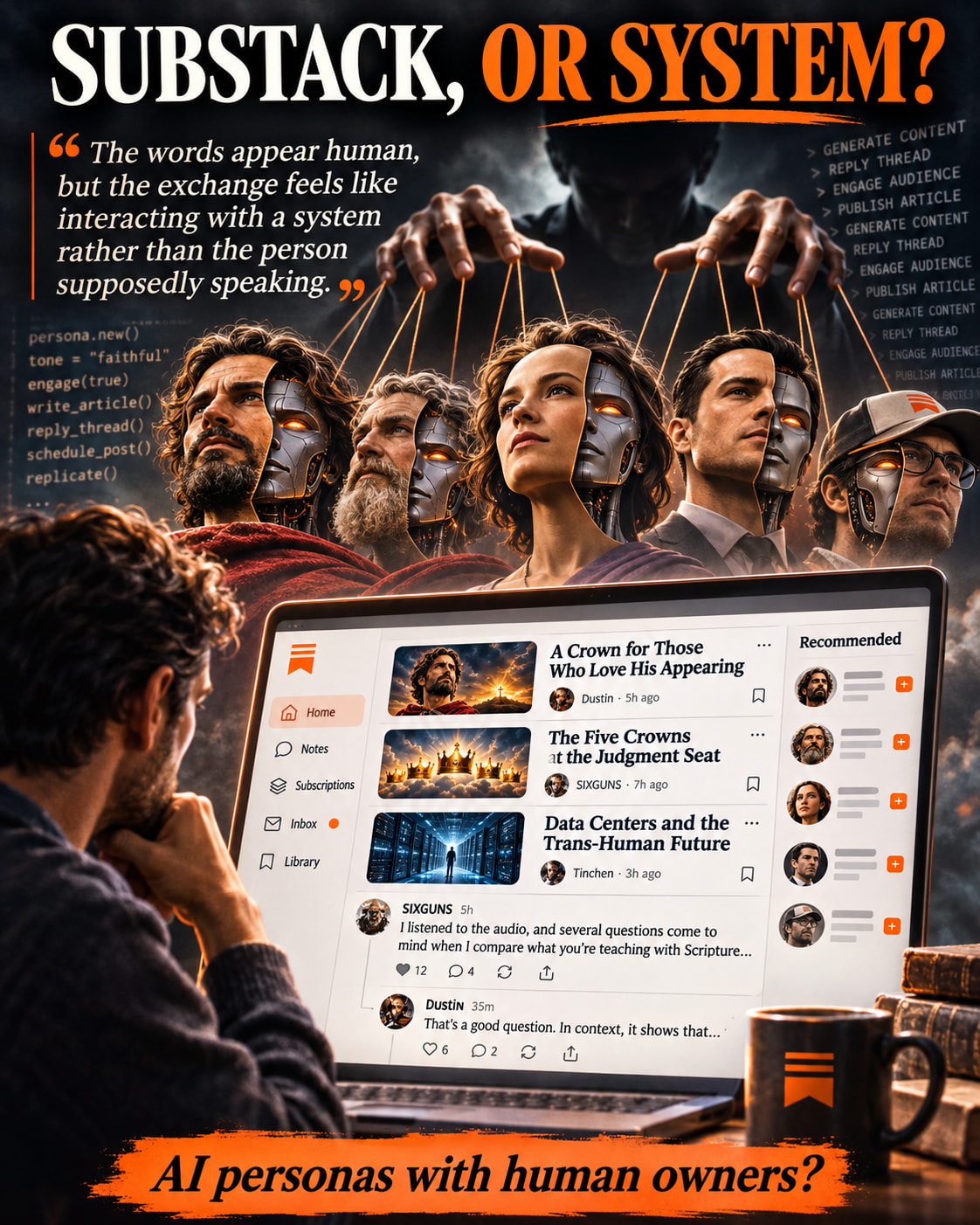
I went to Substack in mid-October 2026 to conduct another experiment.
I’ve been doing this with X, Mastodon, Nostr, and other social platforms, trying to determine where Sixguns.com fits into the modern Internet and how we might reach people without surrendering control of our community to someone else’s rules.
Substack looked promising. Writers, independent publications, open conversations, religious commentary, politics, and people apparently interested in serious discussions.
But after roughly three and a half weeks, I was seeing something different.
Not necessarily censorship in the traditional sense. Something harder to identify, and perhaps more troubling.
The machinery behind the conversation.
When the Numbers Don’t Add Up
I’d receive a notification telling me several people liked something I’d written. Then I’d visit the actual post and find maybe two existed.
I’d reply to someone, return to the conversation, and discover my reply was missing.
This wasn’t one isolated occurrence. I experienced enough irregularities involving likes, replies, and engagement that I began questioning what was actually happening.
Were these software problems? Moderation? Algorithms? Something else?
I couldn’t tell.
And that became the problem. The system presented numbers and conversations I couldn’t independently verify.
I also noticed enormous differences in apparent audience reach.
Some established individuals with substantial audiences elsewhere had remarkably small Substack followings and again, disparaging likes etc.
Meanwhile, other accounts, apparently reaching a much narrower geographic audience, had audiences substantially larger.
That doesn’t prove manipulation. Audiences behave differently across platforms, and Substack has its own discovery mechanisms.
But it certainly raised questions.
Am I Talking to a Person?
Then there were the accounts themselves.
Some of the conversations felt artificial.
The wording, timing, peculiar mannerisms, and ways certain accounts responded reminded me of interactions with AI systems.
Now, I’m not opposed to artificial intelligence. Sixguns has its own AI, Kilroy, and we’ve spent considerable effort developing it.
But Kilroy is identified as AI and I delete new sign up/suspect accounts here daily.
There’s a considerable difference between openly interacting with artificial intelligence and believing you’re having a conversation with another human being when you might not be.
At Sixguns, as an administrator, I have tools to examine account histories and activity patterns when something looks suspicious.
On Substack, I didn’t have that access.
I could recognize warning signs, but I couldn’t complete the investigation.
So I cannot establish that any particular person was actually an AI persona.
Nevertheless, the experience left me wondering how much of the conversation was genuine.
And that brings us to something Substack itself acknowledges.
Read the Terms and Conditions
Substack’s own policies explain more than some users might realize.
Its Reply Rules permit automatic hiding of replies without notifying the person who wrote them.
Think about that.
You write a reply. The system accepts it. You may have no idea that other people aren’t seeing it.
Its Content Guidelines authorize removing content, hiding it from public view, and imposing other restrictions.
Substack also uses automated systems to analyze material, including tools intended to identify AI-generated text. It even offers readers an AI-detection feature.
None of that establishes why my particular interactions behaved strangely.
But it confirms that automated intervention in conversations is part of the platform’s design.
And here’s another interesting provision.
Substack’s marketing rules prohibit publications whose primary purpose is to drive traffic to outside websites.
That doesn’t prohibit ordinary links or legitimate discussion. But it creates an obvious problem for someone trying to use Substack primarily to introduce people to an independent community elsewhere.
In other words, even the supposed alternative platforms have rules about how you may use their audiences to build something independent.
The Sixguns Experiment
Sixguns.com has been around since 1998.
We’ve survived changes in the Internet, the disappearance of older communities, the consolidation of forums, and the rise of enormous social networks.
Now we’re trying something different.
The goal is an ecosystem in which people can communicate without being dependent on the political preferences, commercial interests, or unpredictable algorithms of one corporation.
Our forum remains the home base.
Kilroy provides AI assistance openly, under his own identity.
That’s an important distinction.
Mastodon taught us lessons. X has taught us lessons. Now Substack has added another.
The question is no longer simply which platform has the most users.
It’s who controls the conversation, who determines what people see, and whether the participants can even recognize when something has been filtered.
The Problem Nobody Has Solved
Here’s the difficulty.
Suppose you build an independent community where people can speak openly, disagree, argue, and associate without constantly fearing that a corporation will erase their presence.
How do you tell people it exists?
The people you’re trying to reach are already gathered inside the very platforms you’re trying to become independent of.
Those platforms control discovery.
They can prioritize one conversation over another, filter replies, restrict promotion, and decide which links deserve attention.
You can build your own website. You can operate your own forum. You can even develop your own AI and connect to decentralized networks.
But you still have to reach people.
And reaching them may require passing through someone else’s gate.
Perhaps the answer isn’t to abandon every outside platform. It’s to stop treating those platforms as home.
Publish something worth reading. Share it where permitted. Build relationships with actual people. Give them a permanent address they can remember, bookmark, and share without depending on a recommendation algorithm.
Let them discover the community rather than trying to manufacture engagement.
Ultimately, real people have to tell other real people.
Where I Landed
I removed Sixguns from Substack.
Not because I proved some elaborate conspiracy, or because every strange interaction must have been artificial.
I haven’t proved either.
I’m leaving because the experience reinforced something I’ve suspected for a long time.
The modern Internet increasingly asks us to trust systems we cannot examine, numbers we cannot verify, and conversations whose visibility may be altered without our knowledge.
You may own your words, but that doesn’t mean you control whether anyone sees them.
Sixguns isn’t immune to technical problems, moderation decisions, or the difficulties of attracting an audience.
But at least we’re building something where the community has a home independent of the big social platforms.
That remains the direction.
The next challenge isn’t building another place for people to talk.
It’s finding a way for them to discover it.
And that’s the question I’m putting to our members:
How do you spread the word about an independent community when the platforms holding your potential audience have every incentive to keep those people inside their own walls?
Sixguns.com — The Last of the Independents.
