Report Highlights: Stolen guns often end up in the hands of felons and criminals. Many are never recovered.
- Fewer than 1% of civilian-owned firearms (approximately 200,000 to 380,000) are stolen in the U.S. each year.
- An estimated 40% of firearms stolen in 2022 were taken from vehicles.
- Of the nearly 230,000 firearms trafficked between 2017 and 2021, 60% were delivered to a convicted felon.
Related Studies: Concealed Carry Crime Stats, Gun Violence Statistics, Easiest States to Buy a Gun
For a comprehensive list of our sources, please refer here.
Methodology
This report draws on data from a variety of sources to examine stolen firearms and their relationship to crime in the U.S.
The Bureau of Alcohol, Tobacco, Firearms and Explosives (ATF) traces firearms in the U.S., including stolen guns. The Bureau of Justice Statistics (BJS) provides self-reported data on how criminals obtain firearms. The National Crime Victimization Survey provides survey-based estimates on gun theft victimizations.
The Federal Bureau of Investigation (FBI) tracks reported crimes (including gun thefts), which are used to examine relationships between the theft and criminal activity. Some local sources were used to examine risk factors for stolen guns.
Reporting and definition issues create limitations in examining the relationship between crime and stolen guns. Civilians in most states are not required to report gun thefts, and law enforcement agencies do not always report stolen gun recoveries.
How Many Guns Are Stolen in the U.S.?
Approximately 200,000 to 380,000 firearms are stolen annually in the U.S. Higher estimates account for unreported firearm thefts, while lower estimates include only reported losses. 1, 2, 3
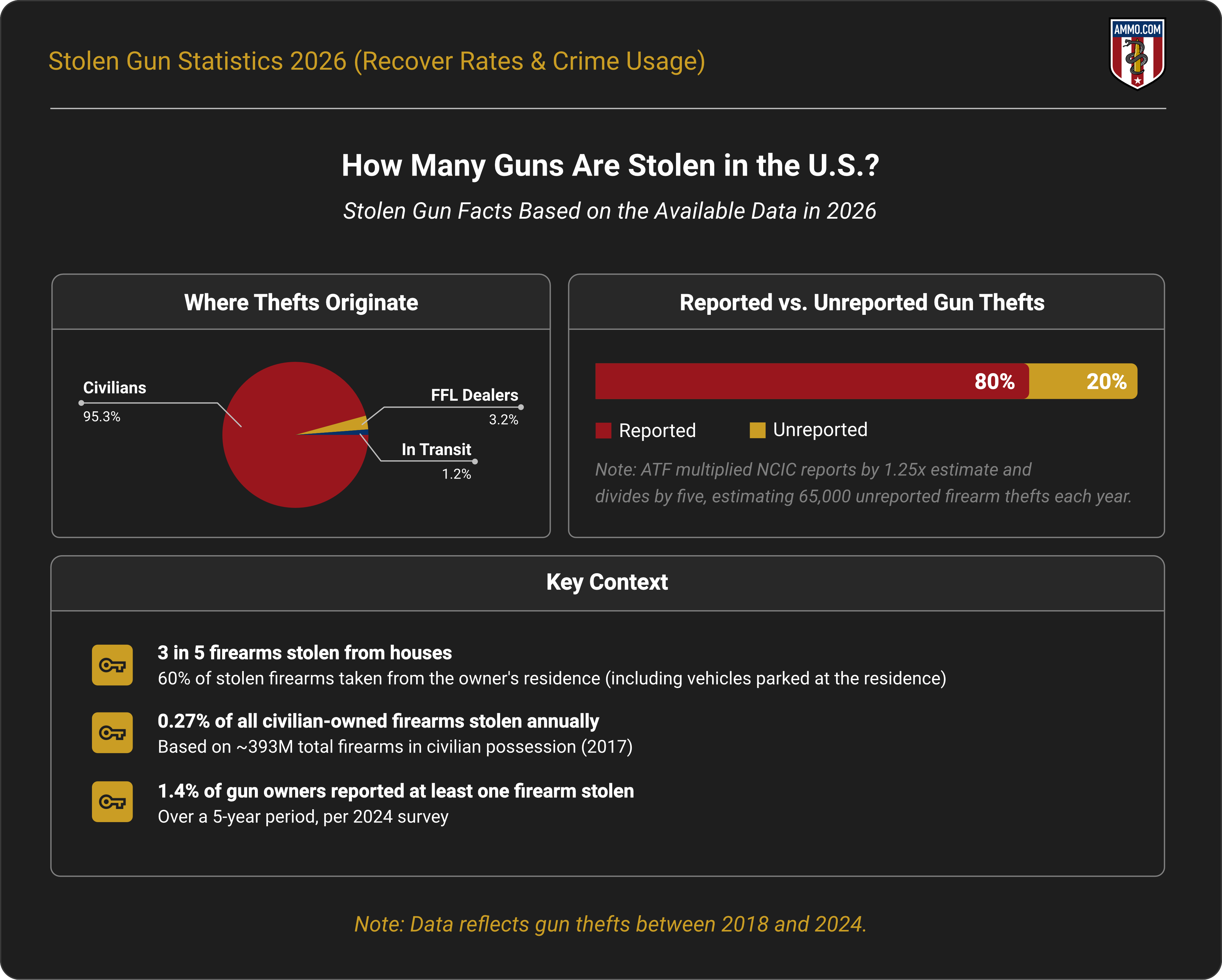
According to the ATF, 1,062,970 firearms were stolen between 2019 and 2023. Of those, 95.3% (1,013,964) of firearms reported stolen were taken from civilian gun owners, 3.2% (28,971) were stolen from federal firearm licensees, and 1.2% (20,035) were stolen while in transit. 1, 10
According to the ATF, a total of 1,074,022 firearms were reported stolen in the U.S. between 2017 and 2021. A 2017 survey on total guns in the U.S. suggested there were 393,347,000 firearms in civilians’ possession in the U.S., which implies that 0.27% of all firearms were reported stolen that year. 1, 4
The ATF’s estimate of 266,000 firearms stolen annually accounts for underreporting. To reach this figure, the ATF multiplied thefts reported to the FBI’s National Crime Information Center by 1.25. In doing so, the bureau estimates that roughly 66,500 firearms are stolen from private citizens each year, but go unreported to law enforcement. 1, 2
A survey-based 2017 study suggested that between 250,000 and 380,000 guns are stolen in the U.S. each year. Of the 1,604 respondents in the survey, 2.4% stated one or more firearms had been stolen from them in the past year. 5
A survey-based 2024 study covering five years suggested that 1.4% of gun owners had at least one firearm stolen. Three-fifths of respondents stated that their firearms were stolen from their homes. Only 28% reported having recovered their stolen firearms. 6
Stolen Guns Used in Crimes
The relationship between stolen guns and crime is difficult to quantify. Not all stolen firearms are reported to law enforcement, and not all law enforcement agencies track stolen guns used in crimes.
The ATF estimates that 266,000 guns are stolen each year, while the FBI recorded 1,221,345 violent crimes in 2024. Theoretically, that represents enough firearms to arm one out of every five violent offenders. However, research suggests that criminals rarely steal guns to commit crimes. 1, 9
A survey published by the BJS in 2016 stated that 6% (17,244) of prison inmates who used guns during the commission of their crimes had stolen them. In all, 43.2% of criminals who used a firearm in the commission of a crime purchased it from an underground dealer. 7
A 2018 report analyzed the relationship between guns and crime in Chicago. The findings indicated that while less than 1% of firearms are stolen annually, only 3% of crime guns recovered were reported stolen. Additionally, there is only a 20% chance that a stolen gun will be recovered. 8
Cars and Stolen Guns
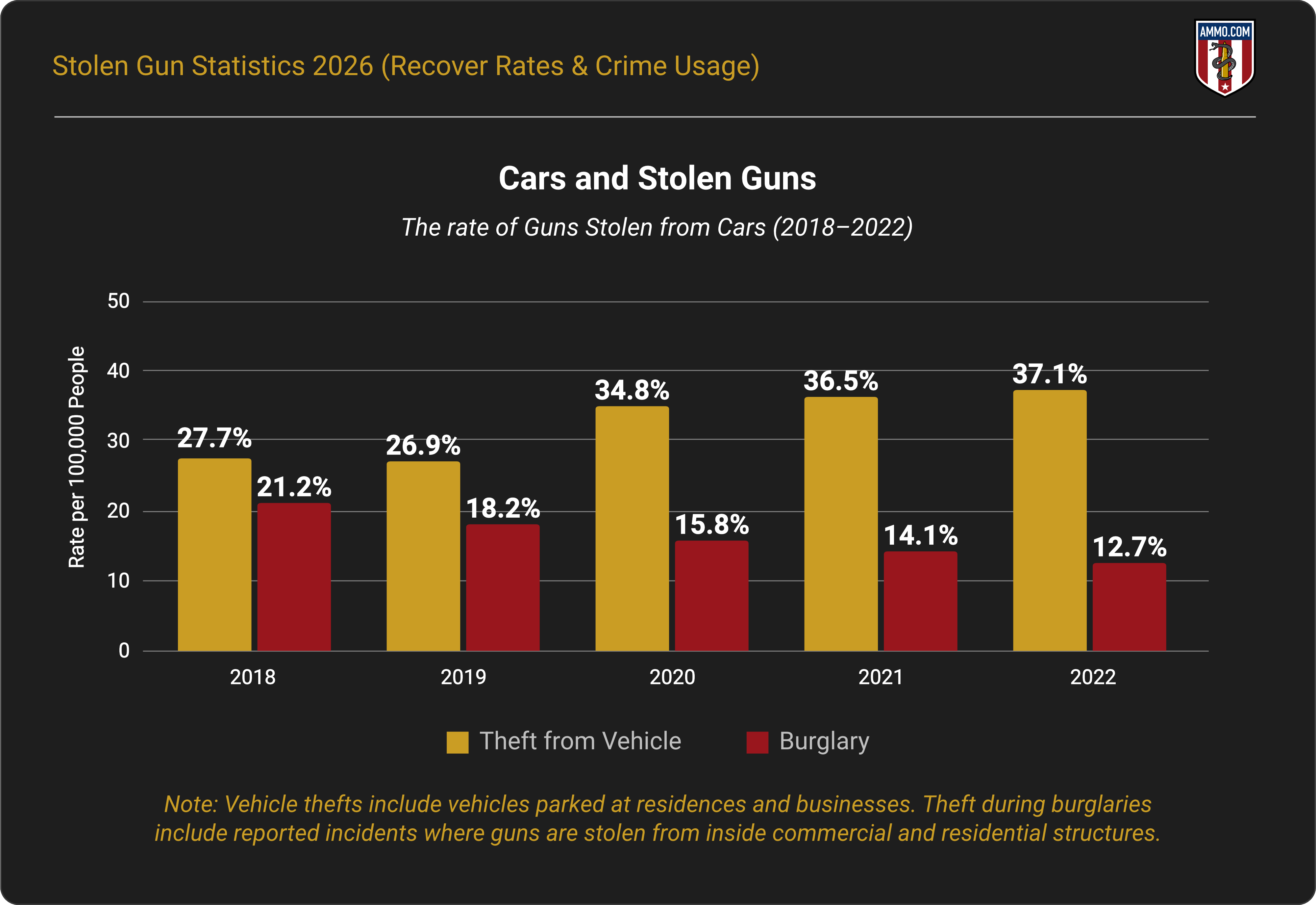
According to the Council on Criminal Justice, approximately 40% (30,906) of 77,089 guns reported stolen were taken from vehicles between 2018 and 2022.
Reported gun theft incidents involving cars increased from 28 per 100,000 in 2018 to 37 per 100,000 in 2022. Over the same years, reported gun thefts during residential and commercial burglaries declined from 21 per 100,000 to 13 per 100,000 people. 11
Reported gun thefts from vehicles increased at greater rates in urban areas than rural ones. Most guns (12,193) were stolen from vehicles parked at private residences in 2022. Parking lots and parking garages had the second highest total of guns stolen (9,423) from vehicles, while restaurants and bars had the lowest (1,305). 11
Some jurisdictions issued reports in 2025 suggesting similar increases in the number of firearms stolen from vehicles. Davidson County, Tennessee’s sheriff’s department reported that 843 guns were stolen from vehicles between January and August of 2025. The same report states that 74% of reported stolen guns in the county were taken from vehicles, totalling approximately 1,139. 12
The Wichita Police Department in Kansas issued a report stating that 118 guns were stolen from vehicles between January and June of 2025. This report shows an increase in gun thefts from vehicles over previous years. In a 2023 report, the same department stated that 49% of the 612 guns reported stolen between January and September were taken from vehicles. 13
Continue reading Stolen Gun Statistics 2026 (Recover Rates & Crime Usage) on Ammo.com
https://ammo.com/articles/stolen-gun-statistics#crime-guns-obtained-illegally