Report Highlights: For decades, Americans have had to choose whether to exercise their Second Amendment rights or use marijuana for pain management and ailments. That legal landscape is finally shifting.
-
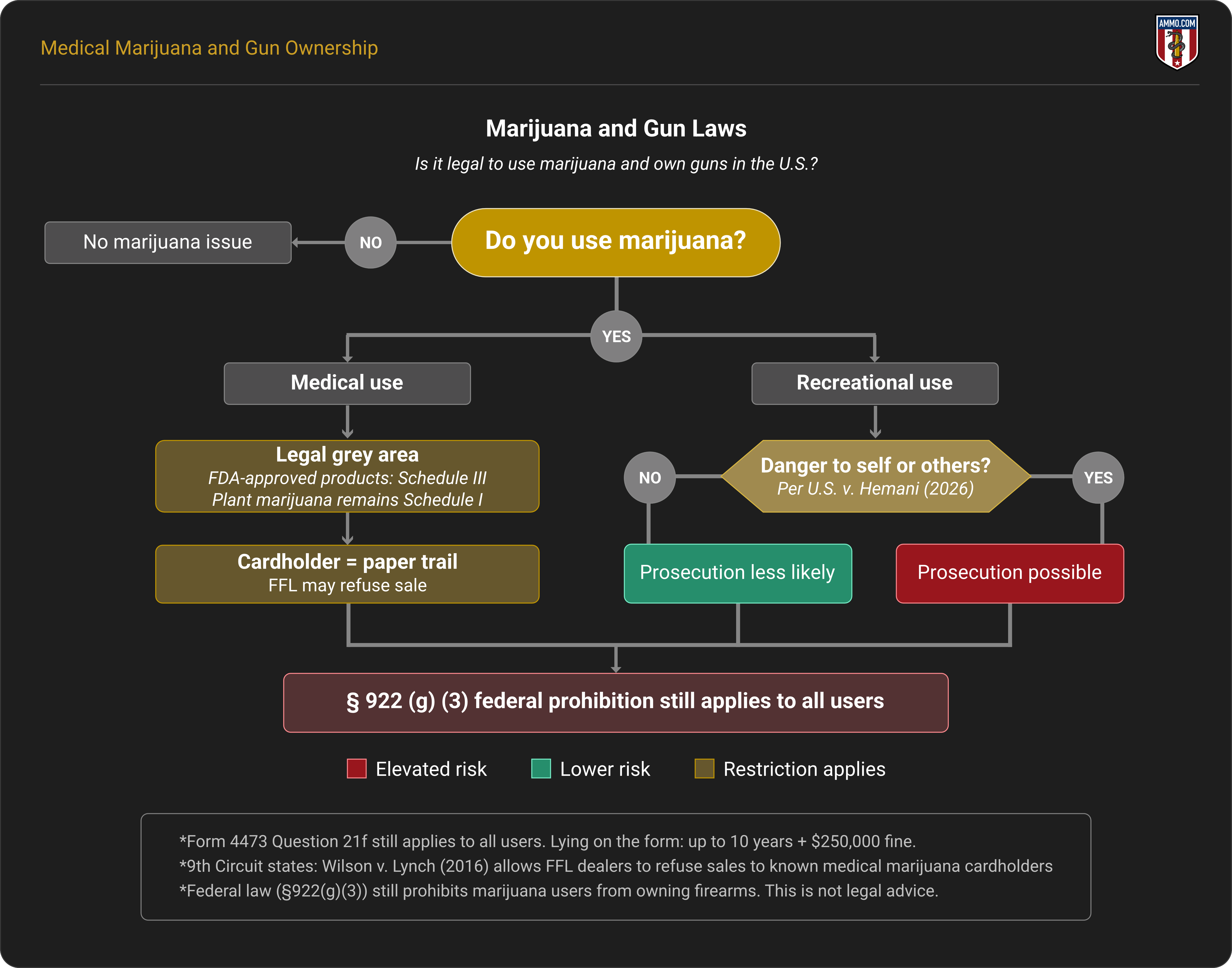
Federal law prohibits medical marijuana and recreational marijuana users from purchasing and possessing firearms.
-
The Supreme Court held that occasional marijuana use alone does not grant the federal government the authority to infringe upon the Second Amendment rights of Americans.
-
The ATF is relaxing restrictions on the Second Amendment, while the FDA is relaxing restrictions on cannabinoids and marijuana products.
What Is the Law Regarding Guns and Marijuana?
Initially passed in the 1968 Gun Control Act and expanded upon to include prohibited persons over the years, 18 U.S.C. 922 § (g)(3) prohibits anyone who unlawfully uses a controlled substance, as defined by the Controlled Substances Act, from owning firearms. It’s not specific to marijuana. It includes every controlled substance. However, marijuana is worth talking about specifically because of its quasi-legal status, including in a number of relatively gun-friendly states such as Arizona, New Hampshire, Texas, and Wyoming.
Despite the unanimous (9-0) Supreme Court ruling in favor of a young man who was prosecuted for owning a pistol while admitting to occasional marijuana use (U.S. v. Hemani 2026), it is still technically illegal to use marijuana and own guns.
If you’ve ever filled out a Form 4473, you’re familiar with Question 21f: “Are you an unlawful user of, or addicted to, marijuana or any depressant, stimulant, narcotic drug, or other controlled substance?” For decades, there was no ambiguity concerning medical or recreational marijuana use. The latest Supreme Court ruling narrows the scope slightly, but the bold warning underneath the question remains:
“Warning: The use or possession of marijuana remains unlawful under Federal law regardless of whether it has been legalized or decriminalized for medicinal or recreational purposes in the state where you reside.”
Regardless of what one thinks about marijuana, or the right of the federal government to regulate drugs or the internal laws of the various states, the fact remains: As of now, possession, sale, and cultivation of marijuana remain a federal offense. Recreational marijuana is a Schedule I drug in the same category as heroin. In April of 2026, FDA-approved cannabinoid and marijuana products were reclassified as Schedule III drugs.
18 U.S.C. 922 § (g)(3) is a particularly difficult issue for people who use medicinal marijuana for bona fide medical purposes, rather than as a sort of legal loophole to consume marijuana legally. Many people use medicinal marijuana for a variety of purposes, including relief from pain, Alzheimer’s symptoms, glaucoma, epilepsy, and a number of complications related to cancer, including nausea and lack of appetite. The science on this is rather conclusive, so much so that Big Pharma makes legal synthetic THC pills known as Marinol.
In United States v. Rahimi (2024), the Supreme Court held that the federal government may disarm “dangerous individuals.” The Hemani ruling slightly narrowed the scope of existing laws, which were once applied to all drug users, regardless of whether they were actually dangerous or not.
Continue reading Medical Marijuana and Gun Ownership: The Laws in 2026 on Ammo.com