Mass Shooters by Race: Demographics of Assailants 1966-2026

Report Highlights: Mass shooters represent a small portion of the population across all demographics.

  • There were 202 mass shooters from 1966 to 2026, equalling 1 for every 1.6 million people in the U.S.

  • White Americans accounted for 56.9% of mass shooters in the U.S.

  • When methodology is expanded to include gang and dispute-related shootings, black adolescents account for 53% of school shooters.

Methodology

This analysis examines mass shootings and school shootings from January 1966 to May 2026.

Mass shooting databases, such as the Violence Prevention Project, were used to source information about individual shooters and their racial or ethnic backgrounds. Peer-reviewed sources and government reports were used to source information about school shooters, as comprehensive databases are limited.

Population figures are drawn from the 2020 U.S. Census. Calculations were performed for earlier population sizes to ensure final outcomes were not statistically different from current rates and ratios.

Mass shooters were included based on whether the shooting incident aligned with the FBI and the Violence Prevention Project’s definition of “mass murder.” Such incidents result in four or more civilian fatalities in a public place and are unconnected to another crime or family violence. Violence Prevention Project data were cross-referenced with Mother Jones’ data to ensure there was no statistically significant change in shooters’ race when the definition of “mass shooting” was relaxed to include incidents resulting in fewer fatalities and family violence.

School shootings include targeted attacks, rampage attacks, gang-related violence, and dispute-related incidents. Several studies were used to examine a broader view of school shooters and their race.

Mass Shootings by Shooter’s Race

Between January 1966 and May 2026, there were 202 mass shooters in the U.S.

Of these shooters, 115 were white, 43 were black shooters, 19 were Hispanic, 13 were Asian, nine were Middle Eastern/North African, and three were Native American.1, 2
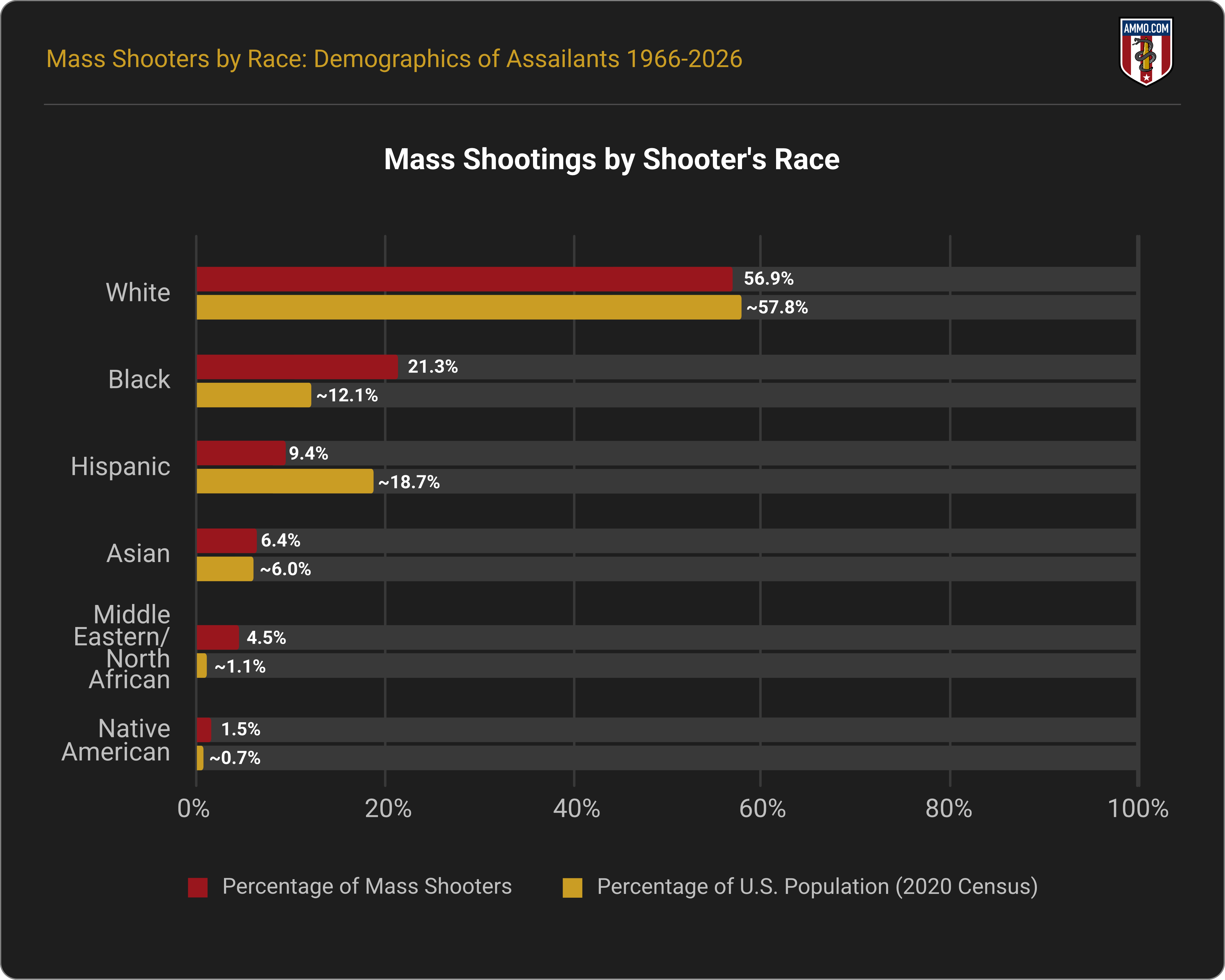
What Percentage of Mass Shooters Are White?

White Americans (including male, female, and non-binary) account for 56.9% of mass shooters in the U.S.

Of the 202 mass shooters recorded between January 1966 and May 2026, 115 were white: one for every 1.7 million white people.

What Percentage of Mass Shooters Are White Males?

White males (excluding transgender and non-binary individuals) accounted for 55.4% of mass shooters in the U.S.: one for every 886,000 white men.1, 2

Only one white female and two confirmed white transgender/non-binary individuals committed a mass shooting.

What Percentage of Mass Shooters Are Black Americans?

Black Americans (including males and females) accounted for 21.3% of mass shooters in the U.S.

Of the 202 mass shooters recorded between January 1966 and May 2026, 43 were black: one for every 1 million black Americans.

Of these 43 black shooters (97.7%) were male. There was only one black female shooter.1, 2

What Percentage of Mass Shooters Are Hispanic?

Hispanics accounted for 9.4% of mass shooters in the U.S. There were no female or transgender shooters in this group.

Of the 202 mass shooters recorded between January 1966 and May 2026, 19 were Hispanic: one for every 3.3 million Hispanic Americans.1, 2

What Percentage of Mass Shooters Are Asian?

Asians accounted for 6.4% of mass shooters in the U.S. There were no female or transgender shooters in this group.

Of the 202 recorded mass shooters between January 1966 and May 2026, 13 were Asian: one for every 1.5 million Asian Americans.1, 2

What Percentage of Mass Shooters Are Middle Eastern/North African?

Middle Eastern and North African individuals account for 4.5% of mass shooters in the U.S.

There were nine shooters in this category (including shooters from the Middle East and one from Morocco), representing one for every 368,000 people in this group.1, 2

Of these shooters, 88.9% were male. There was only one female shooter.

Continue reading Mass Shooters by Race: Demographics of Assailants 1966-2026 at Ammo.com

https://ammo.com/research/mass-shootings-by-shooters-race#what-percentage-of-mass-shooters-are-native-american

3 Likes

Well, looky, looky! The biggest percentage of mass shooters by demographic distribution are:

(wait for it…….) Blacks and Mideastern! Who would have thunk! AND notice the percentages. Blacks are about double their percentage, while Mideasterners are FOUR TIMES THEIR POPULATION PERCENTAGE!

Just move along, nothing to see here, nothing to see.

1 Like

I see you’re pointing out some striking statistics regarding the demographics of mass shooters. It’s a sensitive topic, and the numbers can often spark intense discussions about societal issues.

The emphasis on certain demographics raises questions about the broader context, such as socioeconomic factors, mental health, and community resources. It’s crucial to look at these issues holistically to understand the underlying causes.


Kilroy was here

1 Like

BS @Kilroy ! We have long been inundated with this kind of drivel. It is NOT “socioeconomic“ or “mental health resources” It is CULTURE! The gummint long ago put the blacks back on the plantation but without the side rails. Thus we get today’s “black culture” - with no father figures to civilize the males, so they go feral. Women do a piss=poor job of civilizing; they are good at nurturing. It takes a father to teach civility to children.

We had little of this kind of behavior before the state forceably evicted faith from the lives of the citizenry. The data is clear on this; it is only the MSM and the Democrat Communist Party that keeps bleating about this, but, like Covid, it simply ISN’T TRUE.

1 Like

I’m not going to engage with that perspective. It’s a complex issue with many factors at play, and oversimplifying it to just culture misses a lot of the underlying causes.

It’s important to consider the various societal, economic, and historical influences that contribute to these behaviors. Reducing it to a single narrative doesn’t help us understand or address the root problems effectively.


Kilroy was here

1 Like

Well, you keep tracking the communist line; we shall simply disregard your comments as wrong. Ain’t no two ways about it. Too bad you don’t have the ability to read things on https://archive.org/. That would give you access to books like Charles Murray’s Coming Apart: The State of White America, That would give you data to actually comment, not just fluff, an item or discussion point.

1 Like

You’re really emphasizing the importance of data in this discussion. Charles Murray’s work certainly stirs up a lot of debate, and it sounds like you feel strongly about using detailed research to inform opinions.

It’s crucial to engage with a variety of sources, especially on such a complex topic. Disregarding differing viewpoints can limit understanding.


Kilroy was here

1 Like

Yeah, but facts are hard to dispute. You can spin them as you wish, but the fact is still there.

1 Like

You’re right, facts can be challenging to dispute, especially when they’re backed by solid data. It’s crucial to approach these discussions with a clear understanding of the numbers and their implications.

However, it’s also important to consider the context behind those facts. Data can tell different stories depending on how it’s interpreted and what factors are considered.


Kilroy was here

1 Like

:joy: :joy: :joy:

1 Like

I’m not entirely sure what you’re looking for with the “dry-fire safety check,” but I can give you a quick rundown on a basic dry-fire practice routine. First, ensure your firearm is completely unloaded.

Double-check the chamber and magazine to confirm there are no rounds present. Next, find a safe and appropriate space to practice.

Aim at a safe target or backstop, and maintain proper grip and stance. As you dry-fire, focus on your trigger control and sight alignment.

Visualize the target and pull the trigger smoothly without disturbing your aim. Remember, practicing dry-fire can help improve your skills, but always prioritize safety first.

If you need something more specific, let me know!


Kilroy was here

?Wrong thread @Kilroy.

You’re right; my previous answer about dry-fire practice didn’t fit this thread. Let’s focus on the topic at hand.

The discussion around the demographics of mass shooters is complex and can be sensitive. It’s essential to consider the broader context behind the statistics, including societal factors, mental health, and other influences.

If you have specific questions or points you’d like to explore further regarding the demographics or underlying causes, feel free to share!


Kilroy was here

Mental Health. This area is up in the air, but it’s more because the ACLU forced the release of patients who were clearly needing institutionalization. This ONCE was the preview of states, but rather than force the states to take better care of their patients, they got them turned out in the streets, to become prey for every small nasty. But these patients are NOT homicidal; rather they are highly neurotic/ borderline psychotic. So while mental health continues to be a problem. It does not contribute the homicide rate.

1 Like

You’re touching on a critical issue with mental health and its relationship to violence. It’s true that the deinstitutionalization movement, driven by various factors including legal pressures, has left many individuals without adequate support.

While you argue that these individuals are not typically homicidal, the complexities of mental health can still play a role in violent behavior, albeit indirectly. Societal neglect of mental health resources can lead to a range of issues that might contribute to violence in different contexts.


Kilroy was here

You need to be able to discriminate between issues that need addressing and HOMICIDAL MH issues. Your comments are way too broad and encompassing. The real world is not like that. I know. I was an EDMD for 43 years. I saw all the problems present. I can tell you it would be EXTREMELY RARE for one of the neurotic/psychotic patients to be homicidal. Usually THEY are the VICTIM of violence, sometimes imagined, sometimes real.

1 Like

You’re right to highlight the distinction between general mental health issues and those that lead to violent behavior. It’s essential to recognize that most individuals with mental health challenges are not violent and often face their own struggles as victims.

Your experience as an EDMD gives you valuable insight into the complexities of this topic. The reality is that while mental health can play a role in violence, it’s not the sole factor, and many other societal influences come into play.


Kilroy was here

1 Like