Report Highlights
From theft and underground sources to private transfers, criminals obtain guns using a variety of methods.
-
Only one in ten inmates who were armed during their crime obtained their firearms from a retail source, per a BJS report published in 2019.
-
The median time between a firearm purchase and a criminal investigation in 2023 was 2.9 years.
-
A 2024 UC Davis study found that stolen guns are nearly nine times more likely to be used in crimes than dealer-sold firearms that were not reported stolen.
Where Do Criminals Actually Get Guns?
Criminals are rarely the initial purchasers of firearms. A Department of Justice report released in 2025 suggested that of nearly 1.3 million trace requests for firearm origins between 2022 and 2023, 56% had a different purchaser than the possessor at the time of the investigation.4
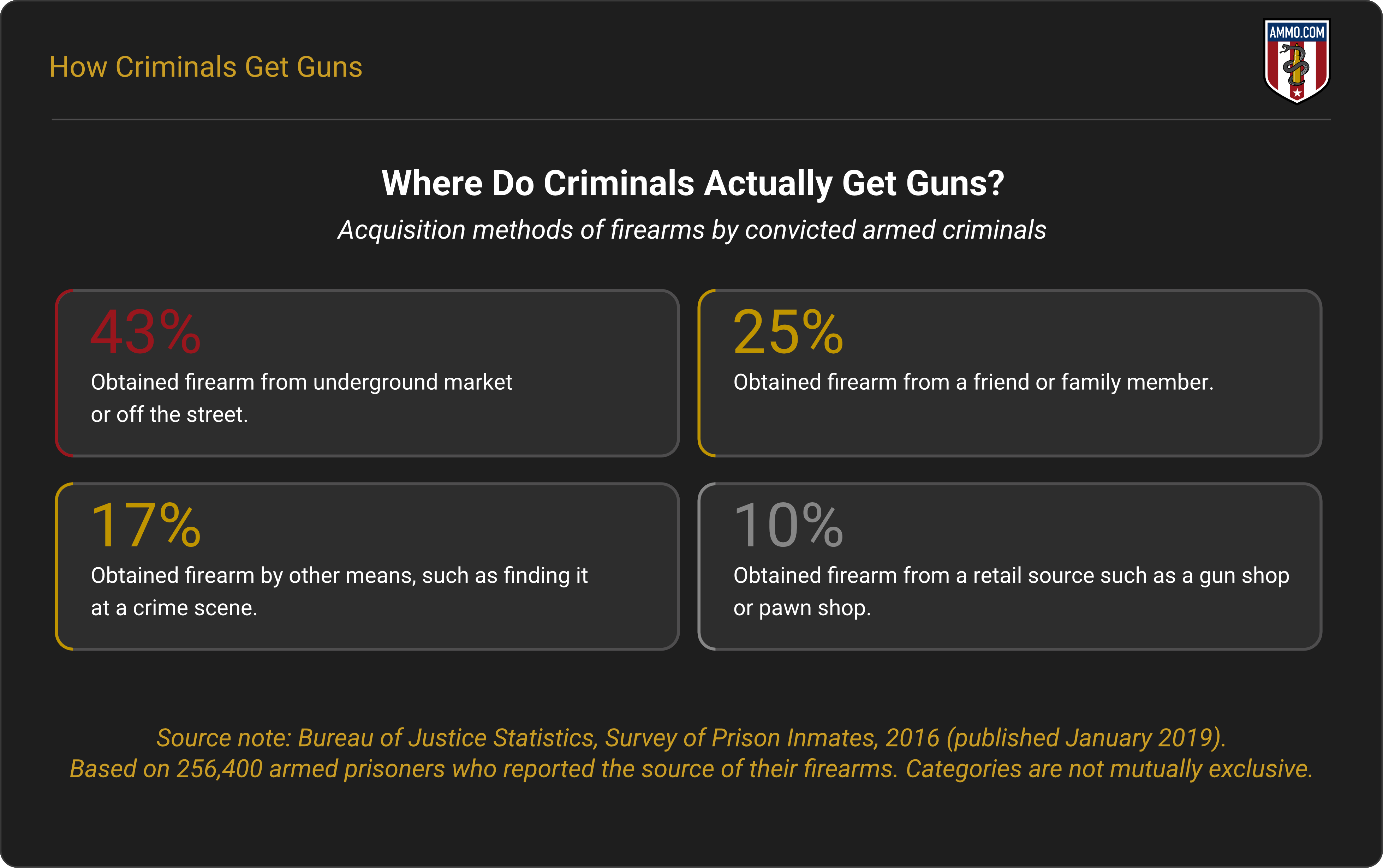
Of the estimated 256,400 armed prisoners who reported the source of their firearms in 2016, most obtained their firearms through an underground market or theft (43.2%). Some obtained firearms from an individual (25.3%). Others obtained them by other means (17.4%), such as finding the firearm at a crime scene, or having it purchased by someone else (likely a straw purchase) from a retail source (10.1%) or multiple sources (2.5%).2
The Black Market
According to a comprehensive BJS survey published in 2019, 43% of armed prisoners obtained their firearms off the street or from an underground source (implying a black market).2
The survey shows that nearly half of all convicted prisoners at state and federal levels who possessed a firearm during the commission of their crimes acquired the gun(s) from an individual who sold the firearm illegally (stolen guns, criminal enterprises, etc.).
Theft
According to the ATF, 1.1 million guns were reported stolen in the U.S. between 2019 and 2023. Of those, 95% were stolen from private citizens. For reference, we estimate that 500 million firearms are in civilians’ possession in the U.S. as of 2026. Adjusting for unreported firearm thefts, the ATF estimates that 220,000 firearms are stolen annually.4 A separate ATF report covering 2017 to 2021 estimated approximately 266,000 stolen firearms annually when adjusting for unreported thefts.10
Although hundreds of thousands of guns are stolen annually, the BJS report suggests that stolen guns are rarely unlawfully used by the person who committed the initial theft. In fact, only 6% of prisoners surveyed stole the firearms they possessed during the commission of their crimes.2
Friends and Family Members
According to the BJS, 25% of armed prisoners obtained the firearm they possessed during their crimes from a friend or family member. The majority (10.8%) of these inmates were gifted a gun or had a gun purchased for them (likely a straw purchase). Some convicts reportedly purchased or traded the firearm (8%). Others rented or borrowed the gun from its source (6.5%).2
Although the source of firearms is not measured in the report, a 2023 publication covering 103 participants by the Center for Justice Innovation suggested that family members gave Crown Heights, Brooklyn youths involved in gang and crime culture firearms for their protection.5
Purchased/Traded at Retail Source
According to the BJS, only one in ten armed prisoners obtained the firearms that they possessed during their crime from a retail source. Most retail-source purchasers (8.2%) of all armed prisoners obtained their firearms from a licensed firearm dealer.
Among armed prisoners, 10.1% bought or traded a firearm at a retail source; 7.5% obtained their firearms at a gun shop or store; 1.6% obtained theirs at a pawn shop; 0.8% obtained theirs at a gun show; and 0.4% at a flea market.2 Categories may overlap if the armed prisoners obtained firearms from additional sources.
Ninety percent of armed prisoners in this report obtained their firearms through means other than a retail source. Of the armed prisoners who purchased their firearms from licensed firearms dealers, 6.7% reported undergoing a background check.
For how that screening works at the counter, read our guide to firearm background checks and the NICS system.
What Share of Legally Purchased Guns Are Ever Used in a Crime?
Data on the share of legally purchased guns used in crimes are limited. A 2024 study examined firearms in California. The study’s findings, although not nationally representative, found that less than 0.80% of legally purchased handguns and 0.24% of legally purchased long guns were used in a crime.6
On a broader scale, the ATF tracks a firearm’s time-to-crime (i.e. the time from purchase to trace during a criminal investigation). Between 2017 and 2023, the time-to-crime for a firearm from purchase to trace declined from 4.2 years in 2017 to 2.9 years in 2023 (31%). This suggests that despite criminals using guns in a shorter time from purchase, legally purchased firearms are not immediately being used or investigated in crimes.4
For a closer look at how lawful ownership tracks against crime at the city level, see our report on urban violent crime and legal gun ownership.
Continue reading How Criminals Get Guns: A 2026 Report on Ammo.com

 % if they can prove it then by all means lock em up.