Report Highlights: Gun violence rates in the U.S. vary depending on demographics, geography, and firearm accessibility and ownership.
-
In 2024, the gun violence rate in the U.S. was 4.7 per 100,000 people; a decline from the 2021 peak of 6.5 per 100,000.
-
There were 1,399 deaths and 2,184 injuries related to mass shootings between 1966 and May 2026.
-
Compared to the same time period in 2024, gun violence in the U.S. declined by 15% in the first half of 2025.
Methodology
Gun violence (defined as the intentional injuring of another human with a firearm) statistics exclude self-inflicted gunshot wounds and unintentional shootings. Although conversation worthy, shootings that do not include interpersonal violence do not represent a consistent threat to the general public. Legal intervention and operations of war were included in this report, as these types of shootings do involve violence by definition. Homicides and justifiable homicides were also included in this report.
Mass shooting (defined as a shooting incident with four or more fatalities excluding the perpetrator or perpetrators) statistics exclude dispute-related, gang-related, or family violence-related events. These types of violence pose a threat to the general public, whereas other shooting incidents with multiple victims are typically targeted toward specific individuals.
All gun death data were drawn from the CDC WONDER database, which compiles death certificate data from all U.S. counties. The most updated death data from 2025 are partial and incomplete; these rates will change as more information is collected.
Gun Violence Statistics in 2026
According to data from the Gun Violence Archive, 4,845 gun deaths and 8,129 gunshot injuries (including homicide, murder, and defensive gun uses) were reported in the U.S. between January and May of 2026.
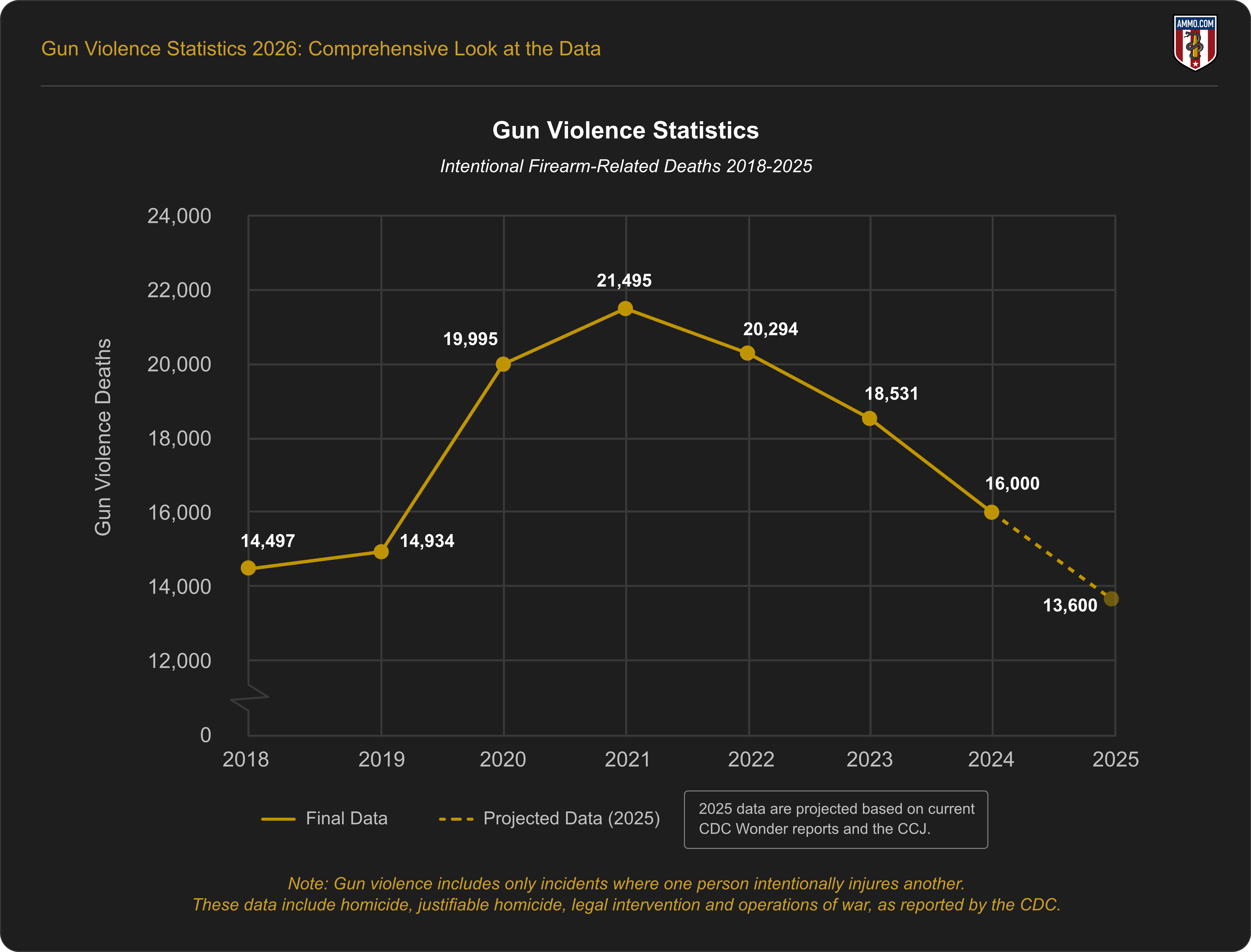
Gun violence in the U.S. increased substantially through 2020 and 2021, then began declining in 2022. While the rate of decline was slow, it began falling more sharply in 2024 and into 2025.
Although the CDC WONDER database does not have complete 2025 death data in 2026, the first half of the year is trending lower for firearm-related deaths (excluding suicides) than in previous years. Data between January and June of 2025 were relatively stable compared to previous years in 2026, when CDC WONDER reported 6,899 gun violence deaths.
For proper comparison, gun violence from January through June of each year was analyzed, as (A) gun deaths tend to increase during summer months, and (B) those data were unreliable for 2025 and 2026 due to partial reporting.
Gun violence increased by 1% from 2018 to 2019, and 37% from 2019 through June 2020. The increase slowed in 2021 to 8%, and then declined by 2% during the first six months of 2022 (compared to the same period in 2021). The first six months of 2024 saw a 13% decline, followed by a 15% decline in 2025.
Gun Violence and Gun Ownership Statistics
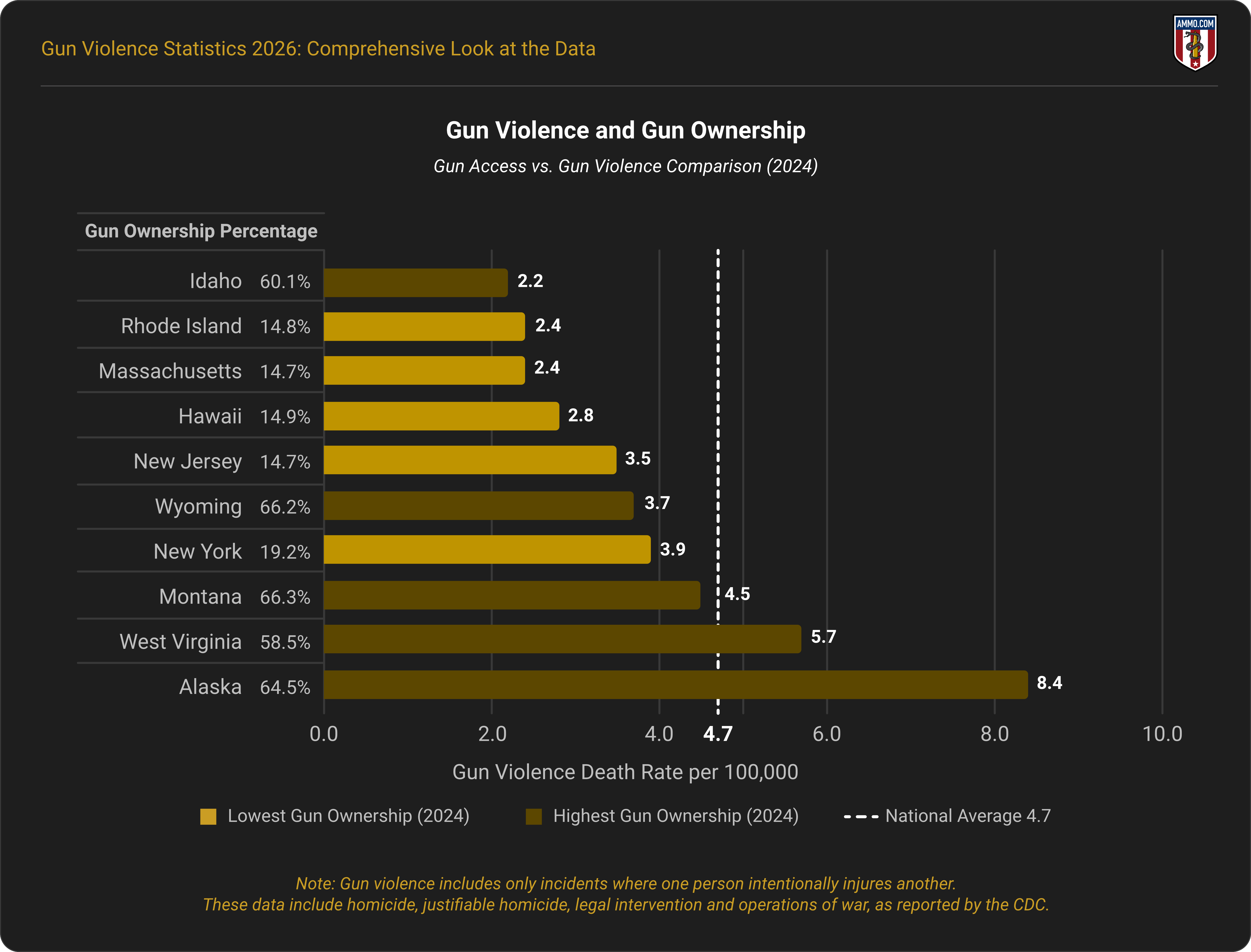
States with the highest rates of gun ownership have small populations, but also had a gun violence rate of 2.6 per 100,000 people compared to 1.7 per 100,000 in states with the lowest gun ownership rates. (Source 2, 3, 7)
Alaska (64.5 guns per 100 residents), Idaho (60.1 per 100), Montana (66.3 per 100), West Virginia (58.5 per 100), and Wyoming (66.2 per 100) had the highest reported rates of gun ownership in 2024. States with the highest gun ownership accounted for 2.6% (1,184) of the 44,447 firearm-related deaths in the U.S. in 2024 (81.5% of which were suicides). Gun violence rates among high ownership states ranged from 2.2 deaths per 100k (Idaho) to 8.4 per 100k (Alaska) in 2024.
Hawaii (14.9 guns per 100 residents), Massachusetts (14.7 per 100), New Jersey (14.7 per 100), New York (19.2 per 100), and Rhode Island (14.8 per 100) had the lowest reported rates of gun ownership. These states accounted for 3.8% of gun deaths in 2024, with 38.7% being attributed to homicide. Gun violence rates in lower ownership states ranged from 2.4 deaths per 100k (Massachusetts and Rhode Island) to 3.9 per 100,000 (New York) in 2024.
In 2024, Louisiana (12.3 deaths per 100,000 residents) and Mississippi (16.1 per 100,000) had the highest gun violence rates in the U.S. These states had a gun ownership rate of 53.1 per 100 and 55.8 per 100, respectively.
Illinois (7.0 deaths per 100,000 residents) and Maryland (6.5 deaths per 100,000) also had high homicide rates, but low firearm ownership: 27.8 per 100 and 30.2 per 100, respectively.
Gun Violence Deaths by Year in the U.S.
Gun violence deaths have fluctuated significantly since the CDC began consistently tracking deaths in 1979. Although the long-term trend shows an overall decline in the past 40 years, rates spiked to 7.0 deaths per 100,000 in 1980 and peaked at 7.1 per 100,000 in 1991 and 1993. Rates spiked again to 6.1 per 100,000 in 2020, and spiked again to 6.5 per 100,000 in 2021. (Source 2, 3)
In the mid-1980s, gun violence rates declined to 5.1 homicides per 100,000 people before rising to all-time highs in 1991 and 1993. A sustained decline began in 1999 when rates initially lowered to 4.0 per 100,000. Rates remained low during the 2010s at 3.7 to 4.6 per 100,000, before spiking again in 2020.
In 2024, the U.S. gun violence rate was 4.7 per 100,000: 27.7% lower than the 2021 peak. Provisional data from 2025 show an additional 15% decline in gun violence death totals from the same period in 2024, with the Council on Criminal Justice projecting a rate of 4.0 per 100,000. (Source 4)
Continue reading Gun Violence Statistics 2026: Comprehensive Look at the Data at Ammo.com
https://ammo.com/articles/gun-violence-statistics#mass-shootings-statistics