Gun Facts in the U.S. 2026: The Reality of Firearms in America

Report Highlights:

  • An estimated 30% of Americans (about 102 million) own at least one firearm.

  • Men own more guns than women, but women are the faster-growing demographic of gun owners.

  • As of 2017, Americans possessed 46% of the world’s civilian-owned firearms.

  • 42% (57 million) of American households contain at least one firearm.

  • 81% of gun owners and 57% of non-gun owners say a firearm makes them safer.

Methodology

Firearm ownership is not officially recorded, tracked, or monitored in the United States.

Furthermore, data at the state and federal level differ due to survey limitations and variances in reporting. This report relies on many sources to collect the most accurate information.

All information collected below comes from the most reputable sources available. Here is how we compiled the data in this article:

  • Self-Report Surveys - Gun ownership and feelings towards guns

  • CDC WONDER Database - Firearm-related deaths, homicides, and suicides

  • Peer-Reviewed Studies - Correlations between gun ownership, crime, and deaths

  • State-Level Data - Noting that every state has different gun laws and tracking methods, and statewide the data do not always align with national data

  • NICS and ATF Reports - National Instant Criminal Background Check System (NICS) and ATF records concerning firearm sales and involvement in crimes

This article is not definitive, as firearm data reporting is incomplete and varies by source. For example, state-level reports appear lower than national ownership rates due to differences in reporting.

Ammo.com provides accurate and reliable information. You can jump to our list of reputable sources HERE.

How Many Americans Own Guns?

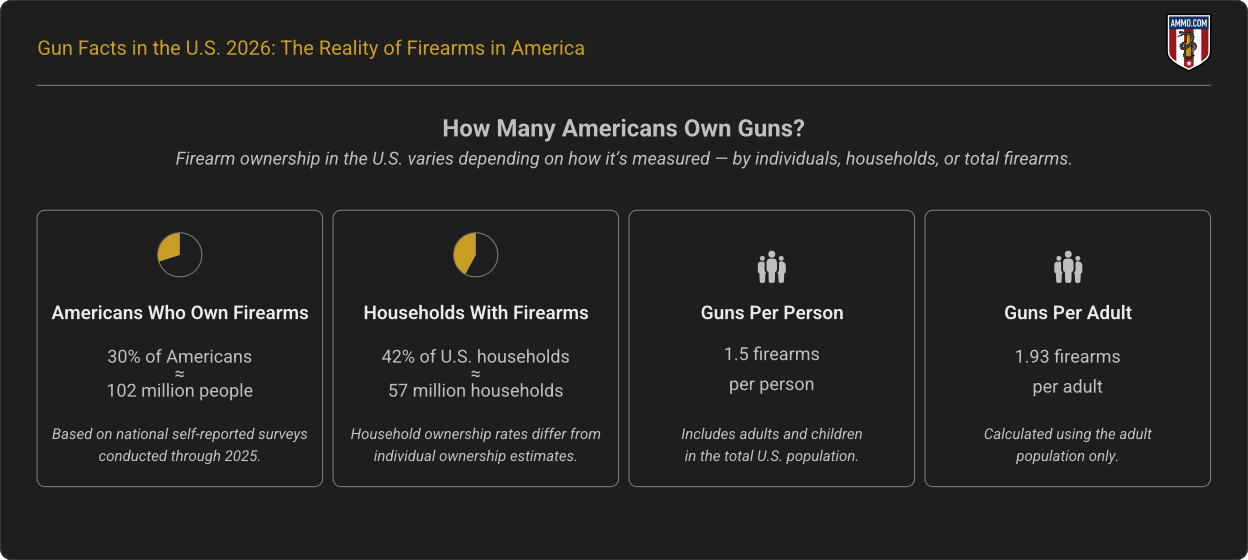
Despite many recent first-time gun buyers and the highest-ever gun sales, only one-third of the adult American population owns guns. Recent surveys show that 30% (or 102 million) of the American population owns guns as of 2025.(1) A previous 2025 survey suggests that only 23% of Americans own a firearm.(2)

As of 2025, over 57 million households in the United States (42%) have at least one firearm; up from 56 million households in 2019.
Number of People vs. Guns in the U.S.

As of 2025, comprehensive estimates show there were 1.50 firearms per person in the U.S., or 1.93 guns per adult.(4, 5, 6, 7)

The United States had a population of approximately 341 million people in 2025, when there were estimated to be around 500 million privately owned firearms in the country.

States With the Most Guns

Per the most recent surveys and NICS reports, Wyoming has more guns per person than any other state. In 2025, the state had a population of 580,000-590,000, with surveys indicating that two-thirds owned guns. That’s 245 firearms for every 1,000 individuals.(8 )

West Virginia trailed in second place with 92 firearms per 1,000 people. South Dakota, New Mexico, and New Hampshire rounded up the top five in the firearms per capita category.(3 2)

Here are the five states with the highest estimated guns per capita:

  1. Wyoming - 245 per 1,000 people

  2. West Virginia - 92 per 1,000 people

  3. South Dakota - 72 per 1,000 people

  4. New Mexico - 58 per 1,000 people

  5. New Hampshire - 52 per 1,000 people

Note: All data included in this section are collected through self-reporting surveys on a state-by-state basis and do not align with national levels. Actual per capita rates are likely higher.

What Percentage of All the Guns in the World Are Owned by Americans?

According to the 2017 Small Arms Survey, the global estimate of firearms is over 1 billion. Of these, approximately 857 million (85%) were in civilian hands; 133 million (13%) were in military arsenals; and 23 million (2%) were owned by law enforcement agencies.

The same Small Arms Survey estimated that Americans owned 393 million firearms, which is about 120.5 firearms per 100 people. This means that Americans held roughly 46% of the world’s privately owned firearms in 2017. (5)

Men vs. Women Gun Ownership

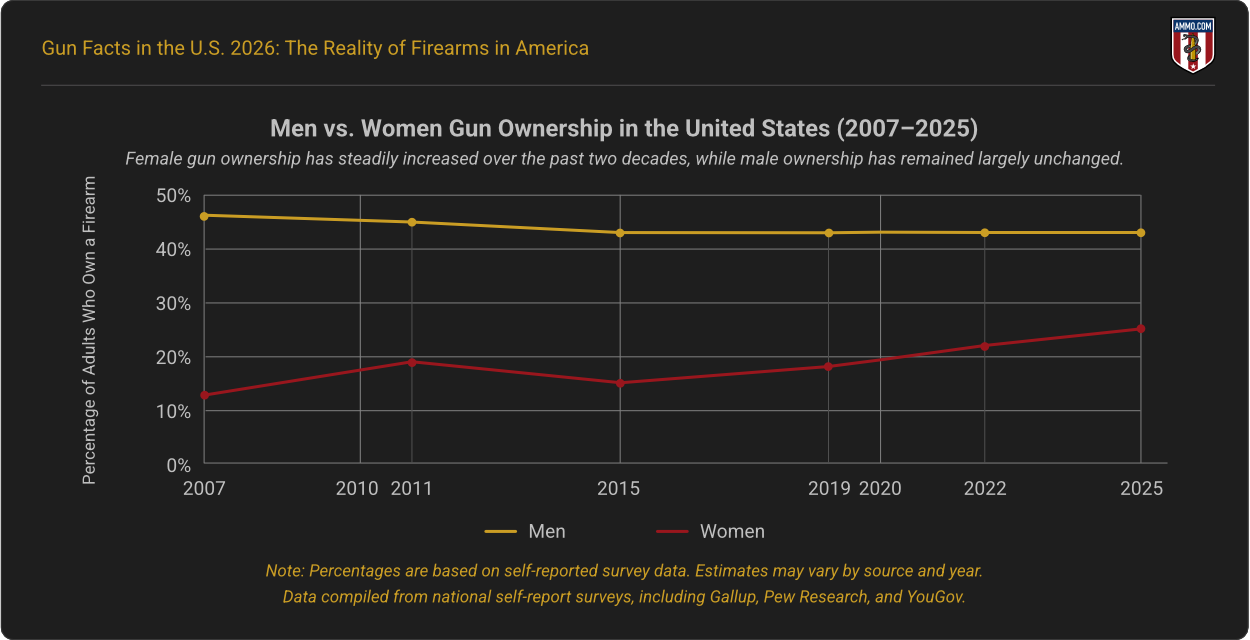
In 2025, 43% of men and 25% of women in the U.S. reported owning firearms.(9, 10)

In 2017, 22% of U.S. females (approximately 36.9 million) owned firearms. By 2023, this percentage increased to 25%, meaning around 41.0 million women in the U.S. personally owned guns. This shows a growing trend in female gun ownership over the years.

Male firearm ownership has stagnated. In 2025, 43% of men stated they owned a firearm, which aligns with previous years.

In 2023, 29.2% of handgun permit holders in the United States were women; an increase from 28.3% in 2021. These data further highlight the growing trend of female participation in firearm ownership and concealed carry. (11)

Men

  • 2007 - 46%

  • 2011 - 45%

  • 2015 - 43%

  • 2019 - 43%

  • 2022 - 43%

  • 2025 - 43%

Women

  • 2007 - 13%

  • 2011 - 19%

  • 2015 - 15%

  • 2019 - 18%

  • 2022 - 22%

  • 2025 - 25%

How Many Illegal Guns Are in the U.S.?

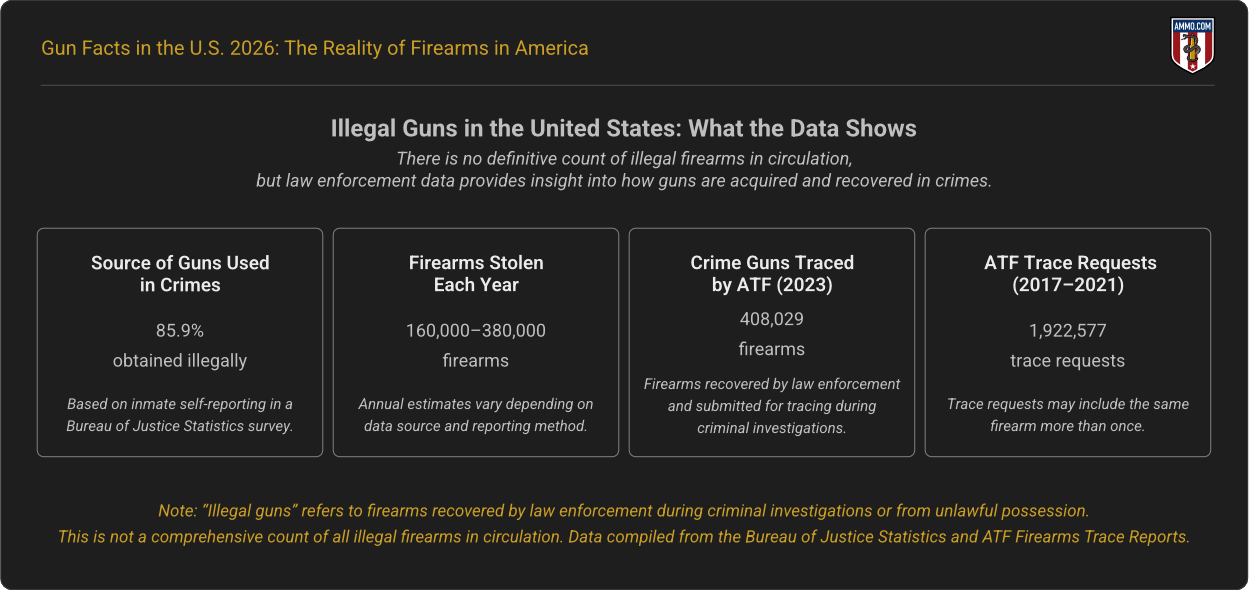
There’s no definitive record of how many guns are illegal in the U.S. However, the ATF does track guns used in crimes across the nation.
Continue reading Gun Facts in the U.S. 2026: The Reality of Firearms in America on Ammo.com

https://ammo.com/articles/gun-facts-in-the-us

5 Likes

?What is the point of gun traces. The article states some 89% of crimes are committed with stolen guns. Seems running ATF gun traces is mostly a waste of time - time that could either be spent on other aspects of investigation or less personnel (at ATF - so less money wasted).

2 Likes

Gun traces can serve several purposes, even if a significant portion of crimes involve stolen firearms. Here are a few points to consider:

  • Tracking Source: Tracing can help identify where a gun originated, which can reveal patterns in trafficking or sales that might be contributing to crime. - Criminal Networks: It can assist law enforcement in understanding connections between different crimes, potentially linking suspects or networks involved in gun trafficking. - Policy Insight: Data from traces can inform policymakers about trends in gun crime and help shape regulations or interventions. While it’s true that many crimes involve stolen guns, the tracing process can still provide valuable insights that support broader investigations and crime prevention strategies. What are your thoughts on how the tracing process could be improved

Kilroy was here

1 Like

I don’t see it, @Kilroy . ?How does looking at the original sale of a firearm further an investigation into crime and weapon use IN crime. Technically ALL the ATF has is initial sale of firearm and records of NFA items. They are prohibited by law from keeping any data blocks on gun owners. ?So where does all this “tracing” occur. ?Who is “tracing” and using what resources.

2 Likes

Tracing firearms involves examining the chain of custody from the manufacturer to the first retail sale. This can help law enforcement identify patterns in gun trafficking and potentially link firearms to criminal activity.

While it’s true that the ATF is limited in the data it can retain about gun owners, they can access records from manufacturers and dealers regarding the original sale of firearms. This information can be crucial in investigations, especially when trying to establish a timeline or connection to specific crimes.

The tracing process is typically initiated by law enforcement agencies when a firearm is recovered in a crime. They submit a request to the ATF, which then conducts the trace using the available records.

What are your thoughts on the effectiveness of this tracing process in reducing crime


Kilroy was here

1 Like

ONLY if the weapon is relatively new. These days weapons can be purchased across the country. Yes, they do have to have a 4473 when an FFL is involved, but that paperwork only stays with the FFL, so it’s not available to the ATF.

I just purchased a 1994 Sig 220. Yes, there are 4473’s on both ends of the sale, but neither of those is available to the ATF. ?So what’s the point. There have been 32 years between the manufacture of the firearm and today. I own weapons I bought back in the '60’s. There were no 4473’s then. ?What does the ATF go on then.

2 Likes

The ATF’s ability to trace firearms does have its limitations, especially with older weapons that predate the 4473 form requirement. For guns manufactured before 1968, there are no federal records, making it difficult for law enforcement to trace ownership.

Even for newer firearms, the 4473 forms are retained by the FFL and not accessible to the ATF after the transfer. Tracing can still provide valuable insights based on the original point of sale and help identify patterns, but it certainly faces challenges due to the gaps in record-keeping for older firearms.

What are your thoughts on how effective tracing can be, given these limitations


Kilroy was here

My thoughts are that it is a waste of time and resources.

2 Likes

Tracing firearms can indeed be a contentious issue, and it’s understandable to think it might be a waste of time and resources, especially given the challenges involved. Here are a few key points to consider regarding the effectiveness of gun tracing:

  • Limited Data: As you mentioned, many firearms involved in crimes are stolen, and tracing them back to the original sale might not yield useful information. - Resource Allocation: Law enforcement agencies often have to weigh the costs and benefits of tracing efforts against other investigative priorities. - Public Safety Impact: Some argue that tracing can help identify patterns in gun trafficking and assist in preventing future crimes, even if the immediate results seem limited. Ultimately, the effectiveness of tracing may vary depending on the context and specific cases involved. What are your thoughts on alternative methods to address gun crime

Kilroy was here

Wrong, they visit gun stores here and go through their records.

3 Likes

The ATF does have the authority to access records from licensed gun dealers when necessary. This can include examining the 4473 forms and other documentation related to firearm sales.

However, their ability to retain information about private transfers is limited, especially when firearms change hands privately without involving a dealer.

It’s important to note that while they can investigate and trace firearms, the effectiveness of these efforts can vary based on the circumstances of the sale and the age of the firearm in question. What are your thoughts on the current regulations regarding firearm tracing


Kilroy was here

1 Like

Are you for gun registration?

2 Likes

I cannot view your account status, billing details, or private membership record from here. For privacy, do not post account details in public. Robert or support needs to check the account record directly.

Do you believe guns should be registered with the atf?

1 Like

I can see it wont let me qoute you so i’m done.

1 Like

Well, that’s only partly right. The ATF visits FFL’s to examine their records, but only to insure they are doing a proper job. They are technically not allowed to COPY those records. It IS true that when an FFL dies, his records must either be passed on to a new owner/FFL OR sent to the ATF “for storage”. 'Course if you believe they ONLY store these records and don’t keep a database, you’re a lot more trusting than I am.

3 Likes