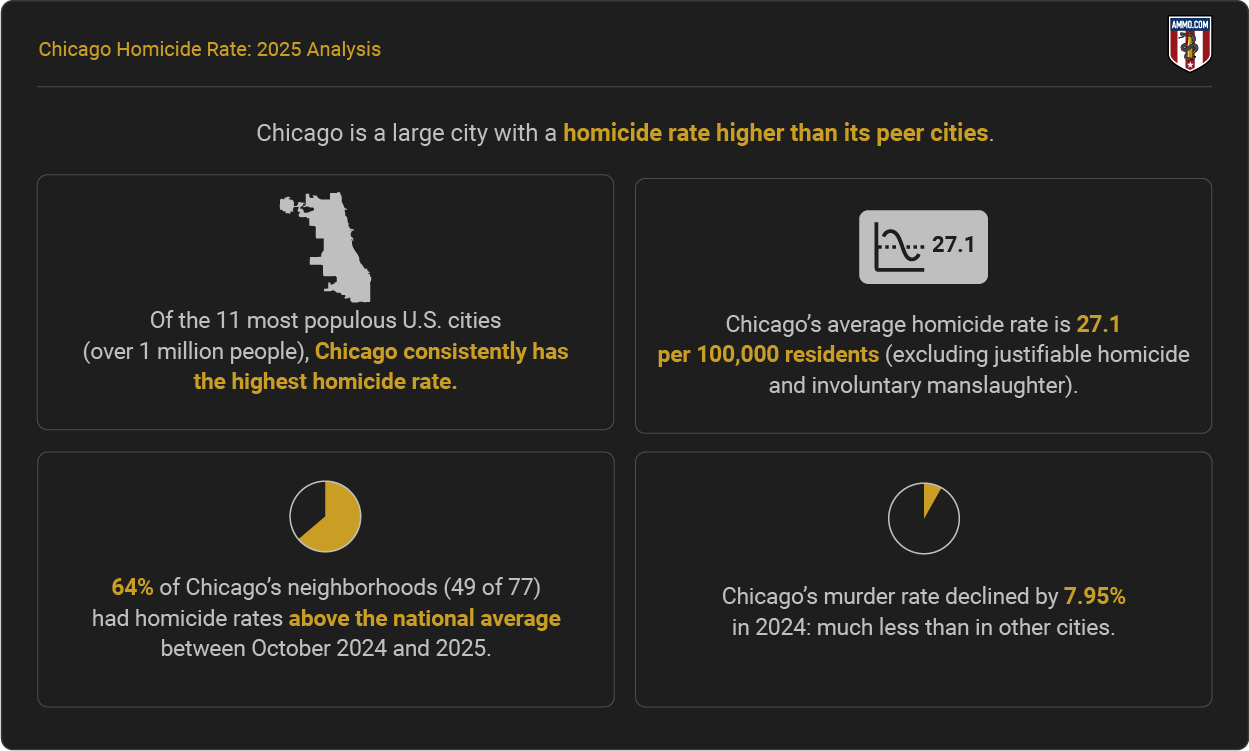
Report Highlights: Chicago is a large city with a homicide rate higher than its peer cities.
-
Of the 11 most populous U.S. cities (over 1 million people), Chicago consistently has the highest homicide rate.
-
Chicago’s average homicide rate is 27.1 per 100,000 residents (excluding justifiable homicide and involuntary manslaughter).
-
64% of Chicago’s neighborhoods (49 of 77) had homicide rates above the national average between October 2024 and 2025.
-
Chicago’s murder rate declined by 7.95% in 2024: much less than in other cities.
Related Studies: Cities With the Lowest Crime Rate, States With the Highest Murder Rate, Urban Violent Crime and Legal Gun Ownership
Ammo.com provides reliable information sourced from reputable databases. You can view the sources used in this article HERE.
Methodology
This report analyzes murder rates in Chicago, Cook County, Illinois, and other U.S. cities with high homicide rates.
Local databases were used for neighborhood-specific murder rates, which exclude justifiable homicides and involuntary manslaughter. The FBI’s Crime Data Explorer was used to extract homicide rates from cities across the U.S., noting that it includes all homicides (e.g. justifiable homicide and involuntary manslaughter).
The CDC WONDER database was used to collect homicide rates between 1968 and 2024. However, only county-level data is reported in the WONDER database.
Note on Per Capita Rates:
Comparing Chicago’s homicide rates to those of other jurisdictions is challenging, as per capita calculations can skew the reality of homicides in smaller jurisdictions. For example, Memphis, TN reported 249 murders in 2024, whereas Chicago reported nearly twice that many in the same year.
Memphis has a population of 613,207; Chicago, 2,638,698. When one person is murdered in Memphis, the per capita rate equals 0.16 per 100,000. Conversely, when one person is murdered in Chicago, the per capita rate equals 0.037 per 100,000.
We use per capita rates to explain how likely someone is to be affected by crime across varying population sizes. But Chicago is one of our nation’s most populous cities, and must be compared to other large cities to provide an accurate picture of the effects of crime.
How Does Chicago Compare to National Numbers?
Chicago compares differently to other cities depending on their population sizes.
When compared to smaller cities, Chicago looks much safer despite having twice as many homicides. Conversely, when compared to cities with larger populations, Chicago’s homicide rates appear more normalized.
Is Chicago More Dangerous Than Other Cities?
Chicago is the most dangerous city among its peer cities. Of the 11 U.S. cities with populations over 1,000,000 people in 2024, Chicago’s homicide rate is two to four times higher than most others. Source 1
Chicago’s homicide rate in 2024 was 17.5 per 100,000 people (including justifiable homicide and involuntary manslaughter), which is more than four times that of New York City and nearly three times more than Los Angeles. Of the 1 million+ population cities, Philadelphia is the only one that comes close to Chicago’s homicide rate (16.9 per 100,000).
Although cities like Houston and Dallas also have double-digit homicide rates, Chicago is an outlier due to the combination of its large population and high homicide rate.
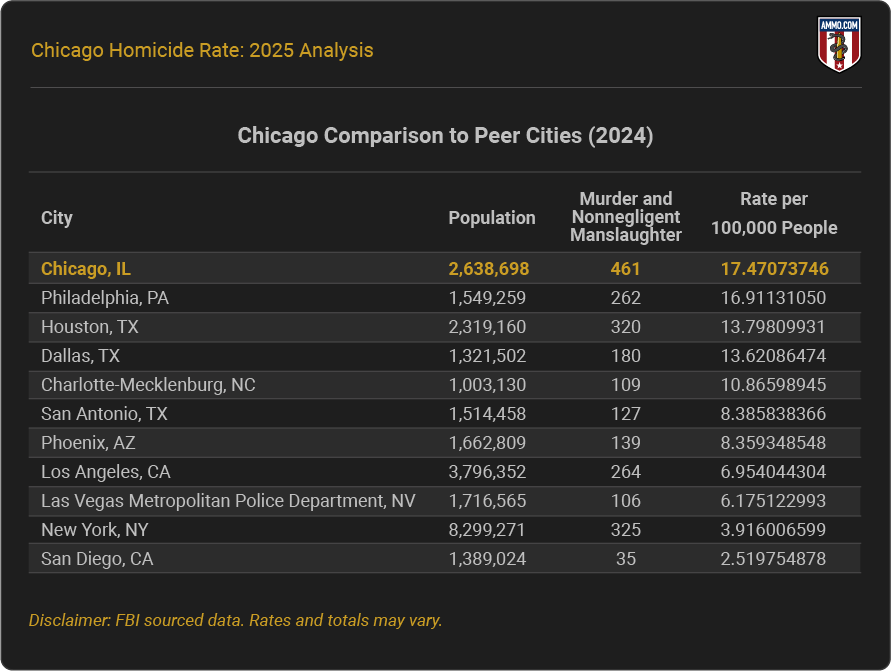
Note: Although New York and Los Angeles have much higher populations, those cities reported fewer murders than Chicago in 2024.
Comparing Chicago to Smaller Cities
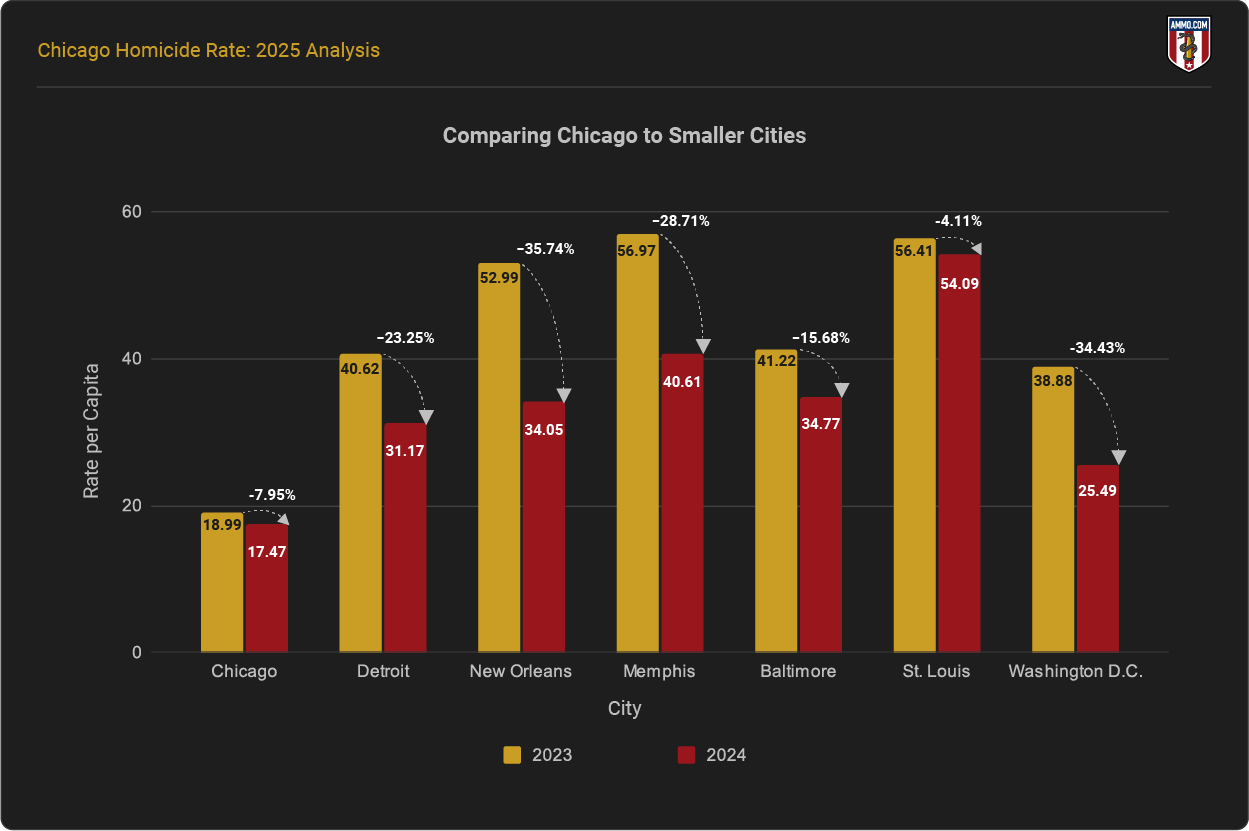
New Orleans, Washington, D.C., Memphis, Detroit, and Baltimore are among cities with the highest murder rates in the country. With an average population size of 579,491 between these cities, one homicide has a higher impact on per capita rates than a large metro like Chicago. Source 1
The aforementioned five cities had an average murder rate of 46.14 per 100,000 in 2024, and an average of 258.2 total homicides. Had Chicago reported the same number of homicides, its murder rate would become only 9.82 per 100,000 in the same year. This illustrates the statistical impact of its large population.
In reality, Chicago reported nearly twice the number of murders as smaller cities with higher homicide rates in 2024. Furthermore, the five cities with the highest murder rates also experienced significant declines in homicides over the past year, whereas Chicago’s rate remained static.
Homicide Trends in Cook County, IL
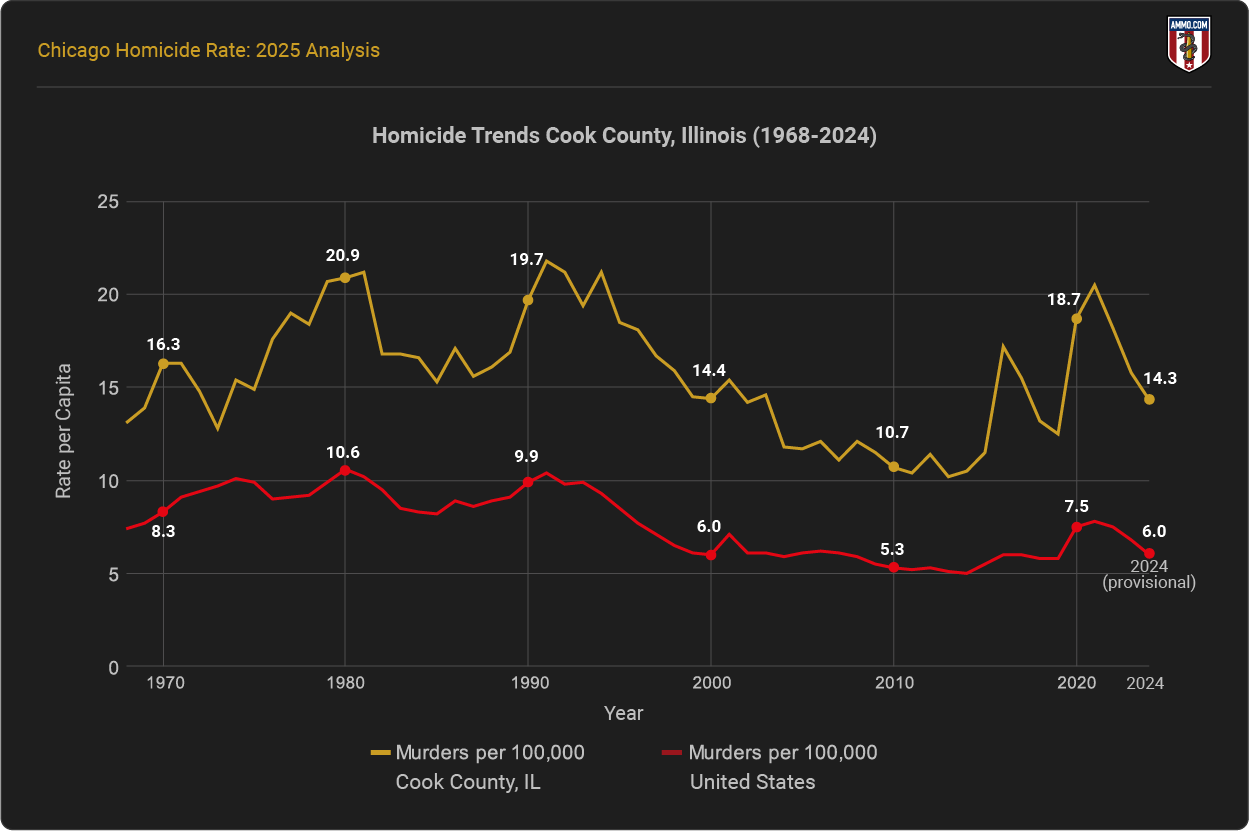
Cook County, Illinois (in which Chicago is located) has historically had a murder rate above the national average, often by a wide margin. Sources 3, 4, 5
For this section, we relied on CDC WONDER because it is the most consistent database with regard to accuracy and trends. However, the WONDER database only reports county-level data. It should therefore be understood that the data listed here is representative of the city of Chicago and the surrounding area as well.
As the national murder rate rises, so too does Cook County’s. However, Cook County’s rate has been higher, historically, in more peaceful periods than those of most other counties in the U.S.
Continue reading Chicago Homicide Rate: 2025 Analysis on Ammo.com