Report Highlights: Mass shootings have increased substantially in the U.S. over the past four decades. This report analyzes the behavioral patterns of mass shooters.
-
Between 1966 and 2025, 81.2% of shooters were in a documented crisis before the event.
-
While 51.0% of mass shooters had prior symptoms of mental illness, 68.2% had a history of domestic violence or targeted at least one member of their family.
-
Gun ownership has remained stable (30%-32% of the U.S. population) between 1980 and 2025, while mass shootings have increased by 126.0%.
Methodology
This report draws on behavioral and environmental information from mass-shooting databases, peer-reviewed literature, and government reports. The Violence Prevention Project (VPP) defines mass shootings as four or more fatalities unconnected to family or dispute-related violence. Mother Jones’ shooter database catalogs mass and spree shootings with three or more fatalities, including family and dispute-related violence in public places. The U.S. Secret Service (USSS) National Threat Assessment Center’s definition of mass attacks includes attacks in which no firearms were used; this is noted where data are cited.
This analysis counts shooters rather than incidents because the primary behavioral patterns leading up to an act of violence are individual attributes. In incidents with multiple shooters, each shooter’s behavioral patterns were examined.
The 2017 Route 91 Harvest music festival was the deadliest mass shooting in U.S. history. This shooting was treated as an outlier in the sections below due to the circumstances of the event and the increased number of fatalities and injuries.
Several variables coded in the VPP apply to multiple shooters simultaneously. Percentages may not sum to 100 due to multiple factors in a single shooter. This report relies heavily on behavioral evidence, which may not be available for several shooters. Missing behavioral patterns may not mean the behavior wasn’t present. They simply indicate there was no evidence of it.
Mental Health & Suicidal Ideations
Data on varying levels of mental illness exist in databases and research literature. Across databases, more than half of mass shooters had prior signs of mental illness, such as depression, while smaller portions experienced psychosis.
Of the 160 mass and spree shooters identified by Mother Jones between 1982 and 2026, 81 (51%) had a prior history of mental illness. Seventeen shooters (11%) had no prior signs of mental illness, and 62 (39%) of the shooters’ mental health history was unknown.2
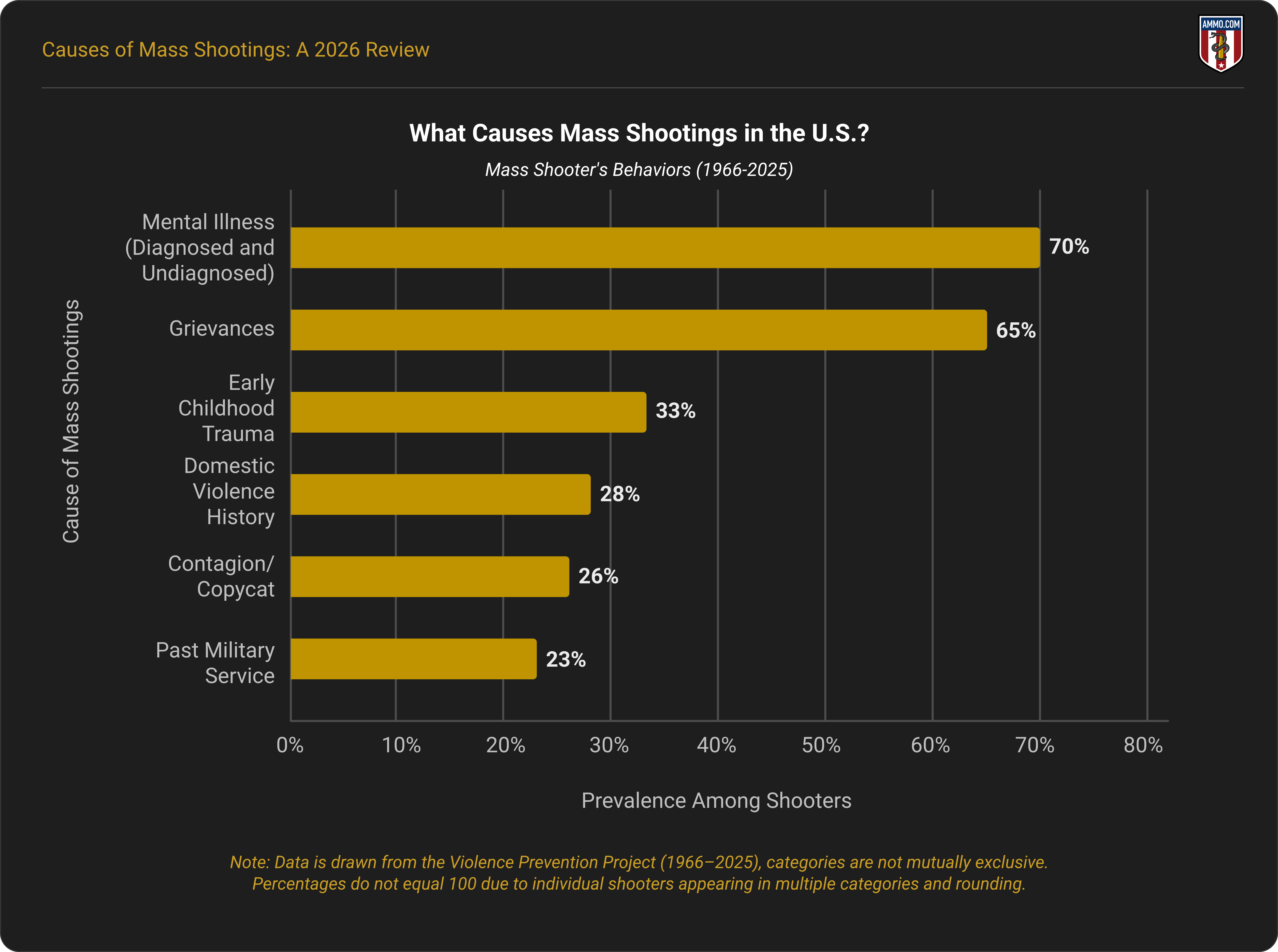
The VPP examined 202 mass shooters between 1966 and 2025. Of those, 141 (70%) had a documented mental health issue (diagnosed or undiagnosed). Seventy-three (36%) intended to die during the shooting. Sixty-six (33%) had a prior history of suicidality. There was no evidence of suicidality in 63 (31%) shooters.1, 6
Most shooters (81.2%) displayed signs of crisis, including recent stressors, triggering events, inability to perform daily tasks, mood swings, unusual calm or happy, abusive behavior, aggravation, isolation, paranoia, depression, or previous contact with mental health professionals or law enforcement.1
Of the 202 shooters listed in the VPP database, 164 (81% of shooters) showed signs of crisis. Of those, 63 (38.4%) had been showing signs for years, 50 (30.5%) for months, 24 (14.6%) for weeks, and 23 (14.0%) for days. Timeframe data for three shooters were unavailable.1
According to a USSS report released in 2023, 58% of attackers who targeted civilians in public places had a history of mental health symptoms. Of those, 62% experienced depression, 25% had suicidal thoughts, and 28% had a history of psychosis (e.g. paranoia, delusions, and hallucinations). Although these attacks varied in weapon type, the findings align with other research, which shows that more than half of those who attacked innocent civilians in public spaces had suicidal ideations, while a few experienced psychosis.3
Grievances (Social/Personal)
Of the 202 mass shooters in the VPP database, 132 (65.3%) had at least one grievance (hate/prejudice, employment, relationship, and interpersonal conflict) listed for their motive. Employment-related grievances were recorded in 43 shooters (21.3%).1
Grievance-related motives also included 40 with an interpersonal conflict (19.8%), 34 with hate or prejudice (16.8%), and 27 with relationship grievances (13.4%).
The Mother Jones database does not track grievances. The USSS National Threat Assessment Center’s 2023 report suggests that of the 173 public attacks in the U.S. between 2016 and 2020, 68% of attackers did not target a specific individual. Only 32% of attackers had at least one specific target.3
Contagion/Copycat Effects
Research suggests that mass shootings are often a result of a contagion or copycat effect, where one attack inspires one or more subsequent attackers. A 2015 study by Towers et al. found that each mass shooting incites an average of at least 0.22 additional shootings within 13 days.7
Another study by Boyd and Molyneux (2021) expanded on Towers’ methodology and found that the contagion effect may be up to three times greater than originally estimated. Roughly 77% of shootings studied occurred after the elevated-risk window of 13 days previously cited in the Towers study.4
The VPP’s database shows that 53 of the 202 mass shooters (26.2%) between 1966 and 2025 had an interest in other mass shooters, while 15 were identified as seeking fame.1
Continue reading Causes of Mass Shootings: A 2026 Review on Ammo.com
https://ammo.com/research/causes-of-mass-shootings#mass-shooters-childhood-trauma-domestic-abuse
 damn kids get off my lawn.