Quick Takeaways: Female gun ownership in the U.S. is on the rise. This guide helps women understand important aspects of gun ownership and self-defense.
- Situational awareness and threat avoidance are fundamental tactics for self-defense.
- Federal and state gun law knowledge is essential for gun owners.
- Purchasing a gun, holster, and ammunition is more straightforward than you might expect.
Top Ten Self-Defense Tips for Female Gun Owners
Having a defensive mindset, learning to use your firearm, and empowering yourself to take control over bad situations requires knowledge and practice. This list covers threat aversion, shooting tips, the legalities of gun ownership, and other basic info you will need to begin building real defensive skills.
#1: Situational Awareness
One of the simplest and most effective self-defense tactics women can use is situational awareness: knowing and understanding what is happening around you.
Criminals often target victims they can easily overpower, with a preference toward unsuspecting victims.1 That’s where situational awareness will give you an advantage. When you’re paying attention to your surroundings, your body language can communicate “I am not an easy victim” to a potential threat.
This skill can be honed before ever purchasing or carrying a firearm. Here are our tips for building situational awareness:
- Familiarize yourself with Lt. Col. Jeff Cooper’s color code of awareness: white (unaware), yellow (relaxed and alert), orange (alert to a threat), red (ready to act in response to an active threat). When in public, it’s best to stay in yellow.
- When in public, pay attention to possible exits, what people are doing with their hands, and anyone acting out of place.
- Walk with purpose. Don’t use earbuds or stare at your phone, as either can signal that you are an easy target.
#2: Threat Avoidance
The best outcome for any defensive scenario is there being no need for defensive action at all. The two key threat avoidance tactics are trusting your gut and leaving a situation before it becomes dangerous.
“Trusting your gut” means trusting your instincts. For example, if a friend invites you out, you may feel tension, a vague sense of dread, butterflies in your stomach, or other indications that you’re unsafe. Any of those sensations is sufficient justification to skip the outing.2
Using situational awareness to identify potential threats is paramount. If you notice someone fighting or becoming hostile, it’s best to remove yourself before an escalation. If removing yourself isn’t realistic, remain calm to avoid further escalating the interaction.
#3: Understanding Self-Defense and the Law
Understanding the laws and how your state handles self-defense shootings is imperative to avoiding unlawful actions. What may feel like a justifiable reason to draw your firearm may not actually be legally justifiable!
States with stand-your-ground laws may remove a duty to retreat if you’re (A) in a place you’re legally allowed to be, and (B) not committing a crime. Other states’ laws may require a defender to attempt retreat before taking defensive action.
If you present your firearm in a threatening or reckless manner, you could be charged with brandishing. Only draw your firearm if there’s an imminent threat that you intend to fire upon.
Before carrying, research city and county ordinances, state laws, and federal laws to ensure you don’t face criminal charges for defending yourself with a firearm.
#4: Understanding Basic Gun Safety
Before you pick up a gun, you must know the four essential rules of firearm safety.
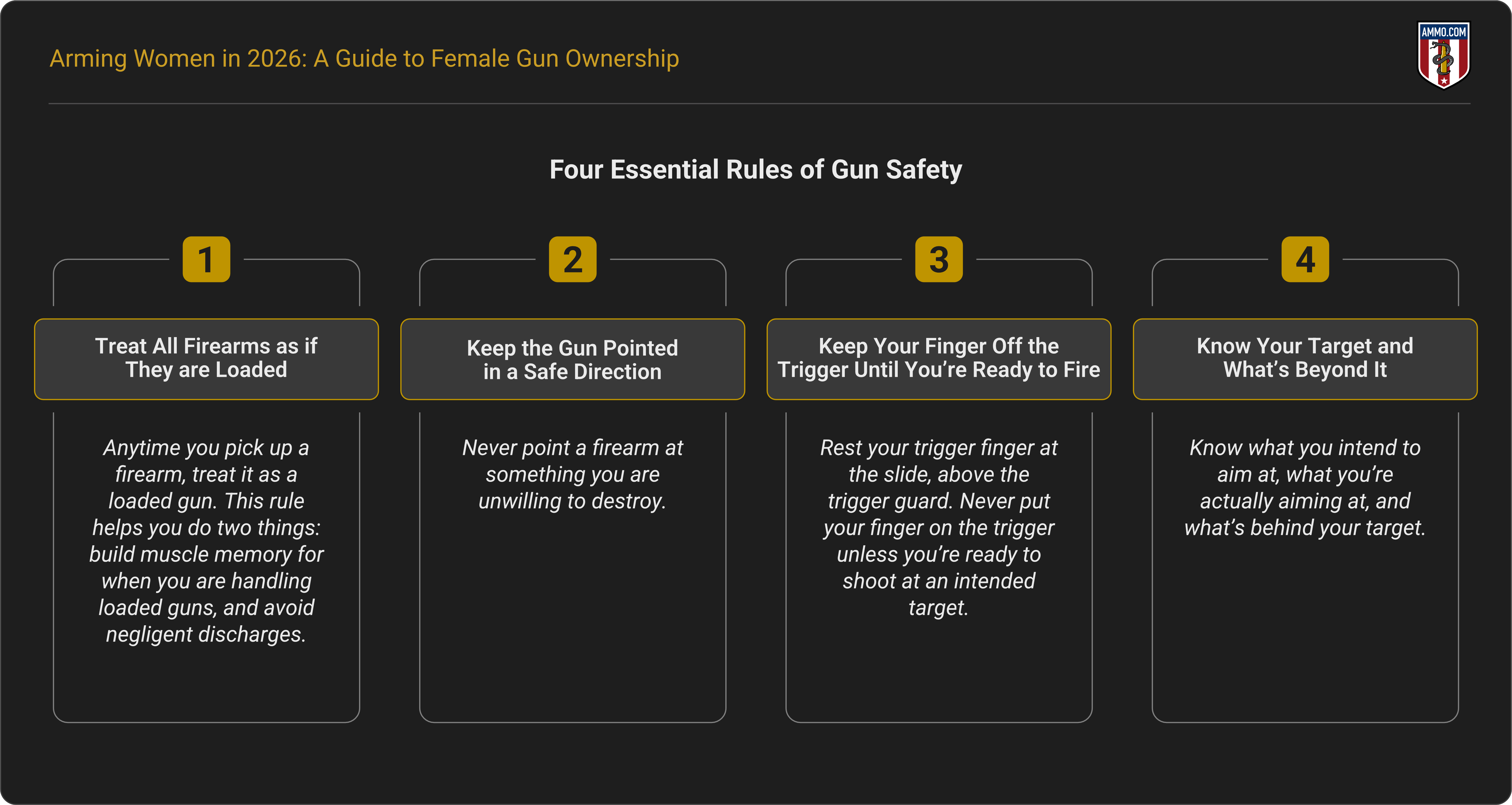
- Treat all firearms as if they are loaded - Anytime you pick up a firearm, treat it as a loaded gun. This rule helps you do two things: build muscle memory for when you are handling loaded guns, and avoid negligent discharges.
- Keep the gun pointed in a safe direction - Never point a firearm at something you are unwilling to destroy.
- Keep your finger off the trigger until you’re ready to fire - Rest your trigger finger at the slide, above the trigger guard. Never put your finger on the trigger unless you’re ready to shoot at an intended target.
- Know your target and what’s beyond it - Know what you intend to aim at, what you’re actually aiming at, and what’s behind your target.
Learning and practicing these four basic safety rules will help you avoid negligent discharges and tragic accidents.
#5: Choosing the Right Pistol
Many female shooters struggle while figuring out which handgun is best. It’s actually quite simple. Aside from one that is affordable, you’re searching for a pistol that is reliable, convenient to maintain, and comfortable to carry and fire.
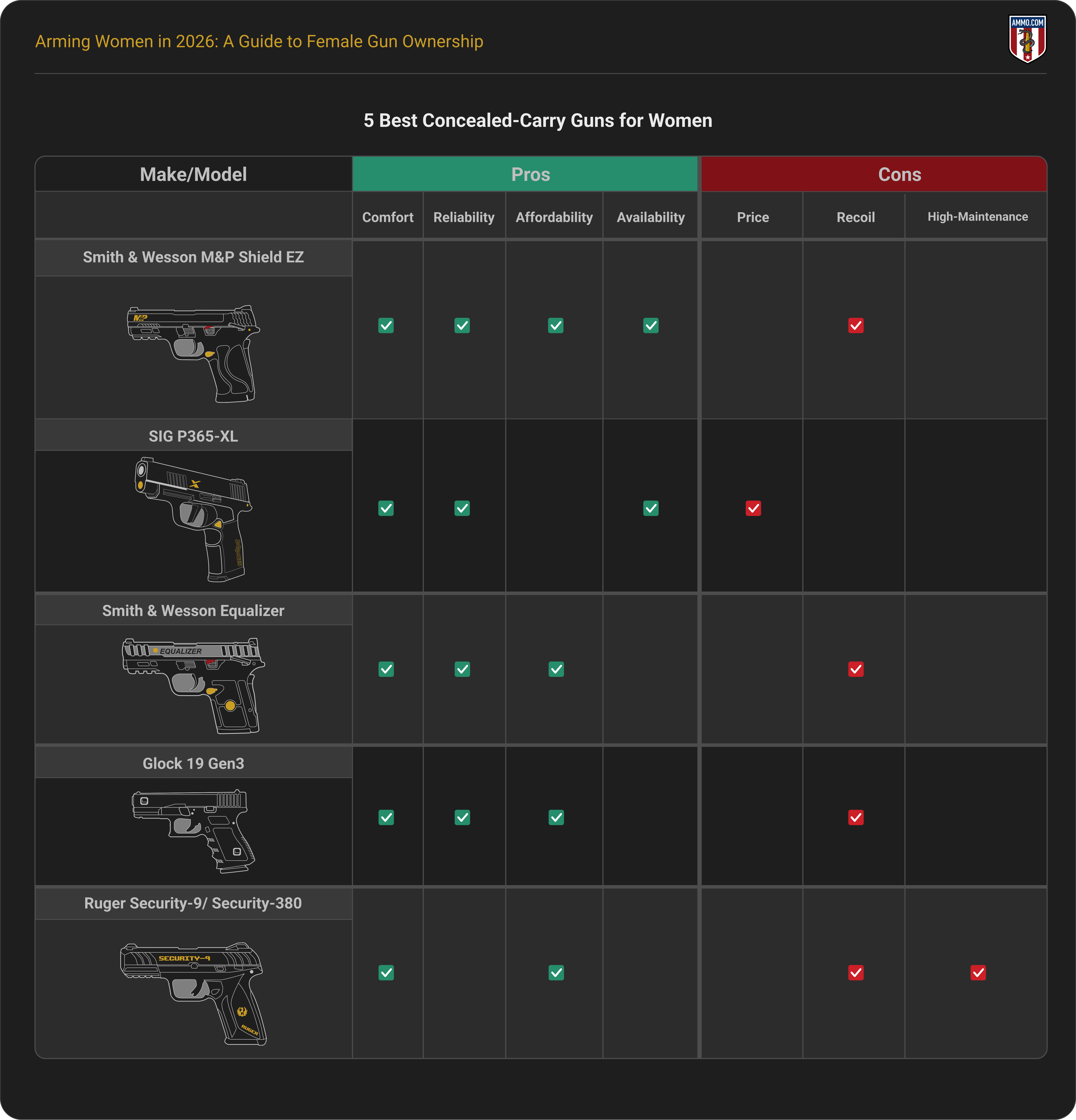
Before buying a gun, it’s best to test out a few different options. See which one you like most. Here are a few of the models that seasoned female shooters say are the best for women:
- Smith & Wesson M&P Shield EZ
- SIG Sauer P365-XL
- Smith & Wesson Equalizer
- Glock 19 Gen3
- Ruger Security-9/Security-380
We recommend trying out all of those models. Some are more affordable than others, but they are all practical solutions to defense for women and men alike.
#6: Choosing the Right Ammo
You have many options when it comes to ammo, but you don’t need to be an expert shooter to know what you need to get started.
Buying Ammo
Make certain you are buying the right ammo for your gun. Look at its slide or barrel, which should be engraved with the name of the cartridge it’s chambered for: e.g. 9mm, 380 Auto (aka 380 ACP), 32 Auto (aka 32 ACP), 38 Spl, etc.
Once you have determined your cartridge, you only need to purchase two types of ammo: one for practice, and another for defense. A cartridge’s intended application is defined by its bullet. Here are the two types of bullets every shooter must have:
- Full metal jacket (FMJ) - A simple bullet with a lead core and gilding metal jacket. The economical choice for target shooting, albeit suboptimal for defense.
- Jacketed hollow point (JHP) - A more sophisticated bullet, with a nose cavity that forces its tip to expand after striking flesh. The preferred choice for defense because it (A) inflicts more trauma to the threat, and (B) reduces the risk of over-penetration that could jeopardize bystanders.
Although FMJs are often used for target practice, it’s a good idea to train with your defense ammo as well. Firearms can be finicky with JHPs, so take your chosen ammunition to the range to ensure your firearm cycles it reliably. Also, choose training ammo loaded with the same bullet weight (measured in grains) as your defense ammo. It won’t perform identically to your defense ammo, but it will give you a closer approximation of your defense ammo’s performance.
Continue reading Arming Women in 2026: A Guide to Female Gun Ownership on Ammo.com
https://ammo.com/articles/womans-self-defense-guide-concealed-carry#learning-to-use-your-gun