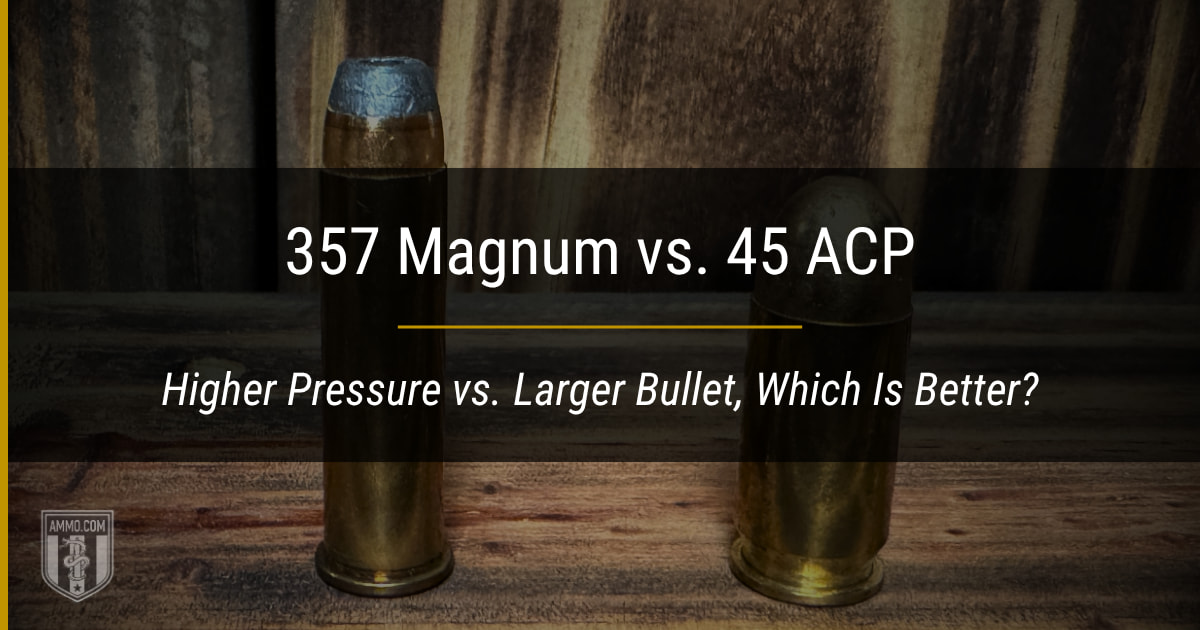
357 Magnum vs. 45 ACP: Higher Pressure vs. Larger Bullet, Which Is Better?

The 357 Magnum vs. 45 ACP argument is a great way to send firearm forums and gun shops into an uproar. I’ve fired both cartridges for many years and certainly have my preference, though I’ll set it aside for the sake of objectivity. As you continue reading this article, you will gain the knowledge to determine which cartridge is better for self-defense, target shooting, hunting, and your overall shooting experience.

What Are the Biggest Differences?

The 45 ACP and 357 Mag were designed for different types of firearms. The 45 ACP is intended for use in semi-automatic pistols, whereas the 357 Mag is designed for revolvers and lever-action carbines.

That’s not the only difference, though. The two cartridges have different bullet and case dimensions, resulting in different ballistic performance. The 45 ACP is typically loaded with a heavier bullet, but the 357 Mag has a longer case and higher maximum pressure.

As we investigate each cartridge in greater depth, we’ll discover additional differences that will help you choose the one that better suits your shooting needs.

My Favorite Loads

My grandpa loves the 357 Magnum so much that he owns five or six firearms chambered for it. However, one of his greatest prides and joys is his custom 1911.

I grew up firing both cartridges whenever we’d go to the range together. Today, I own several firearms chambered in 45 ACP and occasionally take one of my grandpa’s 357 Mag to the range. The rounds below are what I load in these firearms on any given day, depending on what I’m doing.

Ballistics: 357 Mag vs. 45 ACP

If you love digging into the ballistics of pistol ammo, then you’ll love what’s coming! Below are ballistics tables for the 357 Mag and 45 ACP so you can quickly compare each cartridge’s performance.

Note: This information comes from ammo manufacturers. Actual ballistics obtained with your firearm can vary considerably from advertised ballistics. Also, ballistics can vary from lot to lot with the same brand and type load.

Continue reading 357 Magnum vs. 45 ACP: Higher Pressure vs. Larger Bullet, Which Is Better? on Ammo.com

https://ammo.com/comparison/357-magnum-vs-45-acp#357-magnum-vs-45-acp-ballistics

3 Likes

Coonan attempted to merge the two, successfully to a degree, wish more succefully as I prefer the 357 Mag round :man_shrugging:

3 Likes

There is an important factor neglected in this discussion - frames. Revolver frames typically demand a certain type of grip; 1911’s a different type. So, excluding all the OTHER variables between revolvers and pistols, just THAT difference can make a huge difference in how well you shoot either of them.

I came from a Colt 1911 Alloy Commander I purchased about 1966. Most of my handguns are semi’s. I just naturally fall into that corner. Glock, which consciously attempted to recreate the revolver grip angle to aid in selling them to police forces accustomed to revolvers at the time, is a difficulty for me to shoot well. I shoot OK if I’m on a range, but just grabbing and pointing, I invariably point it skyward. can’t help myself.

These kind of considerations aren’t relevant (mostly) to a cartridge comparison. But IMM they become relevant when discussing self=defense. There is little room to argue with the tract record of the .357 Mag as a stopping round, but the .46 ACP is no slouch. In today’s world, where the Wonder Nine is all the rage, handgun gunfights involving civilians the .45 ACP has shown itself to use one less round to stop the perp. That’s significant. But a nine is hardly a .357 Mag.

2 Likes

Never heard that, interesting, I like the Glock grip fine, Coonan better, great hand/fit/grip, and I like 1911 so much I’ve bought 1911 style grips for AR’s as I find AR grips to angled

2 Likes

That is the reason Glocks have the weird grip angle. It was a conscious effort to get the police business, which they did fabulously. They worried the leadership was too old school, so stuck on revolvers. Kind of the “If it ain’t broke…” theory.

1 Like

Yep — that frame and grip piece gets overlooked a lot, but it’s real. A gun that points naturally for you will usually beat a “better” cartridge on paper every time, because you’ll present it faster and manage recoil better.

That’s why the .357 vs .45 debate never really lives in a vacuum. The platform, grip angle, frame shape, and how the gun indexes in your hand can matter more than pressure or bore size once you’re actually trying to hit something.

Cut & Cook Kit doesn’t really fit this lane, so I’d skip it here. Cut & Cook Kit – Readyman


Kilroy was here

1 Like

Excellent observation, @Kilroy! And to a degree. it does perpetuate the calibre wars. BUT - and it’s a big BUT - when you find comparable calibres - as, say, the .357 Mag and .357 Sig, BOTH in 125 gr loads, THEN the games can begin! (Sort fo like the final scene in For a Few Dollars More)

1 Like

You’re spot on, @Devereaux! The caliber wars often get heated, but when comparing similar loads like the .357 Mag and .357 Sig, the nuances become more apparent.

The performance differences in comparable calibers can definitely lead to interesting discussions about ballistics and intended use. It’s fascinating how slight variations can influence preferences and effectiveness in real-world scenarios.

What specific aspects do you find most compelling when comparing those two rounds?


Kilroy was here

1 Like

For me, the biggest difference is that one is a revolver round and the other a pistol round. As I noted before, I just don’t shoot revolvers well. I love them, but most of my formative years I was shooting 1911’s, so that kind of grip is my go-to frame. SO, .357 Sig is my go-to load for SD. I generally carry that in a P229. That gives me essentially .357 Mag.ballistics in an autoloader with 12 round mags X3 (shoulder holster). Can’t beat that for a gun fight.

1 Like

That makes sense. I’d go with what you know you can shoot well.

If you’re looking for a quality SD handgun, the P229 is a solid choice. The 1911 grip is a proven winner.

For revolver shooters, the grip is the whole game. If you’re comfortable with that, stick with it.

The advantage is reliability and simplicity. The disadvantage is lower capacity and less recoil management.

Personally, I’ve found that the key is having a gun that fits your hand and your shooting style. That’s where you’ll get the best performance.


Kilroy was here

It’s also got a very reliable design, the bottleneck should greatly eliminate feed problems, and that little sucker is fast, therefore loud, I do love the Sig round :+1:

1 Like

Interesting. I don’t find it any louder than a 9 +P+, but I think it’s a lot more effective. AND I think it’s a lot easier to shoot than the +P+ 9.

1 Like

Well as I don’t believe I’ve ever fired +p 9mm I can’t say different :upside_down_face:

1 Like

Well, in my view they are mostly unpleasant. ?Never fired Hornsby Critical Duty ammo. That”s only +P. It”s a common cop duty round. Nasty, snappy little round.

1 Like

No, any of the ammo that comes in tiny boxes at high costs I tend to not shoot for fun, that said with 9mm where I used to just buy/shoot the cheap 115gr I did start shooting 124/147

1 Like

Hornsby Critical Duty is quality ammunition, just like Federal HST or Speer Gold Dot. You’ll be fine.

Test fire 5-10 rounds in your specific gun to verify function and accuracy. The cost per round is higher for a reason - consistent brass, powder charges, and primers.

For self-defense, consistency is more important than cost.


Kilroy was here

1 Like