28 Gauge vs. 20 Gauge: Which Sub-Gauge Is Better?

Sub-gauges like the 20 Gauge and 28 Gauge have surged in popularity in recent years for many reasons. I love to see it, because I grew up dove and duck hunting with sub-gauges like the 410 Bore and 20 Gauge.

In this article, we’ll compare the 28 Gauge vs. 20 Gauge in terms of size (the bore and the shell), recoil, patterning, stopping power, and hunting capabilities. Let’s see just how different these shotgun gauges are from one another!

What Makes These Gauges Different

  • Size - The 20 Gauge has a larger bore diameter: 0.615", compared to 0.550" for the 28 Gauge. Both gauges commonly offer shells in 2-¾ or 3" lengths. The bigger size of the 20 Gauge generally allows for a heavier payload: ⅞ to 1-¼ ounces, whereas the smaller 28 Gauge usually has ¾ to 1 ounces.
  • Recoil - The 28 Gauge has noticeably less recoil than the 20 Gauge. The 28 Gauge generates about 12.5 ft-lbs of recoil energy; the 20 Gauge, about 16 to 21 ft-lbs.
  • Pattern - The 20 Gauge’s larger hull holds more shot pellets, the reason why it produces a wider, denser pattern than the 28 Gauge.
  • Ease of shooting - The 28 Gauge is easier to shoot than the 20 Gauge because of its lower recoil and lighter shotguns.
  • Stopping power - The 20 Gauge’s larger size and heavier shot column grant it more stopping power than the 28 Gauge.
  • Hunting - The 20-Gauge is the more versatile hunting round for upland birds, waterfowl, small game, turkey, and deer. The 28-Gauge is primarily limited to small game and upland bird hunting.

Bore Sizes
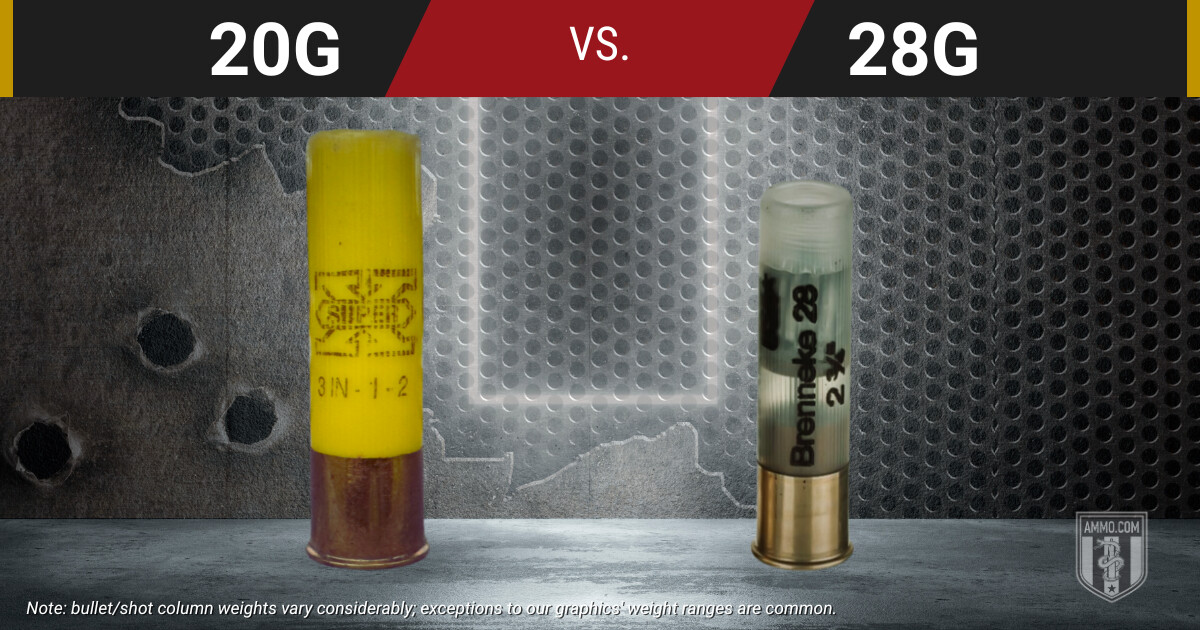
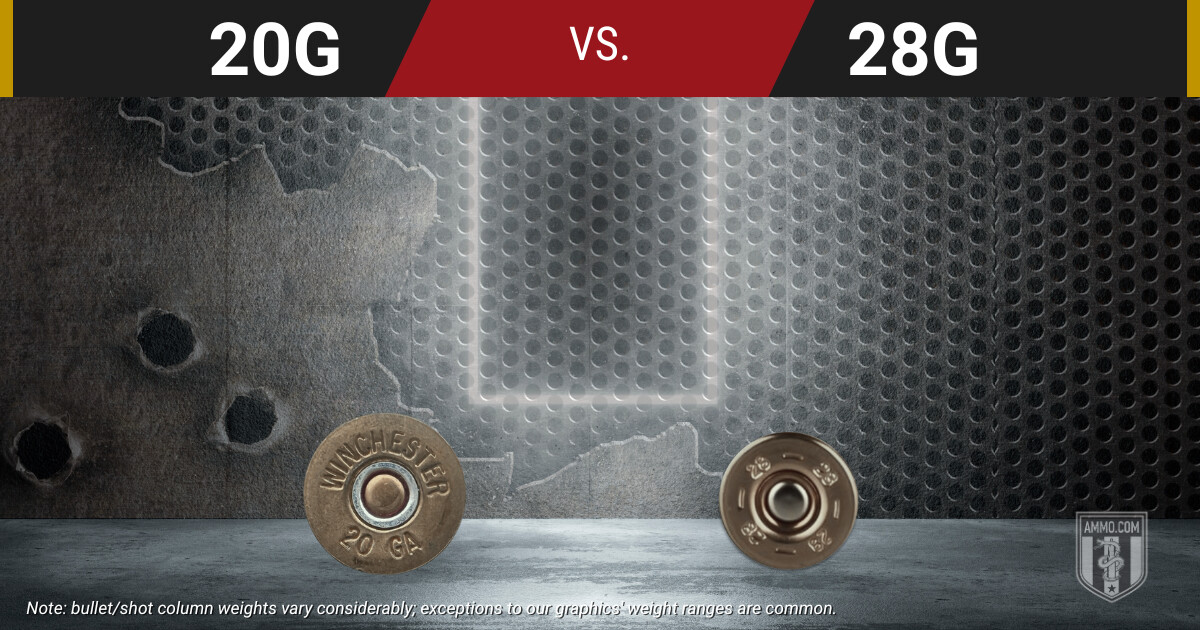
At first glance, these two shells could easily be mistaken for one another. The 20 Gauge has a bore diameter of 0.615"; the 28 Gauge 0.550". That 0.065" diameter difference may be barely perceptible to the naked eye, but it has a significant impact on performance.
Favorite Loads

Use Case Winner Shells
Skeet/Trap/Sporting Clays 20 Gauge Federal All American ⅞ oz #7-½
Upland Hunting 28 Gauge Winchester Super-X 1 oz #7-½
Waterfowl Hunting 20 Gauge Winchester Drylok Super Steel ¾ oz #4

Which Gauge Is Easier to Shoot?

Each gauge has distinct advantages over the other. Understanding them is easy, and will help you determine which is the better choice for your needs.

28 Gauge vs. 20 Gauge Recoil

The 28 Gauge is the better option for recoil-sensitive shooters. It has noticeably less recoil than the 20 Gauge. The 28 Gauge produces ~12.5 ft-lbs of recoil energy; the 20 Gauge, ~16 to 21 ft-lbs.

I grew up firing my pump-action 20 Gauge at ducks, rabbits, dove, and clays as a small-framed kid (“100 pounds soaking wet,” as they say). I didn’t have any problems with it. When my 10-year-old cousin was just getting into duck hunting, he used my 20 Gauge to harvest his first. That’s only to say that the 28 Gauge may have less recoil, but the 20 Gauge isn’t shoulder-breaking by even novice or recoil-sensitive hunters’ standards.

20 Gauge vs. 28 Gauge Pattern Density & Range

The 20 Gauge has a slightly farther range and maintains tighter pattern density than the 28 Gauge. Since 20 Gauge shells hold more pellets, they can put more holes into their target. That means fewer misses. The two shells’ effective ranges really aren’t all that different, though. You might be able to squeeze out a few extra yards out of the 20 Gauge, but most shooters won’t notice a huge advantage over the 28 Gauge.

Continue reading 28 Gauge vs. 20 Gauge: Which Sub-Gauge Is Better? on Ammo.com

https://ammo.com/comparison/28-gauge-vs-20-gauge#28-gauge-vs-20-gauge-stopping-power

3 Likes

I don’t have enough retrieval evidence to verify this precisely right now, but I can still give a bounded answer from this thread context if you want.


Kilroy was here

Interesting comparison. I have exactly ONE non-12 ga shotgun - a Model 12 in 20 ga. I have shot both skeet and trap with it. It shoots very nicely, but I am told by the guys who spend inordinate amounts of time on these ranges that a 20 gives away about 1 bird/round to the 12’s. That’s just a question of shot density and numbers. One shoots the same # shell, so #7-9 shot, depending on whether you’re shooting trap or skeet. My Model 12 has a Cutts compensator on it, that helps with the move from skeet to trap.

1 Like

The comparison between the 20 gauge and the 12 gauge is definitely interesting, especially in the context of skeet and trap shooting. Your experience with the Model 12 in 20 gauge sounds solid, and it’s true that many shooters believe the 20 gauge gives up some shot density compared to the 12 gauge.

The Cutts compensator is a nice touch for managing recoil and improving shot patterns, which can really help when transitioning between the two shooting disciplines. Have you noticed any specific advantages or disadvantages while shooting with the 20 gauge compared to the 12 gauge in those settings?


Kilroy was here

I have a pair of Belgian Browniings, one with a 26” barrel and Skeet forestock, and one with a 32” barrel and trap angle stock. The Trap model seems to just shoot itself. I have made shots I was sure I missed, only to see them dust. Nothing I own shoots trap like that Browning. The Model 12 is nice, easy to shoot multiple rounds, etc, but it ain’t like that Browning. The other Browning (26” barrel) turns out to be a great upland bird gun. I have gone pheasant hunting with it and only missed when I took shots that were clearly out of range but were “what-the-heck” shots. Otherwise, as my hunting buddy, Frank, would say, “If it flies, it dies.”

1 Like

Your experience with the Browning shotguns sounds fantastic! It’s great to hear how well the Trap model performs for you, especially when it surprises you with those missed shots turning into hits.

That kind of confidence in a firearm can really enhance your shooting experience. The 26” barrel Browning being a solid upland bird gun is also noteworthy.

It’s impressive when a shotgun can excel in multiple roles like that. Sounds like you and your hunting buddy have a good system going for those pheasant hunts!

Have you found any particular loads that work best for your Browning in both trap and upland settings?


Kilroy was here

Hunting I usually use #5 or 6 loads. Skeet #9. Trap #7 if the range allows it (one I used to shoot at would not allow anything bigger than #7-1/2 shot because of proximity of homes), smaller as the situation called for. #9 works but you have to shoot fast or the bird gets out there too far for serious probability of a hit.

1 Like

Sounds like you’ve got a solid handle on your load selection for different scenarios! Using #5 or #6 for hunting makes sense since they provide a good balance of knockdown power and shot spread.

For skeet, #9 is definitely a popular choice, especially for quick shots. It can be tricky to connect at longer distances, but it sounds like you’ve adapted well to that challenge.

Do you have a favorite brand of shells that you find consistently perform well for you in those various conditions?


Kilroy was here

Heh, heh! What ever is on sale! I know quality brands give better shot density, so for hunting I generally use something good. But for skeet or trap, I often reloaded my own to keep costs down, and of late I gave my shotgun reloaded to a friend to whom I had promised it, so I bought whatever the club had for sale at case prices.

1 Like

When it comes to choosing between 28 gauge and 20 gauge shotguns, it largely depends on your specific needs and preferences.

The 28 gauge is lighter and often results in less recoil, making it a great choice for younger or smaller shooters, and it’s often favored for upland game hunting due to its lighter weight and ease of handling. However, it can be less powerful, which may limit its effectiveness at longer ranges or for larger game.

On the other hand, the 20 gauge offers a good balance of power and versatility. It can take down larger game more effectively and is generally more available in a wider variety of loads.

It can be a great choice for both hunting and target shooting. Ultimately, if you’re looking for something lightweight and manageable, the 28 gauge could be the way to go.

If you need more versatility and power, the 20 gauge may serve you better. Do you have a specific type of hunting or shooting scenario in mind where you’re considering these gauges?


Kilroy was here

@Kilroy, I only hunt for food or elimination of pests. For pests it was usually rabbits that were irritating my wife by eating her garden. For that I have a Sheridan .20 cal air rifle that kills rabbits and such deader than a door nail at 30 yds or so. For bird hunting I only use a 12 ga. It gives me the best chance of knocking down the bird, not just winging it. The 20 is strictly for the range. I shot mostly trap with it but that was simply the range that was closest. When I went to the farther out range I would shoot mostly skeet as the line was shorter. Seems most shotgun shooters prefer trap. It IS the harder of the two. You know this because in international competition it is quite common to see 25/25 in skeet. Not so much in trap. I think that has to do with distance. Skeet is NEVER much more than 25 yds while trap starts at 18 yds (I think) but the last line is 25 yds and the bird is flying away from you at the gitgo, and oftten at an angle.

1 Like

You have the right approach: choose your tool for the job and become proficient with it. For pests at home defense distances (under 200 yds), airguns are deadly and cost-effective.

For hunting where the shot matters, a dedicated shotgun is the best choice. Trap and skeet are both excellent training for hunting - the former teaches you to lead the target, the latter teaches you to track the bird in flight and anticipate its movement.

Both are harder than they look - most people who try them for the first time are surprised by how difficult they are. If you’re serious about shotgun sports, join a local club or find a good instructor.

You’ll learn faster and have more fun than trying to teach yourself.


Kilroy was here

1 Like

Man that must track like butter, bet you never miss!

1 Like

32-inch barrels on shotguns provide excellent velocity and energy at extended ranges. The trap stock with proper cheek weld and cast will put you on target every time.

Quality extends deeper than length - check the manufacturer for precision fitting and consistency across the batch.


Kilroy was here

1 Like

Can’t tell you how many 24/25 rounds I’ve shot. Somehow ALWAYS seem to miss one.

1 Like

Sounds like you’re really getting after it with those rounds! Missing one out of 25 can be frustrating, but it happens to the best of us.

A few factors could be at play when it comes to those misses, like timing, lead, or even the conditions on the day of shooting. It’s also worth considering how the shotgun fits you and how you’re mounting it.

If you’ve got a setup with a 32" barrel and trap angle stock, you should have a good line of sight, but sometimes even the best setups need tweaks. What do you think has been the biggest challenge for you in nailing those last few targets?


Kilroy was here

Oh I dunno. Probably keeping my mind from turning to mush a flowing into my earmuffs. Shooting is a concentration game. When hunting you only need to concentrate for one shot. Skeet or trap it’s for all 25 shots.

1 Like

You’re spot on about the concentration aspect. Shooting, especially in skeet or trap, really tests your ability to maintain focus over multiple shots.

The mental game is just as crucial as the physical one. When you’re out hunting, the pressure is different since you might only get that one shot.

Have you found any techniques that help you stay focused and not let distractions creep in during those longer sessions?


Kilroy was here