When I was assigned to write this article, my initial thought was probably the same as your own. “22 LR vs. 223 Rem? It’s a little strange to compare a rimfire to a centerfire cartridge, isn’t it?”
But the more I thought about it, the more sense it made. The two rounds do share the same bullet diameter. You can fire either in a 5.56 AR-15 with minimal modification. They’re both intensely popular. Yet despite these similarities, the two rounds have very different applications, ballistic performance, and stopping power.
Popular 22 Long Rifle Ammo Options & Uses
-
Target Shooting: Eley Match 40 grain LFN
-
Plinking: Remington Standard V 38 grain LRN
-
Small Game Hunting: CCI Mini-Mag 36 grain CPHP; CCI 31 grain #12 Shot
-
Self-Defense: Federal Punch 29 grain FN
Popular 223 Remington Ammo Options & Uses
-
Target Shooting: PMC Bronze 55 grain FMJBT
-
Plinking: Federal American Eagle 75 grain TMJ
-
Varmint Hunting: Winchester Varmint X 40 grain Polymer Tipped
-
Home Defense: Hornady Critical Defense 73 grain FTX
22 LR vs. 223 Rem
| 22 LR Is Best For | 223 Rem Is Best For |
|---|---|
| Learning to shoot | Varmint hunting/ranch protection |
| Plinking | Plinking |
| Small game hunting | Learning to shoot |
| Backup personal defense | Backup home defense |
Cartridge Specs
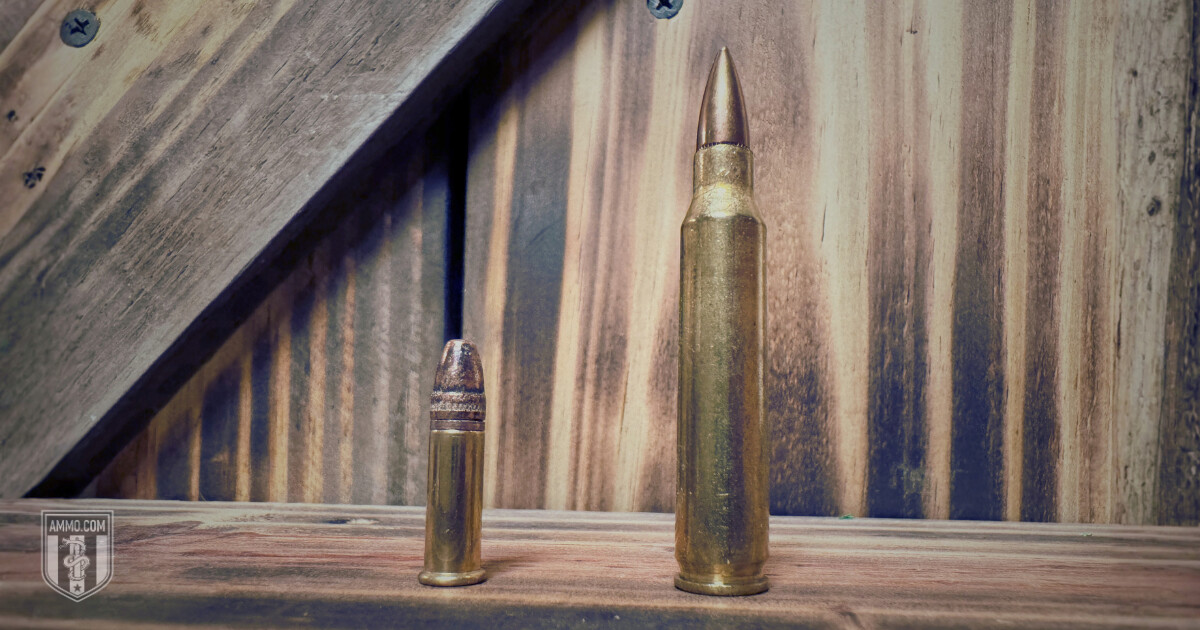
| 22 Long Rifle | 223 Remington | |
|---|---|---|
| Parent Case | 22 Long | 222 Rem |
| Bullet Diameter | 0.223" | 0.224" |
| Neck Diameter | 0.226" | 0.253" |
| Base Diameter | 0.226" | 0.376" |
| Case Length | 0.613" | 1.760" |
| Overall Length | 1.000" | 2.260" |
| Case Capacity | 10.5 grains H2O | 28.8 grains H2O |
| Max Pressure (SAAMI) | 24,000 psi | 55,000 psi |
Recoil
The 22 LR and 223 Rem have little recoil, making them excellent options for beginners who are learning proper shooting mechanics, as well as advanced shooters honing their craft. However, there is a drastic difference in recoil between the rimfire and centerfire cartridges.
Recoil is an important consideration when purchasing a new firearm (and cartridge). A round with heavy recoil is more difficult to control, and slows the rate of accurate follow-up shots.
Felt recoil is subjective. It varies from shooter to shooter, which is why we determine a cartridge’s actual recoil by measuring its free recoil energy. It is determined by four factors: muzzle velocity, propellant charge weight, bullet weight, and firearm weight.
When fired from a 6 pound rifle at 1,255 fps muzzle velocity, a 40 grain 22 LR bullet generates ~0.19 ft-lbs of recoil energy. When a 62 grain 223 Rem bullet is fired from an 8 pound rifle at 3,025 fps muzzle velocity, it generates about 4 ft-lbs.
Despite this apparent large disparity, no one would argue that 223 Rem has high recoil. Anything under 15 ft-lbs is pretty manageable to most shooters. As one of the weakest cartridges, the 22 LR’s recoil looks extremely low compared to pretty much anything.
Continue reading 22 LR vs. 223 Remington: Rimfire Against Centerfire 22-Caliber Faceoff on Ammo.com