The 22 Creedmoor and 22 ARC might share the same caliber, but they have significant differences that make one better suited to your specific needs than the other. After reading this 22 Creedmoor vs. 22 ARC comparison, you’ll know which one you should buy based on recoil, trajectory, stopping power, and six other factors.
22 Creedmoor vs. 22 ARC
Let’s begin with the pros and cons of each cartridge, then dive into how they differ across various shooting scenarios and applications.
The 22 Creedmoor is the better option when:
- You only fire factory ammo
- Maximizing velocity is most important to you
- You’d rather use a standard bolt face/action
The 22 ARC is the better option for:
- Reloaders
- Shooters willing to sacrifice a little velocity for more consistent accuracy
- High-volume shooters
Pros & Cons
22 Creedmoor
✓ Pros
- Flat trajectory
- Low recoil
- Heavy bullet stabilization
✗ Cons
- Short barrel life
- Limited stopping power
- Not AR-15 compatible
- Low ammo availability
22 ARC
✓ Pros
- AR-15 compatible
- Low recoil
- Long barrel life
- Excellent ballistics
✗ Cons
- Limited effective range (500 yards)
- Very limited stopping power
- Low ammo availability
Technical Specs
| Specification | 22 Creedmoor | 22 ARC |
|---|---|---|
| Parent Case | 6.5 Creedmoor | 6.5 Grendel |
| Bullet Diameter | 0.224" | 0.224" |
| Neck Diameter | 0.256" | 0.221" |
| Base Diameter | 0.4703" | 0.441" |
| Case Length | 1.920" | 1.525" |
| Overall Length | 2.450" | 2.260" |
| Case Capacity | 52.6 grains H2O | 34.6 grains H2O |
| Max Pressure (SAAMI) | 62,000 psi | 52,000 psi |
22 Creedmoor vs. 22 ARC Recoil
While both cartridges have manageable recoil, the 22 ARC feels like a gentle nudge on the shoulder from a friend while the 22 Creedmoor is more like a solid thud from someone who isn’t all that fond of you.
The 22 ARC generates ~2.5 ft-lbs of recoil energy when it fires a 62 grain bullet at 3,300 fps muzzle velocity from an 8-pound rifle. The 22 ARC is a round you can fire all day at the range without getting a sore shoulder. Its low recoil also makes it an excellent round for introducing new shooters to the sport. Ultimate Reloader agrees: “What I love about the 22 ARC is how gentle it is.”
The 22 Creedmoor, on the other hand, generates ~8.5 ft-lbs of recoil energy when it fires a 55 grain bullet at 3,850 fps muzzle velocity from an 8.5-pound rifle. That higher velocity comes at the cost of additional recoil.
The 22 ARC recoils against the shooter’s shoulder much less. That said, the 22 Creedmoor isn’t what I’d classify as a “shoulder bruiser,” either.
Trajectory
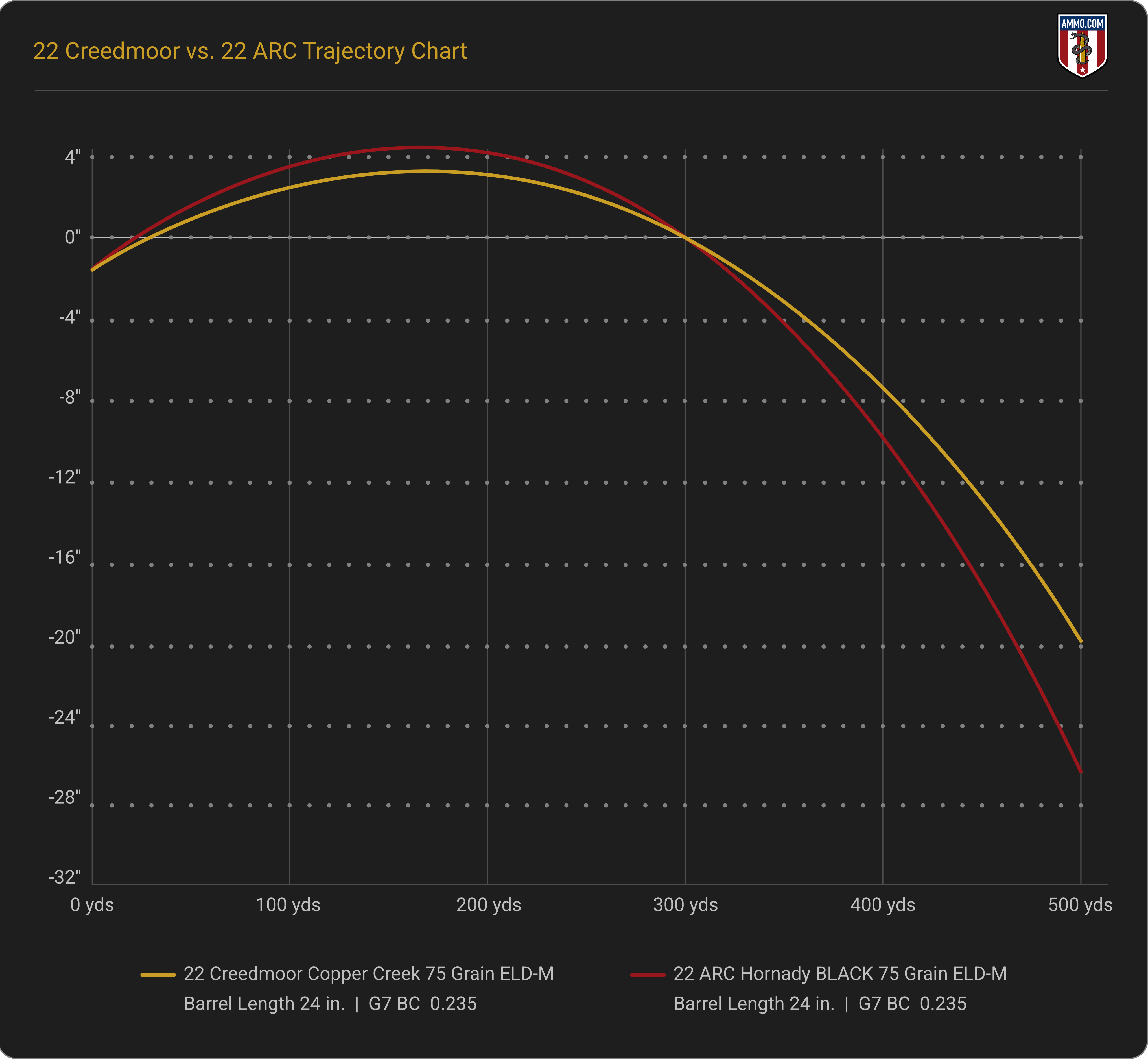
When both cartridges are loaded with 80 grain ELD Match bullets and zeroed at 200 yards, the 22 Creedmoor exhibits a much flatter trajectory. This is due to its larger case, larger propellant charge, and higher chamber pressure.
At 300 yards, there’s only a 4" difference in drop. The 22 ARC has -13" bullet drop; the 22 Creedmoor, only -9". At 400 yards, the gap widens. The 22 ARC has bullet drop of -29"; the 22 Creedmoor, -20". At 500 yards, the 22 ARC drops -53"; the 22 Creedmoor, -33".
If you need a flat-shooting .22 caliber cartridge, the 22 Creedmoor is the better option.
Accuracy
While accuracy ultimately depends on the shooter’s capabilities, the 22 ARC is often more accurate at close range (within 300 yards) due to its low recoil. The 22 Creedmoor tends to be more accurate at extended ranges (500-1,000 yards) because of its flatter trajectory.
This section is a tie. If you’re shooting within 300 yards, the 22 ARC is the better option. If you’re shooting farther, then the 22 Creedmoor takes the lead.
Continue reading 22 Creedmoor vs. 22 ARC: Which 22 Is Better for You? on Ammo.com
https://ammo.com/comparison/22-arc-vs-22-creedmoor#22-creedmoor-vs-22-arc-ballistic-coefficient
