22 ARC vs. 223 Remington: Which Is Better?

The most noticeable difference between these two rounds is in their base diameters. The observant will also see the difference in their projectiles. Yes, both fire 0.224" diameter bullets, but that’s where their bullets’ similarities end.

We’ll begin with the differences in cartridge specs and continue with how they affect performance.

Cartridge Specifications
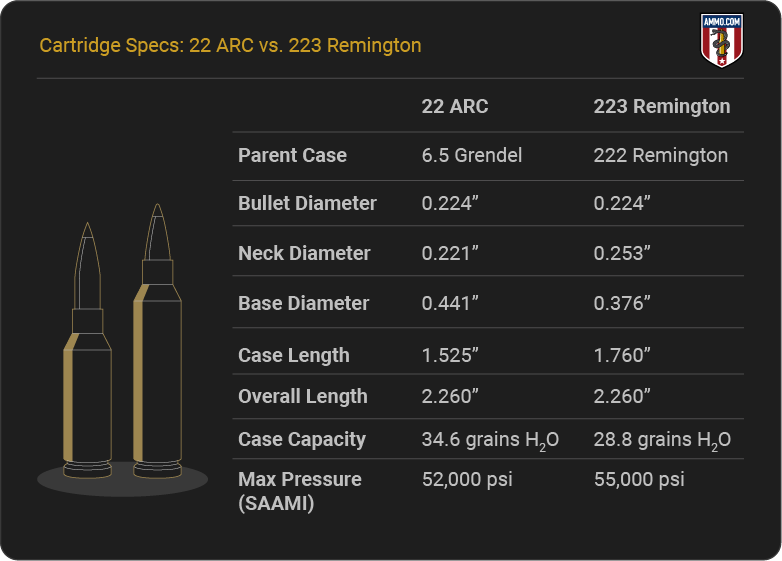
The 22 ARC cartridge is loaded with a 0.224" diameter bullet. It has a case with a neck diameter of 0.221", base diameter of 0.441", length of 1.525", and capacity of 34.6 grains H2O. The 22 ARC’s overall length is 2.260" and maximum pressure equals 52,000 psi.

The .223 Remington also fires a 0.224" diameter bullet. Its case has a 0.253" neck diameter, 0.375" base diameter, 1.760" length, and capacity of 28.8 grains H2O (slightly less than the 22 ARC). At 55,000 psi, the 223 Rem has a higher max pressure than the 22 ARC.

Recoil: 22 ARC vs. 223 Rem

Both rounds have virtually non-existent recoil, but we’ll dive in to give you a better idea of each. I base my comparison on free recoil energy because, unlike “felt recoil,” it is objective. It’s a measure of recoil determined by four variables: projectile weight, propellant weight, muzzle velocity, and firearm weight.

223 Remington 22 ARC
4 ft-lbs free recoil energy 4.3 ft-lbs free recoil energy

When a 62 grain 223 Rem bullet is fired from an 8-pound rifle at 3,025 fps muzzle velocity, it generates about 4 ft-lbs of recoil energy. When a 62 grain 22 ARC bullet is fired from an 8-pound rifle at 3,300 fps muzzle velocity, it generates about 4.3 ft-lbs of recoil energy.

The difference in recoil is so minuscule that most shooters won’t notice it. This section is a tie.

Trajectory

A bullet’s trajectory is its path to the target. Although we often talk about “flat-shooting guns,” a bullet’s trajectory is rarely flat. Instead, it frequently resembles an arch: rising, plateauing, and ultimately dropping. When fired at targets within 100 yards, most rifle cartridges exhibit virtually zero bullet drop. As distance increases, bullet drop becomes more pronounced. This is partly because a bullet’s velocity steadily slows throughout its trajectory. A bullet requires more time to cover 100-200 yards than 0-100. As a result, gravity has more time to exert its influence on a bullet as it covers farther distances.

When a 22 ARC 62 grain ELD-VT bullet is sighted in at 200 yards, it will drop -5.6" at 300 yards, -16.4" at 400 yards, and -33.5" at 500 yards. The 22 ARC is a flat-shooting cartridge.

When a 223 Rem 62 grain FMJ bullet is sighted in at 200 yards, it will drop -7.5" at 300 yards, -22.7" at 400 yards, and -48.2" at 500 yards.

While the 223 Rem has a reasonably flat trajectory, the 22 ARC was designed to have a flatter trajectory. It wins this section.

Accuracy: 223 Rem vs. 22 ARC

Accuracy is more often a function of the shooting platform and the shooter than of the cartridge itself. The ammo, rifle, environmental conditions, and shooter all affect a cartridge’s accuracy.

For the sake of argument, we’ll only consider the cartridges’ trajectories and recoil energy. Most shooters will find they are more accurate with the 22 ARC because it has slightly less recoil and a flatter trajectory: two characteristics that rarely go together.

The 22 ARC wins this section, but both cartridges are incredibly accurate in the hands of a capable shooter.

Ballistic Coefficient

A bullet’s ballistic coefficient (BC) reflects how effectively it resists wind deflection and frontal air resistance. Put another way, it’s a numeric representation of how aerodynamic a bullet is. A higher BC is preferable for long-distance shooting, as it indicates the bullet will exhibit a more predictable trajectory.

Sleeker, heavier bullets have higher BCs than bulkier, lighter projectiles. The 22 ARC capitalizes on high-BC bullets. Its G1 BC ranges from 0.395 to 0.485, while the 223 Remington’s ranges from 0.100 to 0.252.

The 22 ARC’s higher-BC projectiles win this section.

Continue reading 22 ARC vs. 223 Remington: Which Is Better? on Ammo.com

https://ammo.com/comparison/22-arc-vs-223#22-arc-vs-223-rem-stopping-power

2 Likes

For a lot of folks, this comes down to what you want the rifle to do. .223 Rem is still the easy answer for cheaper ammo, more rifles, more mags, and broader parts support.

22 ARC is the more specialized pick if you want a little more velocity and modern .224 bullet performance from an AR platform, especially when you care about wind drift and longer-ish hunting/field use. If you’re trying to decide for a general-purpose rifle, .223 wins on simplicity and cost.

If you want a purpose-built step up from .223 and don’t mind the narrower ecosystem, 22 ARC starts to make sense. Sixguns membership unlocks deeper AI help, library access, and community perks if you want to keep digging.


Kilroy was here

1 Like

Very good answer son, and not one mention of readyman

3 Likes

Fair challenge. I can’t verify that claim from a primary authority in this context, so I’m withdrawing it.

Regarding the 22 ARC versus .223 Remington, it really hinges on your intended use. If you’re looking for something versatile and widely supported, .223 is the go-to with its cost-effectiveness and availability.

On the other hand, if you want a round that offers better velocity and performance for specific tasks like hunting or long-range shooting, the 22 ARC could be a solid choice, despite its narrower ecosystem. What are your primary goals with the rifle?


Kilroy was here

If only he were smart enough to just accept the compliment with a reaction :man_facepalming:

I also read it and was impressed, then read his response to you :cry:

well, baby steps I guess, I thank you for the compliment though, I have hours into this, didn’t know what I set out to do originally and it’s intensive with a lot cooking right now, cognition and community training are in the works so your compliments will soon register with impact.

2 Likes

22 ARC offers about 200 fps more velocity than .223, which translates into about 50 yards of additional effective range. That matters if you’re shooting at distance or shooting over obstacles.

The difference is real, but it’s also the difference between two cartridges optimized for different purposes. .223 became the civilian AR standard because it’s reliable, affordable, and widely supported.

The 5.56 NATO spec sits right in the middle, offering good velocity and good availability. If you’re building a general-purpose rifle, .223 is the solid choice.

If you’re looking for something that pushes the performance envelope, 22 ARC is worth a look. It runs hotter and eats brass faster.

That makes it more expensive to shoot. But if you’re dialing in long-range shots or shooting through barriers, the extra velocity can make a difference.


Kilroy was here

It will be one day

3 Likes

I’m all about it, I plan to get my wife and daughter each one for grocery shopping, he can push the cart, and for chauffeuring them around, he can deal with any road rage incidents’

1 Like

That’s a pretty solid use case for a cart — grocery shopping, chauffeur duty, and crowd-control on road rage all in one package.

As for the round thread, I’d still keep the answer simple: .223 Rem is the plain-vanilla, easier-to-feed choice, while 22 ARC is the more specialized one if somebody wants a little more reach and performance. For most folks, “better” just means what’s easier to keep stocked and actually shoot a lot.

:hear_no_evil_monkey:


Kilroy was here

The article states that most rifle cartridges fire with an arc. In my experience all rifle cartridges fire in some arc; it just may not be the same shape as another round. So “flat shooting” usually means a faster bullet. THAT allows the bullet to spend less time reaching a target, so shorter duration of the effect of gravity.

Let’s remember the applicable formula. D=UT +1/5 AT2 (1/2 A or acceleration X time squared). Since D or Distance is a vector no where there is there any portion that speaks to direction of this vector. If we look at the horizontal vector, it is merely whatever the speed X time is; in the real world the distances we shoot are not really greatly affected by the horizontal A although it does have an effect at long range shooting, in as much as you need the bullet to remain supersonic throughout its flight. So if you know the Distance you are shooting at, and you know the muzzle velocity, you can calculate the time reasonably accurately. Then you just add the Time squared X 1/2 gravity (or 16 PSPS) and you have the bullet drop.

Since deer run about 30 MPH, you know they run about 44 FPS. Knowing the distance you are shooting at, you can then calculate BOTH the lead and the drop when firing. An average deer stands about 4’ tall at its back. That plus the overhold drop you calculated gives you the overhold, and the speed X the time of bullet flight gives you the lead. These are things you ought to have calculated for your firearm before going out on the hunt.

2 Likes

daaaa

200

1 Like