When it comes to self-defense, many shooters hold to the belief that you should shoot the caliber that has the best ballistics and the most stopping power that you can handle. These shooters like to favor a larger caliber bullet, such as the 10mm Auto.
Other shooters believe that the ideal defense round should be lightweight and low recoil to allow accurate and quick follow-up shots, reasoning that modern jacketed hollow points (JHP) have made the caliber debate moot. These are typically your 9mm Luger concealed carry permit holders.
The 9mm vs. 10mm caliber debate is an interesting one. These two handgun rounds are extremely different from each other, despite their bullet diameters only being separated by 1mm.
It begs the question: Is bigger actually better when it comes to self-defense?
In this article, we will compare the 9mm Luger and the 10mm Auto under the auspices of determining which round would be the better choice for personal defense.
Quick Verdict: And the Winner Is…
| Use Case | Winner | Why |
|---|---|---|
| Stopping Power | 10mm Auto | 10mm Auto was designed to be more powerful than the 9mm and 45 ACP |
| Recoil | 9mm | The 9mm has significantly less recoil than the 10mm. |
| Capacity | 9mm | Since 9mm rounds are smaller than 10mm rounds, most 9mm pistols have a higher mag capacity |
| CCW | 9mm | Most 9mm pistols are easier to conceal, have lower recoil, and higher magazine capacity |
| Home Defense | 9mm | The 9mm is less likely to overpenetrate, has a higher magazine capacity, and lower recoil |
| Bear Defense | 10mm Auto | The 10mm Auto has significantly more stopping power than the 9mm and ammo designed for bear defense |
| Cost | 9mm | 9mm pistols and ammo are less expensive than 10mm Auto firearms and ammo |
| Availability | 9mm | 9mm firearms and ammo are more popular and abundant than 10mm Auto |
What’s the Difference Between 9mm and 10mm?
When new shooters first hear about the 9mm Luger and the 10mm Auto, they often think that they are very similar cartridges. I mean, how much difference can 1mm make?
Well, the answer is: quite a bit!
Sure, the bullet diameters are only 1mm different, but the bullet weight, muzzle velocity, and striking energy are considerably different when comparing 10mm vs. 9mm.
When you’re loading up your favorite semi-auto, which one do you go for? Do you go for your trusty Glock 19? Or is a Glock 20 your go-to personal defense handgun?
In the next few sections, we will break down the differences between the 10mm Auto and the 9mm Luger to give you a better idea of which handgun caliber will be better for your needs.
Case Specs
| Specs | 10mm | 9mm |
|---|---|---|
| Parent Case | .30 Remington | 7.62x21mm |
| Bullet Diameter | 0.400 in | 0.355 in |
| Neck Diameter | 0.432 in | 0.380 in |
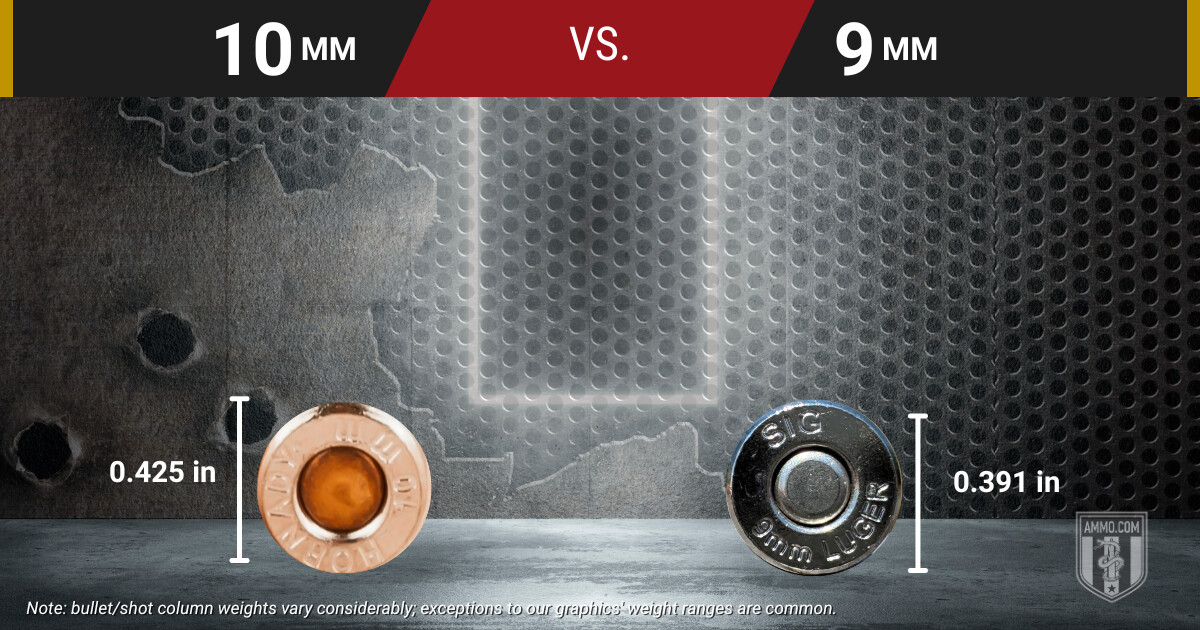
| Base Diameter | 0.425 in | 0.391 in |
| Case Length | 0.992 in | 0.754 in |
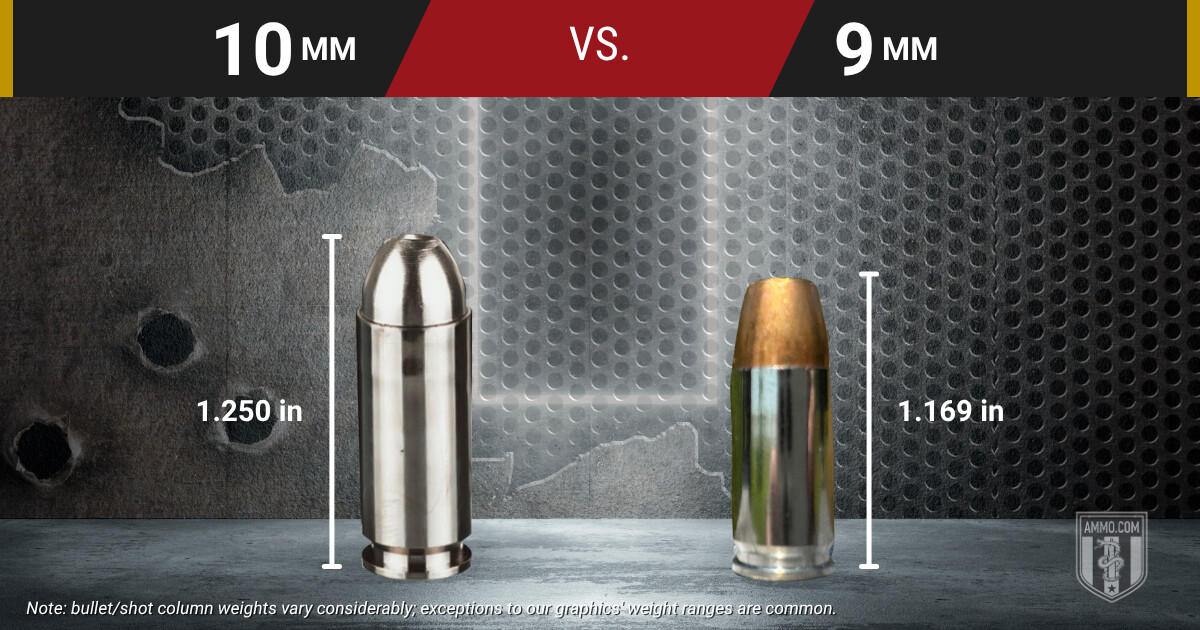
| Overall Length | 1.25 in | 1.169 in |
| Case Capacity | 24.1 grains | 13.3 grains |
| Max Pressure (SAAMI) | 37,500 psi | 35,000 psi |
Looking at the cartridge spec chart, we see that the 9mm Luger and the 10mm Auto are extremely different.
The first thing to note is that the 10mm fires a .40 caliber bullet (0.4005” true bullet diameter), while the 9mm Luger fires a smaller 0.355” diameter bullet. Furthermore, the case capacity of the 10mm round is just short of double that of the 9mm. More gunpowder can fit into the 10mm case, allowing it to fire heavier bullets at higher muzzle velocities.
Simply put, the 10mm round is bigger in every category compared to the 9mm Luger. With the large case comes higher pressure, velocity, energy, and recoil.
All those specs lead to the biggest in favor of 10mm ammo…
Continue reading 10mm vs. 9mm: Stopping Power, Recoil, and Best Use Cases on Ammo.com
https://ammo.com/comparison/10mm-vs-9mm#10mm-vs-9mm-stopping-power

